Biography
of Aurelios Markos
- Aurelios Markos, a free citizen, is attested as a member of a Mithraic community (syndexios), with a recorded role as Fuller (textile worker).
- Attested at Nicopolis ad Istrum, Moesia inferior, Moesia in early 3rd century (TNMM 341).
TNMP 93
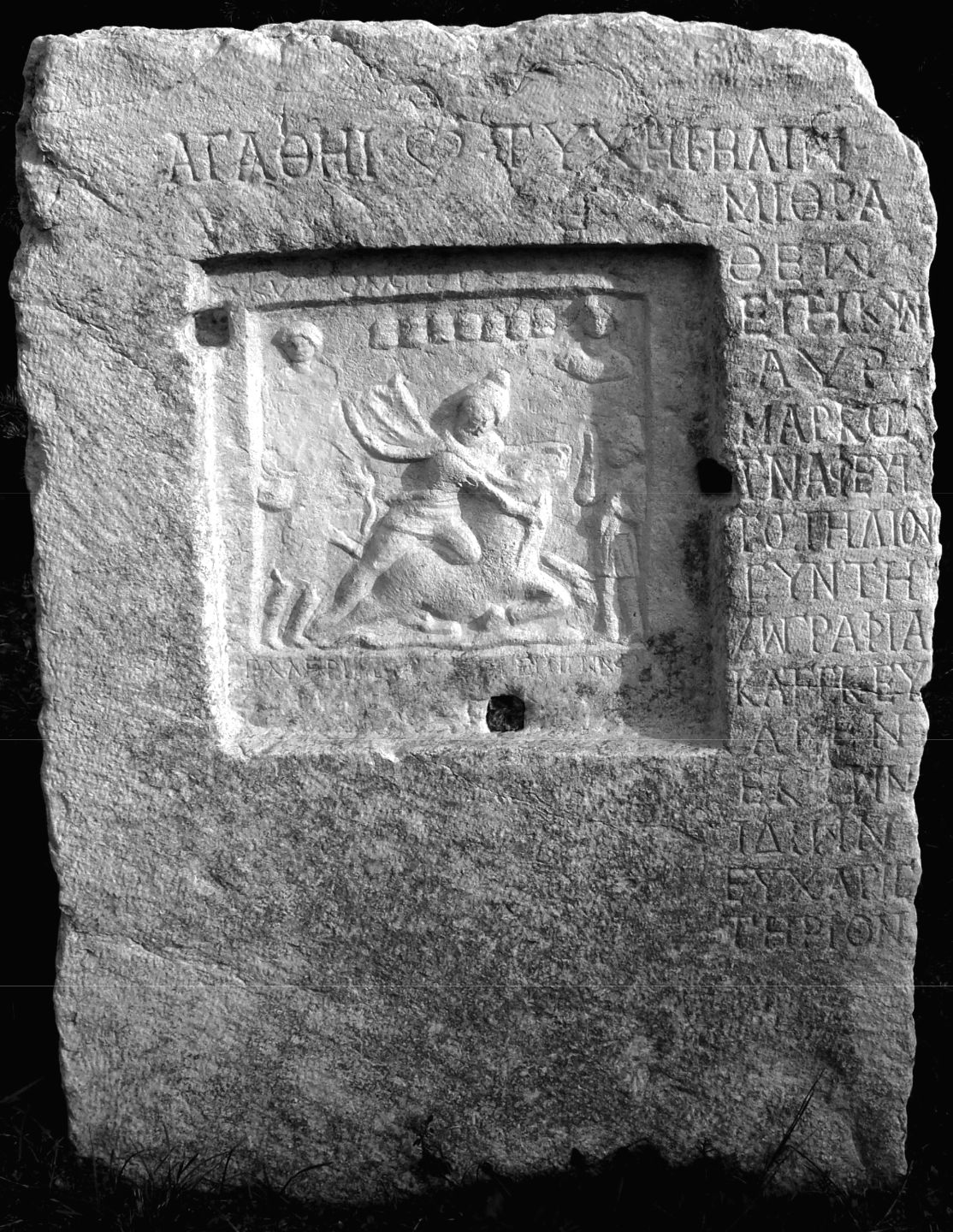
Aurelios Markos was a fuller (γναφεύς) active at Nicopolis ad Istrum, in Moesia Inferior, around the end of the 2nd or beginning of the 3rd century CE. He is known from a Greek inscription on the Tauroctony stele from Nicopolis ad Istrum (TNMM 341; CIMRM 2264–2265), in which he dedicated to Helios Mithras, “the god who hears prayers”, a stele together with its painted decoration, made at his own expense as a thank-offering.
Sharankov (2013) demonstrated that Markos’ inscription belongs to a later phase of the monument. An earlier, previously unnoticed inscription records its original dedication by Galerios, son of Proteos, an assistant-fuller. The fact that both dedicants were involved in the same trade may suggest a professional or personal connection between them, although its nature remains unknown. The later modification of the stele may have included a painted panel mounted in front of the tauroctony, possibly allowing the image to be concealed and revealed during ritual use (Sharankov 2013; Bottez 2018).
References
- Cristina-Georgeta Alexandrescu (2019) Mithras Cult in Moesia Inferior.
- Epigraphic Database Heidelberg. Tauroctony stele of Nicopolis ad Istrum in EDH.
- Valentin Bottez (2018) Mithras in Moesia Inferior. New data and new perspectives.
- Николай Шаранков (2013) Посвещение на Митра от Никополис ад Иструм.
Attestations
Tauroctony from Nicopolis ad Istrum
TNMM 341
The Tauroctony of Nicopolis ad Istrum is a rare Mithraic stele bearing two Greek dedications from different phases of its use.
Ἀγαθῇ τύχῃ Ἡλίῳ / Μίθρᾳ / θεῷ / ἐπηκόῳ / Αὐρ(ήλιος) Μάρκος / γναφεὺς / τὸ στήλιον / σὺν τῇ ζωγραφίᾳ / κατεσκεύ/ασεν / ἐκ τῶν / ἰδίων / εὐχαρισ/τήριον.
To Good Fortune. To Helios Mithras, the god who hears prayers, Aurelius Marcus, fuller, had the stele made together with the painting, at his own expense, as a thank-offering.