Biography
of Galerios
- Galerios is attested as a member of a Mithraic community (syndexios), with a recorded role as Assistant-fuller.
- Attested in the late 2nd – early 3rd century.
- Attested at Nicopolis ad Istrum, Moesia inferior, Moesia in early 3rd century (TNMM 341).
TNMP 94
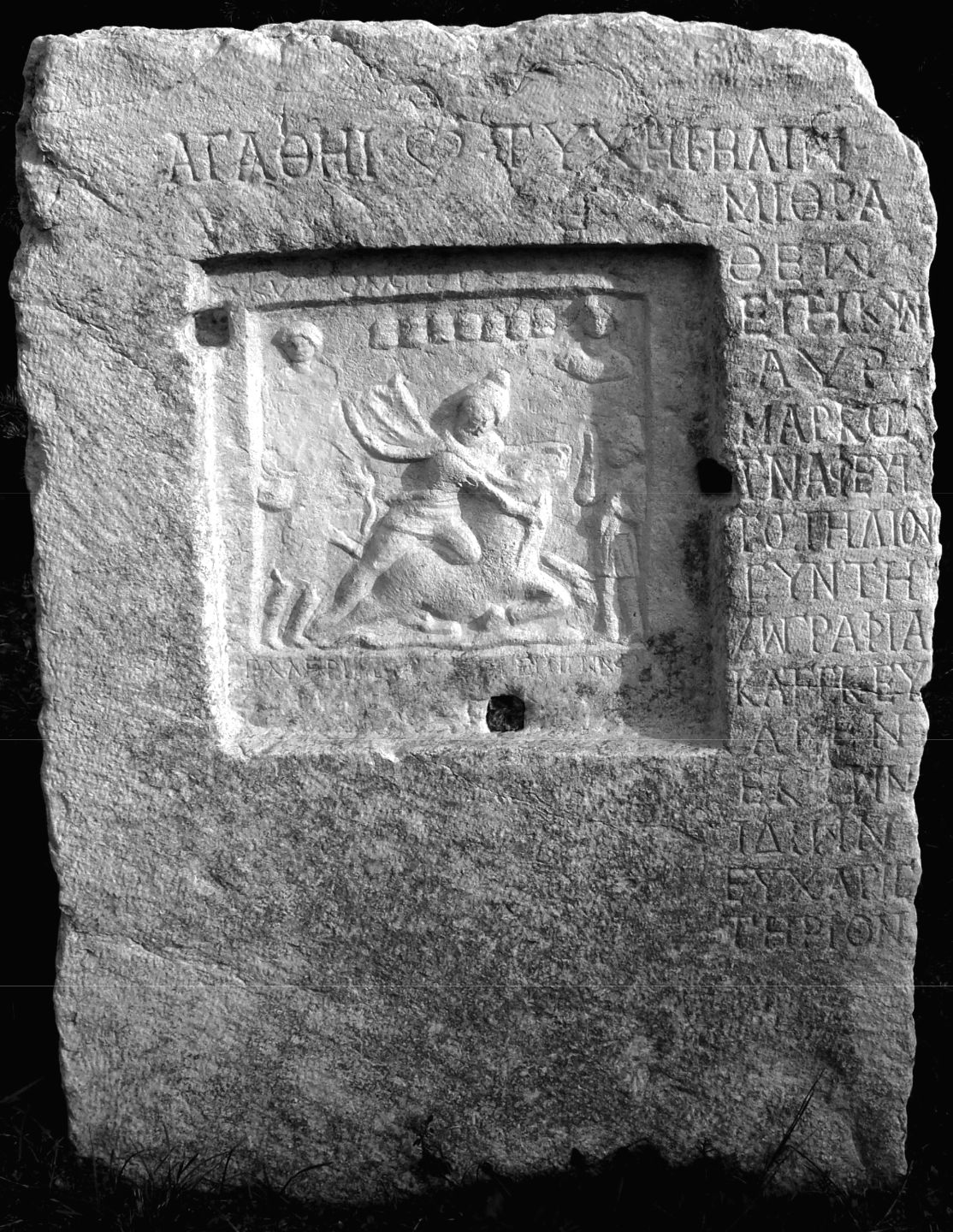
Galerios was an assistant-fuller (ἐπιγναφεύς) active at Nicopolis ad Istrum, in Moesia Inferior, around the end of the 2nd or beginning of the 3rd century CE. He is known from a lightly incised Greek inscription on the Tauroctony stele from Nicopolis ad Istrum (TNMM 341; CIMRM 2264–2265), in which he identifies himself as the son of Proteos and dedicates a votive offering to “Lord Mithras”.
His inscription belongs to the earliest known phase of the monument. Although individual letters can be discerned in an illustration published by Vermaseren, it escaped the attention of earlier editors and was first identified and published by Sharankov (2013).
The unusual term ἐπιγναφεύς, first attested in this inscription, is formed from ἐπι- and γναφεύς (“fuller”) and is interpreted by Sharankov as “assistant-fuller”. A later inscription on the same monument records an intervention by Aurelios Markos, himself a fuller, suggesting a possible professional or personal connection between the two men, although its nature is unknown (Sharankov 2013; Bottez 2018).
References
- Cristina-Georgeta Alexandrescu (2019) Mithras Cult in Moesia Inferior.
- Epigraphic Database Heidelberg. Tauroctony stele of Nicopolis ad Istrum in EDH.
- Valentin Bottez (2018) Mithras in Moesia Inferior. New data and new perspectives.
- Николай Шаранков (2013) Посвещение на Митра от Никополис ад Иструм.
Attestations
Tauroctony from Nicopolis ad Istrum
TNMM 341
The Tauroctony of Nicopolis ad Istrum is a rare Mithraic stele bearing two Greek dedications from different phases of its use.
Ἀγαθῇ τύχῃ Ἡλίῳ / Μίθρᾳ / θεῷ / ἐπηκόῳ / Αὐρ(ήλιος) Μάρκος / γναφεὺς / τὸ στήλιον / σὺν τῇ ζωγραφίᾳ / κατεσκεύ/ασεν / ἐκ τῶν / ἰδίων / εὐχαρισ/τήριον.
To Good Fortune. To Helios Mithras, the god who hears prayers, Aurelius Marcus, fuller, had the stele made together with the painting, at his own expense, as a thank-offering.