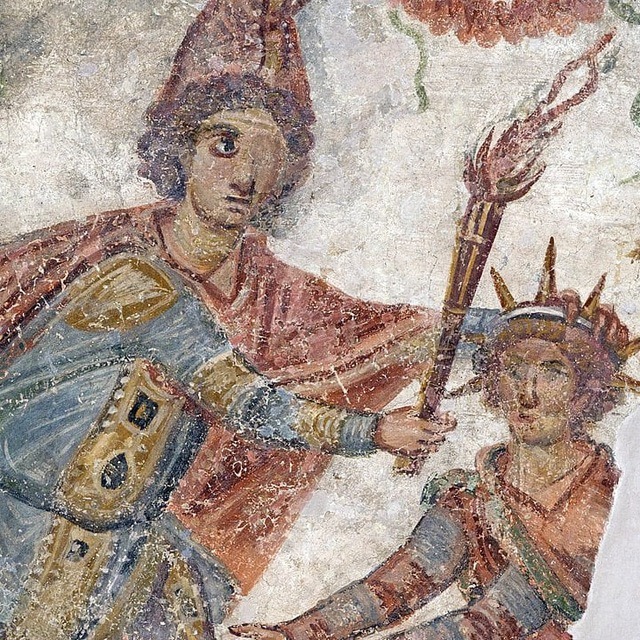
Supposed fragments of Tauroctony from Artashat(Artaxata)
"During excavations at Artashat in 1971, at the same site not far from a previously mentioned statue, another fragment of a marble statuette was found, representing the torso of a youth with a small animal skin and a child’s leg with a dangling heel, indicating the dynamism of the depicted figure (Plate XVIII2). Another marble fragment was discovered near the remains of a sanctuary dedicated to the sun god. It is assumed that this fragment depicts the hoof of a bull. Does this not suggest that the sanctuary once contained a statue of Mithra slaughtering a sacrificial bull?" (p. 23) https://arar.sci.am/publication/410263я
S. Obukhov cites this part from the text and comments on this find: "...Thus, G.A. Koshelenko sees in the tauroctony a reinterpretation of the late Babylonian rite of Kalu. In his opinion, the New Year’s rite, when a white bull was sacrificed - the personification of the generative forces of nature—was even more important (citing F. Thureau-Dangin and G. Widengren). It is known that the rite of taurobolium was celebrated in the mithraeum at Uruk-Varka, as evidenced by the discovery of a clay stamp depicting a tauroctony scene. Sculptural remains of a tauroctony scene were also discovered in layers dating from the first centuries AD in the ancient Armenian city of Artashat. This rite, apparently in a reinterpreted form, is described in the Armenian folk epic about David of Sassoun."

![Supposed fragments of Tauroctony from Artashat(Artaxata)
"During excavations at Artashat in 1971, at the same site not far from a previously mentioned statue, another fragment of a marble statuette was found, representing the torso of a youth with a small animal skin and a child’s leg with a dangling heel, indicating the dynamism of the depicted figure (Plate XVIII2). Another marble fragment was discovered near the remains of a sanctuary dedicated to the sun god. It is assumed that this fragment depicts the hoof of a bull. Does this not suggest that the sanctuary once contained a statue of Mithra slaughtering a sacrificial bull?" (p. 23) https://arar.sci.am/publication/410263я
S. Obukhov cites this part from the text and comments on this find: "...Thus, G.A. Koshelenko sees in the tauroctony a reinterpretation of the late Babylonian rite of Kalu. In his opinion, the New Year’s rite, when a white bull was sacrificed - the personification of the generative forces of nature—was even more important (citing F. Thureau-Dangin and G. Widengren). It is known that the rite of taurobolium was celebrated in the mithraeum at Uruk-Varka, as evidenced by the discovery of a clay stamp depicting a tauroctony scene. Sculptural remains of a tauroctony scene were also discovered in layers dating from the first centuries AD in the ancient Armenian city of Artashat. This rite, apparently in a reinterpreted form, is described in the Armenian folk epic about David of Sassoun."
Sources:
1: Аракелян, Б. Н. - Очерки по истории искусства Древней Армении ([ref:6a9f1ba5e8702])
1: Խաչատրյան, Ժ. Դ. - Արտաշատ II ([ref:6a9d9eb8b7f4c])
2: Обухов, С. В. - Пантеон и царский культ в Коммагене. Эпоха Митридата I Каллиника и Антиоха I Теоса: историко-археологическое исследование](https://www.mithraeum.eu/album/post/bb5a228be876916a.jpg)
 arar.sci.amОчерки по истории искусства Древней Армении - Pan-Armenian Digital LibraryNasza Biblioteka Cyfrowa is... Here put the description for the main page matadata, visible e.g. when sharing on Facebook.