This site uses cookies to offer you a better browsing experience.
Find out more on how we use cookies in our privacy policy.

 
Support The New Mithraeum The New Mithraeum is an independent, non-profit project dedicated to Mithraic studies, ancient religions and classical culture. Developed and maintained independently since 2007, the site exists without advertising, paywalls or institutional funding. If you have found value in its articles, interviews, photographs or database, please consider supporting the project with a contribution. Every contribution helps keep The New Mithraeum open, free and alive. Thank you.
Support us →
Provincia

Mithras in Liguria

Liguria linked northern Italy to southern Gaul and the western Mediterranean through coastal and Alpine communication routes.

The material documented in Liguria reflects the movement of Mithraic cults through maritime exchange, regional mobility and urban settlements along the northwestern coast of Italy. The province formed part of the transitional zone between Italy and Gaul.

Mithraic monuments of Liguria

Places in Liguria


Augusta Taurinorum

Augusta Taurinorum was the Roman city corresponding to modern Turin.


Aveia Vestina

Aveia was an ancient town of the Vestini and Roman former bishopric, which remains a Latin Catholic titular see.


Dertona

Dertona was a Roman town in northern Italy, today Tortona.


Industria

Industria was a Roman settlement in northern Italy, today associated with Monteu da Po.

Inscriptions from Liguria

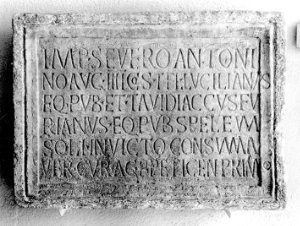
Altar by Flavius Lucilianus from Aveia

Imp[eratore] Severo Antoni/no Aug[usto] IIII co[n]sule T. Fl[avius] Lucilianus / eq[ues] pub[licus] et T. Avidiaccus Fu/rianus eq[ues] pub[licus] speleum / Soli invicto consumma/ver[unt] cur[am] ag[ente] P. Peticen[o] Prim[o].
Under Emperor Severus Antoninus Augustus, serving his fourth consulship, Flavius Lucilianus, a public horseman, and Titus Avidiaccus Furianus, also a public horseman, completed the sanctuary dedicated to Sol Invictus. This was done under the supervision of Publius Peticenius Primus.
Back to Top