Your search Al-Bahnasa gave 3015 results.

Marble relief fragment from Intercisa, Pannonia Inferior, too damaged for the original subject to be identified.
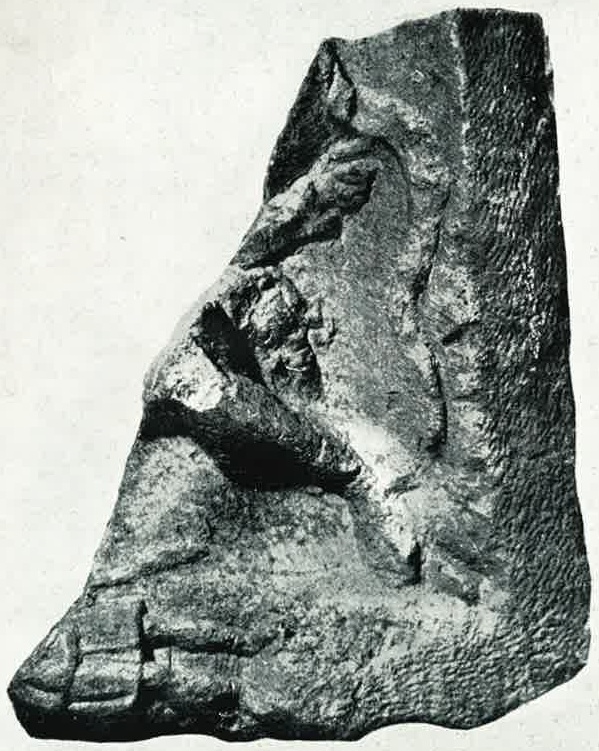
Right upper corner of a white marble tauroctony relief from Budapest, ancient Aquincum or its vicinity, in the National Museum since 1868, preserving part of the grotto border and divine busts.
Fragment of a relief from Aquincum, Pannonia Inferior, walled into a house at Majláth-Utcai 51, preserving the lower left corner of a tauroctony with the bull's hind-leg, Mithras's leg, and the scorpion.
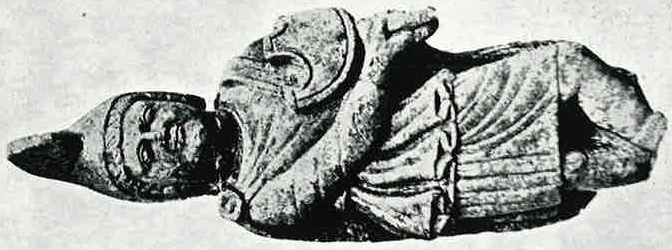
Small head in Phrygian cap from Aquincum, Pannonia Inferior, possibly representing a torchbearer or Attis.
Marble tauroctony relief from Aquincum or possibly Budaörs, Pannonia Inferior, depicting the bull-slaying scene with cypress trees between the torchbearers and the central group.
Marble tauroctony relief from Aquincum, Pannonia Inferior, found at Budapest III, Fötér, depicting Mithras as bull-slayer with both torchbearers flanking the central group.
Minor finds from Mithraeum IV at Aquincum, Pannonia Inferior, comprising a stamped terra-sigillata bowl (CINNAMI), serpent-vase fragments, pine-apples, altars, balls, and lamps.
Fourth Mithraic sanctuary discovered near the southern town-wall of Aquincum, Pannonia Inferior, between a rectangular building and an apsidal structure; excavated in 1941–42 and yielding the most complete sculptural assemblage from the city.
Sandstone statue from near Mithraeum III at Aquincum, Pannonia Inferior, depicting a lion to the right with an open frontal mouth, holding an ox head between its forefeet with a red-painted tongue.
Third Mithraic sanctuary at Aquincum, Pannonia Inferior, between the Amphitheatre and the Krempelmühle, attested by five altars and a decorated mosaic; the building itself is not fully known.
Second Mithraic sanctuary discovered at Altofen in 1888, Pannonia Inferior; rectangular (15.03 × 7.06 m) and raised two metres above ground, with benches and a cult niche; one of the most fully excavated Mithraea from the Danubian region.
Observation that two altars dedicated by Caius Iulius Primus to Sol deo sacrum at Aquincum may belong either to Mithraeum I or to Mithraeum III.
Fragment of a relief from Brigetio, Pannonia Superior, preserving the central tauroctony scene surrounded by a laurel wreath.
Two marble reliefs of the same height from Brigetio, Pannonia Superior, each depicting a cross-legged torchbearer in Oriental dress — Cautes and Cautopates — holding their torches.
Two sandstone fragments from Mithraeum III at Carnuntum, Pannonia Superior, comprising a base with one leg and a downward torch, and a Phrygian-capped head of Cautopates; probably stood at the beginning of the benches alongside the Cautes statue.
Minor finds from Mithraeum I at Carnuntum, Pannonia Superior, comprising legionary brick stamps, burnt coal and wood, ash with ox, sheep, and goat bones, and fragments of serpent-vases; the coin evidence points to a terminus ante quem in the early third century…
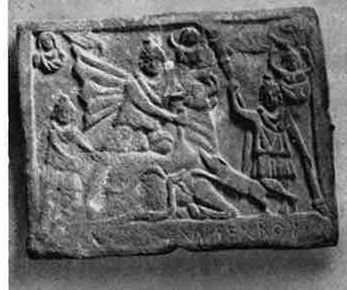
White marble tauroctony relief from Stix-Neusiedl, Pannonia Superior, depicting Mithras killing the bull with the raven perched on the rim of the god's flying cloak — an unusual detail placing the raven on the cloak rather than on the grotto border…
Fourth Mithraic sanctuary discovered at Ptuj, ancient Poetovio, at Zgornji Breg in 1937; the sanctuary (c.14 × 7 m) is oriented west–east with the standard corridor and bench division, an altar before the cult niche, and a water-basin in the pronaos.
Marble stele from Mithraeum III at Ptuj, ancient Poetovio, tapering towards the top and bearing a square hollow with five nail-holes designed to hold a small silver plaque — the plaque was removed, perhaps taken by the Mithraists themselves.
Very small marble head in Phrygian cap from Mithraeum II at Ptuj, ancient Poetovio.
