Your search Al. N. Oikonomides gave 3559 results.

Finds discovered near the crossing of the criptoporticus of the Mithraeum at Capua, including marble plate fragments, a tuff base, red lamps, and animal bones.
Miscellaneous finds from the middle of the Mithraeum of Capua, including a terracotta antefix with centaurs, basins, marble bases, lamps with a Sol head, and coins of M. Aurelius and Constantine.
Fresco showing a standing figure in a small cloak approached by two other persons, from the initiation sequence of the Mithraeum of Capua.
Fresco depicting Cautopates in Eastern attire between two laurels, cross-legged, pointing his torch downwards over a burning altar, from the Mithraeum of Capua.
Graffito bearing the Mithraic salutation Nâma, engraved on column 1 of the Mithraeum of Dura-Europos, Syria.
Painted inscription naming a tribune Archelao, found on a column or wall of the Mithraeum of Dura-Europos, Syria.
Fragments of wall plaster decorated with green leaves and tree branches, adhering to the south wall of the Mithraeum of Dura-Europos, Syria.
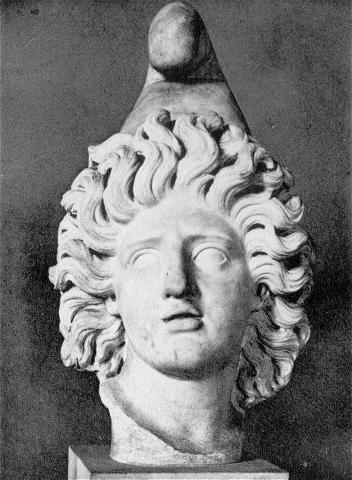
The head of Mithras had seven holes made for fastening rays.
Gold lamina from Ciciliano showing a nude, serpent-entwined Aion-Kronos holding a key and surrounded by Greek voces magicae (2nd c. CE).
Sculpted stone heads and statue fragments belonging to Mithraic torchbearers from the nave of the Vindobala Mithraeum.
Group of Mithraic and other cult remains possibly originating from several neighbouring sanctuaries destroyed or abandoned in Late Antiquity.
Two painted decorative phases from the Santa Prisca Mithraeum whose figures became clearer after later conservation work.
Marble cippus from the Quirinal residence of Ceionius Iulianus Kamenius preserving references to his Mithraic and other priestly functions.
Inscription now preserved in the Palazzo Ducale of Urbino whose wording may point to the existence of a Mithraic community.
Relief featuring an enigmatic agricultural implement interpreted either as a scythe or an early type of plough.
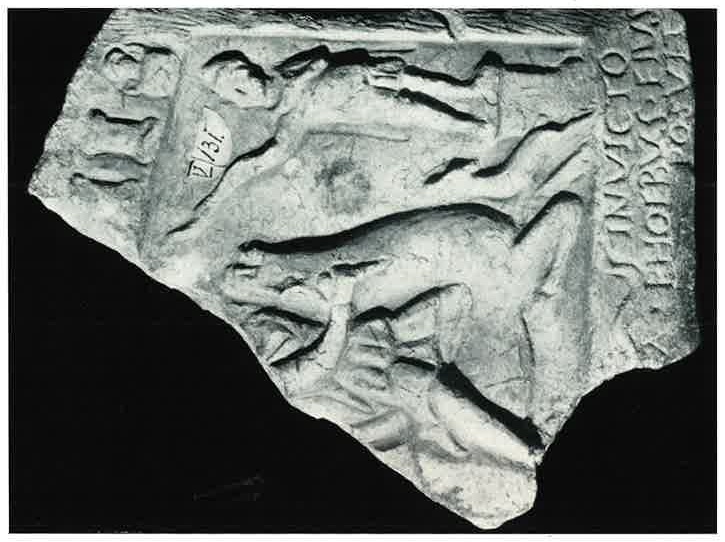
White marble tauroctony relief fragment from Romula, Dacia, now in Turnu Severin; the composition is partially preserved.
Inscription copied at Vintu de Jos near Apulum, Dacia, in the 16th century, probably from Apulum, dedicated to Invicto Mithrae by Lucius Octavius Gratus.

Marble tauroctony relief from Vintu de Jos near Apulum, Dacia, depicting the standard bull-slaying scene.
Inscription from Apulum, Dacia, dedicated to Bono Puero by Aurelius Chrestus — one of several dedications to the Bonus Puer from Apulum with Mithraic associations.
Inscription from Apulum, Dacia, dedicated to Soli invicto Mithrae by Turranius Marcellinus and Antonius Senecio Iunior, conductores armamentarii — managers of the imperial arms depots.
