Your search As Salhiyah gave 2383 results.

Rough-hewn statuette found at Emir Ghasi in Lycaonia, once thought to represent a Mithraic soldier; according to Cumont, a modern forgery.
Inscription from Civitas Montanensium, Moesia Superior, dedicated to Deo sancto invicto by Lucaius ex voto.
White marble tauroctony relief from Golema Kutlovica, ancient Civitas Montanensium in Moesia Superior, depicting the standard bull-slaying scene.
Limestone tauroctony relief found in a quarry at Békásmegyer, ancient Vicus Vindonianus in Pannonia Inferior, together with the upper portion of a sacrificial altar; the standard bull-slaying scene with torchbearers.
Circular sandstone fire-basin with a spout from the Mithraeum at Königshoffen, found near the entrance; one of three fire-basins attested in the sanctuary.
Square sandstone fire-basin from the Mithraeum at Königshoffen bearing a partially legible dedication to Deo Mithrae; found near the entrance area.
Square sandstone fire-basin from the Mithraeum at Königshoffen, found with remnants of pitch still adhering to its interior, dedicated to Deo invicto Mithrae by Marcus Bellius.
Rectangular sandstone water-basin from the Mithraeum at Königshoffen, placed near the great tauroctony relief; only the bottom, front, and part of the left side survive, and the front inscription records the flow of water as a votive act.
Circular limestone water-basin from the entrance area of the Mithraeum at Königshoffen, equipped with a spout and two handles; traces of red paint survive on the interior.
Dark red sandstone altar fragment from the Mithraeum at Königshoffen whose upper section, reconstructed from additional fragments, is shown to have supported a shell-shaped basin; dedicated to Soli invicto.
Dark red sandstone fragment from the Mithraeum at Königshoffen preserving part of a rock base with a serpent's tail; the white-painted front suggests a rock-birth composition.
Left portion of a brown sandstone statue from the Mithraeum at Königshoffen depicting the lower part of a rock encircled by a serpent, forming the base of a rock-birth group; the base preserves remnants of an inscription.
Upper corner of a sandstone base from the Mithraeum at Königshoffen bearing a fragmentary inscription in which the word Leo is legible, suggesting a Mithraic grade dedication.
Circular stone base wrapped by a serpent, possibly belonging to a representation of Aion.
Altar inscription dedicated to Kautopates by Eutyces, a freedman serving the two emperors, found at Mascula (modern Khenchela).
Limestone base bearing a dedication to Helios Mithras by Midon son of Solon, with a bust of Mithras in Phrygian cap, found at Savçilar on the border of Phrygia and Mysia, 78/77 A.D.
Small bronze bust of Sol with five rays found at Strasbourg, ancient Argentoratum, during construction works in the 1860s–70s; associated with the Mithraic assemblage from the city.
Upper portion of a sandstone statue from Strasbourg, ancient Argentoratum, showing a head surmounted by a serpent's head; the fragment probably belonged to an Aion.
Small surviving fragment depicting Mithras as bull-slayer together with the torchbearer Cautes.
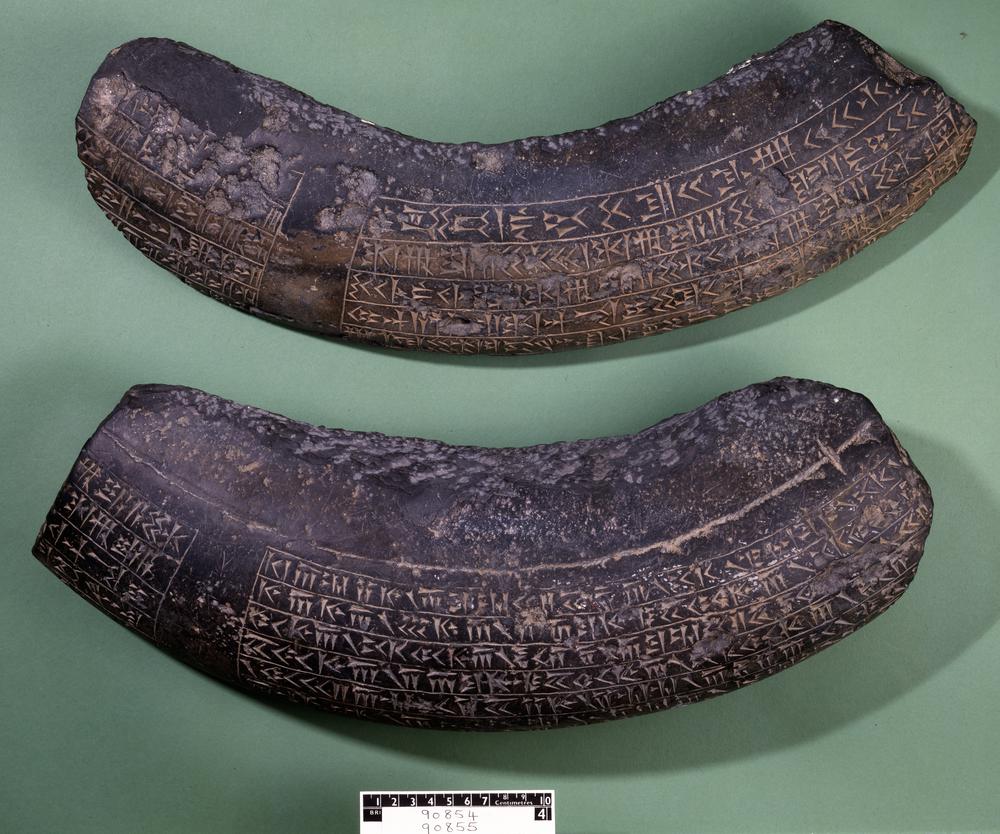
The base of the column bears an inscription that records the rebuilding of a palace at Ectabana ’by the favour of Ahuramaza, Anahita and Mithra’.
