Your search As Salhiyah gave 2391 results.

Marble altar found in flood gravel at Aguntum, Noricum, dedicated to Deo invicto Soli Mithrae collectively by the Aguntenses, making it one of the rare collective dedications to Mithras.
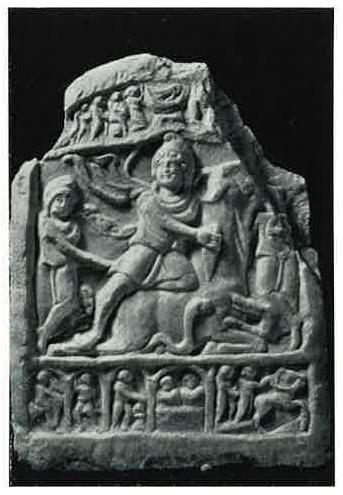
Small limestone tauroctony relief from Enns, ancient Lauriacum in Noricum, found about 100 metres east of the north-east corner of the castra, depicting Mithras killing the bull with dog and serpent and flanking torchbearers.
Carbonised plant remains (4,210 g) from the third room of the Mithraeum at Linz, ancient Lentia, comprising vine, prunes, hedge- and cornelberries, apple pips, walnuts, and millet; interpreted as a ritual food offering to the god.
Several thin silver fragments from the Mithraeum at Linz, ancient Lentia, reconstructed as a votive object surmounted by a crescent or two horns; paralleled in sanctuaries of Jupiter Dolichenus.
Pottery assemblage from the cult room of the Mithraeum at Linz, ancient Lentia, including glazed dishes, three-handled serpent-vases, and related fragments; a vessel type closely associated with Mithraic ritual in the Danubian provinces.
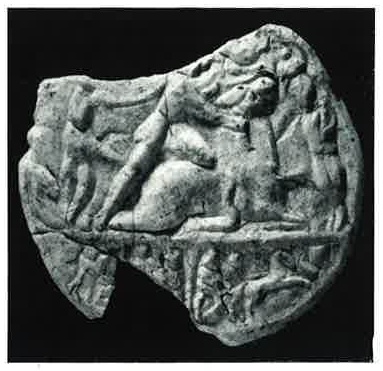
Small circular marble tauroctony relief from the Mithraeum at Linz, ancient Lentia, depicting Mithras killing the bull with dog, serpent, and scorpion, flanked by cross-legged torchbearers with a lion behind Cautopates; the lower section is divided into three subsidiary scenes…
Altar from the Mithraeum at Moosham, Noricum, dedicated to Deo invicto Mithrae for the welfare of Lucius Albius Atticus; the dedicant's name has been deliberately abraded.
Small Mithraic sanctuary (8 × 8 m) excavated in 1950–52 on a slope west of Schloss Moosham, Noricum, on the left bank of the river Mur; the finds include a marble epistylium, a Mithras head, and fragmentary altars.
Limestone statue fragment from Nyon, ancient Colonia Iulia Equestris, depicting a lion encircled by a serpent with schematic scorpions engraved in small triangles on each flank; a composition associated with Mithraic lion symbolism.
Underground oblong room at Nyon, ancient Colonia Iulia Equestris, situated on the edge of a second Forum dating to the second half of the first century AD, with a series of pillars along the side walls consistent with Mithraic architecture; its interpretation as a Mithraeum remains tentative…
Round perforated bronze plaque from Augst, ancient Augusta Rauricorum, bearing a dedication of an aurichalcum image of Sol to Deo invicto; interpreted by Cumont as evidence for identifying the dedicatee as Mithras.
Deposit of 1,200 coins spanning Augustus to Constantine and a small bronze bell from Thun-Allmendingen, representing the longest chronological range of any coin assemblage from a Mithraic context in Germania.
Limestone left hand holding a caduceus from Thun-Allmendingen, belonging to a statue of Mercury associated with the possible Mithraeum.
Fragmentary limestone relief from Thun-Allmendingen of the same dimensions as the bull relief, depicting a swine; both may have formed part of the sanctuary's ritual décor.
Site excavated by C. F. L. Lohner in 1824–25 at the Renzenbühl near Thun-Allmendingen, Germania Superior, where the outline of five rooms was identified, one or more of which may have served as a Mithraic sanctuary.
Large sandstone altar from the Mithraeum at Königshoffen, hollowed out at the back with a circular opening in the top, which stood before the great tauroctony relief; the front bears a dedication to Deo invicto Mithrae.
Miscellaneous sandstone altar fragments from the Mithraeum at Königshoffen, including uninscribed pieces and one bearing a solar disc with two heart-shaped figures on the upper front face.
Grey sandstone slab from the Mithraeum at Königshoffen, a companion piece to the preceding, recording the same act of repainting a cult image by Caius Celsinius Matutinus, veteran of Legio VIII Augusta Alexandriana.
Upper left corner of a sandstone altar from the Mithraeum at Königshoffen, preserving the beginning of a dedication to Deo invicto by Caius Iulius; the rest is lost.
Sandstone altar from the Mithraeum at Königshoffen, dedicated to Deo invicto by a dedicant whose name begins Primu[s]; the remainder of the text is fragmentary.
