Your search As Salhiyah gave 2397 results.

Terracotta statuette from Mithraeum II at Ptuj, ancient Poetovio, depicting Mithras as bull-slayer with yellow-painted garments; the piece was not recovered during the author's visit and may be lost.
Marble relief from Mithraeum II at Ptuj, ancient Poetovio, depicting standing Jupiter with sceptre and thunderbolt beside standing Hercules with the Hesperides' fruit and club — a divine pair with Mithraic associations.

Left portion of a marble tauroctony relief from Mithraeum II at Ptuj, ancient Poetovio, preserving the bust of Sol and below it standing Cautopates with a downward torch, together with the bull's hind-leg and Mithras's right leg.
Marble lion from Mithraeum II at Ptuj, ancient Poetovio, holding a swine's head under its left fore-leg — a sacrificial animal pairing associated with the Mithraic lion grade.
Marble statue on base from Mithraeum II at Ptuj, ancient Poetovio, depicting the naked Mithras entwined by a serpent as he emerges from the rock; the breast is damaged, and the head and arms are lost.
Inscription on the column base from Mithraeum II at Ptuj, ancient Poetovio, dedicated to Deo invicto Mithrae for the welfare of the Emperors and Geta Caesar by Salvianus, contrascrip of the statio Atrantiana; Geta's name was subsequently erased.
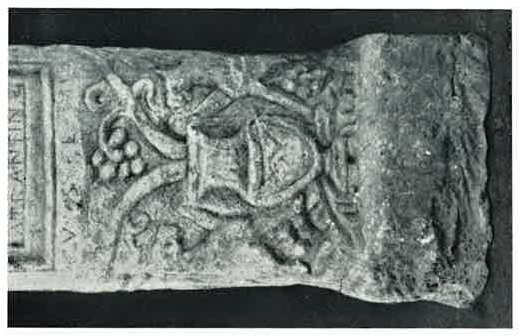
Marble column from the entrance of Mithraeum II at Ptuj, ancient Poetovio, serving as a statue base, its front decorated with a kantharus between panthers and vine tendrils; the inscription names Salvianus, contrascrip of the statio Atrantiana.
Marble relief fragment from Mithraeum II at Ptuj, ancient Poetovio, preserving the hindmost part of the bull and the right leg of Mithras with the scorpion in its usual position.
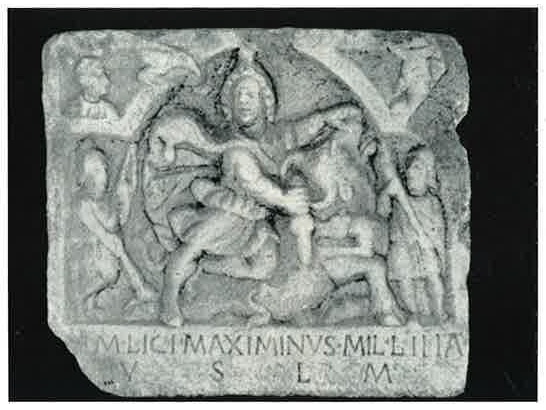
White marble tauroctony relief from Mithraeum II at Ptuj, ancient Poetovio, depicting Mithras in Oriental dress killing the bull with a girdle and the raven perched on the grotto's border.
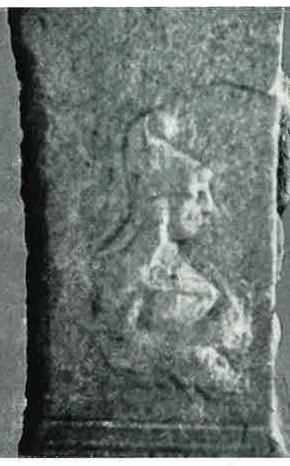
White marble altar from Mithraeum I at Ptuj, ancient Poetovio, decorated below the inscription with the dressed bust of Cautopates, a palm between two ram's heads above, and busts of Mithras on both lateral faces.
Inscription from Mithraeum I at Ptuj, ancient Poetovio, set up by Primitivos, contrascrip of the imperial procurator Caius Antonius Rufus, in memory of Hyacinthus — probably the founder of the sanctuary.
White marble base from Mithraeum I at Ptuj, ancient Poetovio, bearing a dressed bust of Sol on the left lateral face and an inscription recording a dedication related to the Mithraic transit ritual.
Inscription from the area of the castellum at Sisak, ancient Siscia, recording that Iucundus, imperial dispensator of Pannonia Superior, built a portico and an aparatorium for Deo invicto Mithrae ex voto.

Small marble tauroctony relief from Ruše, Noricum, badly weathered, depicting the bull-slaying in a grotto-like niche with cross-legged torchbearers on bases.
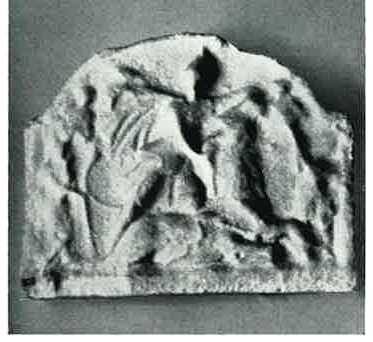
Small marble tauroctony relief from Ruše, Noricum, depicting Mithras killing the bull in a grotto, notable for the unusually elongated neck of the bull; dog and serpent approach the wound, and the raven perches above.
Altar found in the Zollfeld at Virunum in March 1837, together with a statue of a bearded man holding a modius, dedicated to Invicto patrio by Ulbius Gaianus, praefectus vehiculorum — a rare reference to Mithras as a paternal deity.
Inscription from Virunum, Noricum, dedicated to Deo invicto Mithrae in honour of the Domus Divina by Eppius, son of Ariminensis — a rare instance of filiation used as a sole identifier.
Conglomerate statue from a layer of fire debris in the Mithraeum at Schachadorf, Noricum, depicting a naked Mithras without Phrygian cap being born from the rock with upraised hands; a coiling serpent is visible below.
Miscellaneous objects from the Rückingen Mithraeum including stone balls, cult-vase fragments, lamps, and two candlesticks
Sandstone Mithras relief discovered in 1950 near Rückingen, proving the existence of a Mithraeum there from the late second to early third century AD
