Your search Bad Ischl im Salzkammergut gave 2083 results.
The Bad Ischl area has been inhabited since the time of the prehistoric Hallstatt culture. Documentary evidence of the settlement dates back to 1262, when it was referred to as Iselen.

A certain Secundinus, steward of the emperor, dedicated this altar to Mithras in Noricum, today Austria.

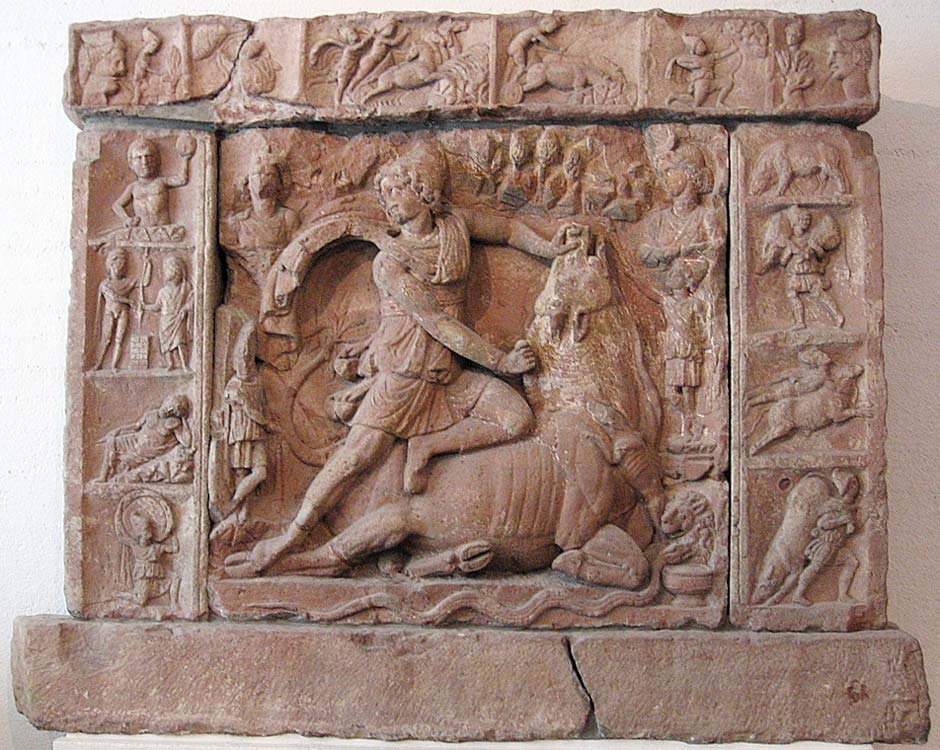
The Tauroctony relief of Neuenheim, Heidelberg, includes several scenes from the deeds of Mithras and other gods.
The Mithraeum Felicissimus has a floor mosaic depicting the seven mithraic grades.
Fragment of a limestone altar from Wiesbaden, ancient Aquae Mattiacae, preserving the crossed legs of a torchbearer
Second Mithraic sanctuary discovered in 1826 some 150 metres west of Mithraeum I at Heddernheim, ancient Nida, with finds in the Wiesbaden museum.
First Mithraic sanctuary discovered at Heddernheim (ancient Nida) in 1826, with finds preserved in the Städtisches Museum at Wiesbaden.
Tercera entrega de la trilogía de Jaime Alvar dedicada al estudio de los cultos a dioses procedentes de Oriente en la Península Ibérica.
This small inscription from Termini Himeraeae in Sicily was dedicated to Sol Invictus as protector of the emperor Antoninus Augustus.
This fragmentary tauroctony relief from Timziouin near Saïda depicts Mithras slaying the bull within a cave-like frame, accompanied by the raven, serpent, scorpion, and Cautopates.
Small votive altar in white limestone from Aquae Mattiacae, dedicated to Deo Invicto by a miles pius. The top preserves the head of Cautes with his raised torch.
Small marble column dedicated by Iunia Zosime, mater, to Virtus Dendrophori from silver weighing two pounds, from the Mitreo degli Animali at Ostia.
An altar found in the west corner of the sanctuary at Borcovicium (modern Housesteads) in 1898, recording a dedication to Jupiter Optimus Maximus, the god Cocidius and the genius of the place by soldiers of the Second Augustan Legion on garrison duty.
The statue of Arimanius/Ahriman was found in 1874 under the city wall of York during the construction of the railway station.
This altar mentioning the god Arimanius was found in 1655 at Porta San Giovanni, on the Esquilino.
Badly damaged limestone statuette of a standing figure in Eastern attire, head, arms and feet lost, from the Mithraeum near Memphis, Egypt.
These twin inscriptions found in the Mithraeum of Tazoult were dedicated by the legate Marcus Valerius Maximianus.
Limestone altar dedicated to Cautes by the Roman optio Septimius Valentinus, discovered in the Mithraeum of Sárkeszi in Pannonia Inferior.
Marcus Valerius Maximus records in this inscription his knowledge of astrology as well as the name of his wife.
Marble funerary plaque erected by Lucius Septimius Archelaus, a Pater and priest of Mithras, for himself, his wife, and their freedmen and descendants.