Your search Boulogne-sur-Mer gave 706 results.

Two limestone statue fragments from Mithraeum II at Aquincum, Pannonia Inferior, representing Mercury in a shoulder-pinned garment with wings in his hair; probably stood in room A on base y.
A head in a Phrygian cap, possibly belonging to a torchbearer statue, formerly kept at St. Wendel in Belgica but possibly transported to the Provinzialmuseum in Trier, where it may be identical with CIMRM 993.
Two terracotta lamps formerly in the Coll. Passeri and now probably in the Museo Olivieri at Pesaro: the first showing Mithras as a bullkiller, the second in the shape of a bull's head inscribed Μέθρα ἱερός on the horns, both regarded as probably forged…
A small terracotta lamp from the Mithraeum at Pons Saravi (modern Saarburg) in Belgica, bearing a beardless head on its upper surface and the inscription SOLI on its underside, found among numerous lamp fragments.
Numerous animal bones including birds, beasts of prey, and the muzzle of a wild boar, found as ritual deposits in the Mithraeum at Pons Saravi (modern Saarburg) in Belgica.
A marble standing torchbearer statue in Phrygian cap, tunica, cloak and anaxyrides, found at Torrita near Nazzano in Etruria at the beginning of the nineteenth century, formerly in Trasi's house at Torrita and later in Rome; present location unknown.
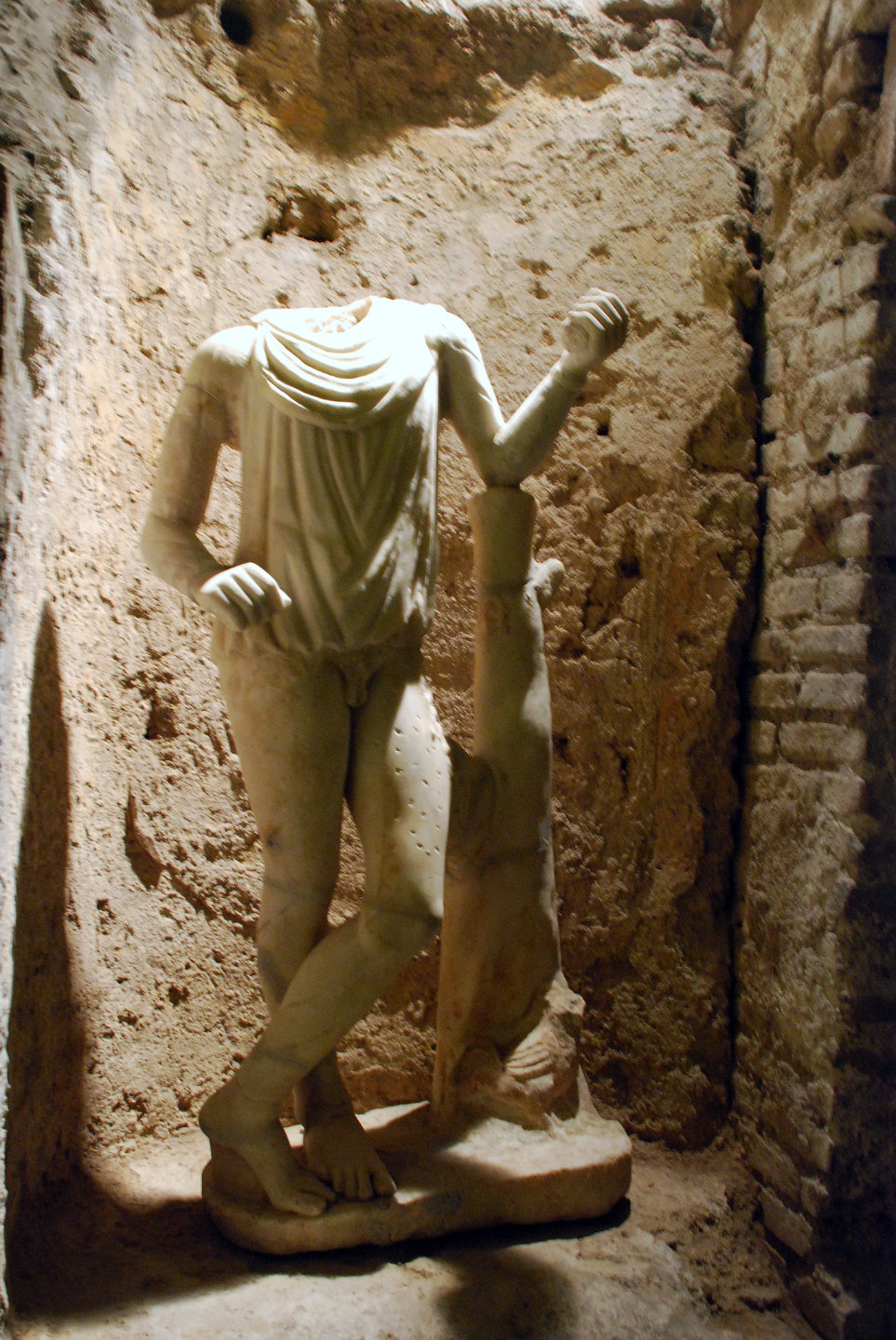
The marble statue of Cautes, found in the Mithraeum of Santa Prisca, was originally a Mercury.
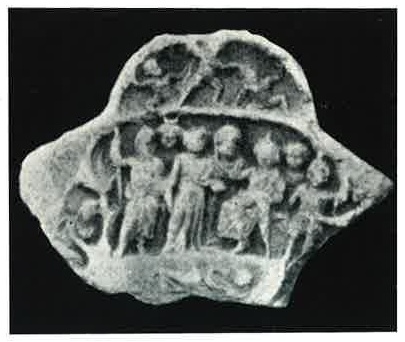
White marble tauroctony relief from Veles, ancient Bylazora in Macedonia; the merchant reported that other fragments of the same monument were walled into a fountain in Veles.
The six divine names inscribed on the bronze hatchets from Thun-Allmendingen — Iovi, Neptuni, Minervae, Mercurio, Matribus, Matroni — reflecting the polytheistic religious landscape of the Mithraic community at this site.
Altar from the Mithraeum at Königshoffen, dedicated to Deo Cissonio — a Celtic god identified with Mercury — by Gittonius Pippausus; the dedicant's Celtic name may be etymologically connected to that of the deity.
A lost Mithraic relief acquired near Rome and formerly held by the Lyceum Hosianum of Braunsberg in East Prussia, known only through a 1910 communication to Cumont; possibly identical with the relief from Macerata.
A marble plinth inscription formerly in the Vigna Guidii outside the walls of Rome, recording L. Valerius Megistus as pater and sacerdos of the Invincible Mithras.
Two tauroctony statues formerly at the Villa del Grande near the Porta Maggiore in Rome, both lacking the upper part of Mithras and the bull's head.
A stone statue probably found in Rome, depicting a naked Mithras emerging from the rock with his index finger raised to his lips and his right arm broken off, described by Cumont as an unfinished work never completed.
A lost Mithraic relief formerly at the Villa Borghese in Rome, known only through a brief mention in early modern antiquarian literature and no longer traceable.
Tauroctony relief formerly in the house of the Alterii near S. Marco in Rome, now of unknown whereabouts, described by Gruterus as showing Mithras pressing both knees onto the bull and grasping its horns with the knife in the shoulder, with scorpion, serpent, raven, Sol and Luna…
Altar found in the church of S. Giovanni de Mercato in Rome, with a dedication to the holy Invictus Mithras by C. Tullius Trophimianus.
Base of bluish marble formerly in the Villa Giustiniani near Porta Flaminia and now in the Vatican Musea, Cortile della Pigna, with a round pedestal encircled by a bearded crested serpent biting its own tail, probably supporting a statue of Aion.
Small marble base apparently found in the same Aventine sanctuary during former excavations, with a dedication to Jupiter Optimus Maximus Dolicheno and Sol digno praestantissimo.
Mosaic-paved floor of the central aisle of the Mitreo delle Sette Porte at Ostia, with a krater flanked by serpent and eagle, standing Jupiter and Saturn, torchbearers at the podia, and planetary gods Mars, Luna, Venus, and Mercury.
