Your search Bu Njem gave 1882 results.

In this relief of Mithras as bull slayer, recorded in 1562 in the collection of A. Magarozzi, Cautes and Cautopates have been replaced by trees still bearing the torches.

Emperor Caracalla ordered one of Rome’s largest temples to the god Mithras to be built in the baths bearing his name.

Burgos is a city in the autonomous community of Castile and León in Spain.
Regensburg is a city in eastern Bavaria, at the confluence of the rivers Danube, Naab and Regen, Danube's northernmost point.
Under Roman rule from the 1st century CE, Histria was incorporated into the province of Moesia. The city is noted on the Tabula Peutingeriana, which places it 11 miles from Tomis and 9 miles from Ad Stoma.
Settlement of prehistoric origin that developed into the Roman Vicus Vetonianus, modern Dieburg, incorporated into the civitas Auderiensium in Germania Superior and attested as an active centre during the Roman period.
Around 300 BC, Burdigala was the settlement of a Celtic tribe, the Bituriges Vivisci. The Romans conquered the area in 60 BC and made Burdigala the capital of the Roman province of Aquitania during the reign of Emperor Vespasian.
Rottenburg am Neckar; until 10 July 1964 only Rottenburg; Swabian: Raodaburg is a medium-sized town in the administrative district of Tübingen in Baden-Württemberg, Germany. Rottenburg is the seat of a Roman Catholic bishop, being the official centr
The Saalburg is a Roman fort located on the main ridge of the Taunus, northwest of Bad Homburg, Hesse, Germany.
Ladenburg is a town in northwestern Baden-Württemberg, Germany. The town's history goes back to the Celtic and Roman Ages, when it was called Lopodunum.
Brocolitia, also called Procolita or Brocolita, was an auxiliary settlement on Hadrian's Wall. This site is now known as Carrawburgh.
Tribune of the First Cohort of Vardulli, he erected a mithraeum at Bremenium together with his consacranei.

This marble tablet found at Portus Ostiae mentions a pater, a lion donor and a series of male names, probably from a Mithraic community.
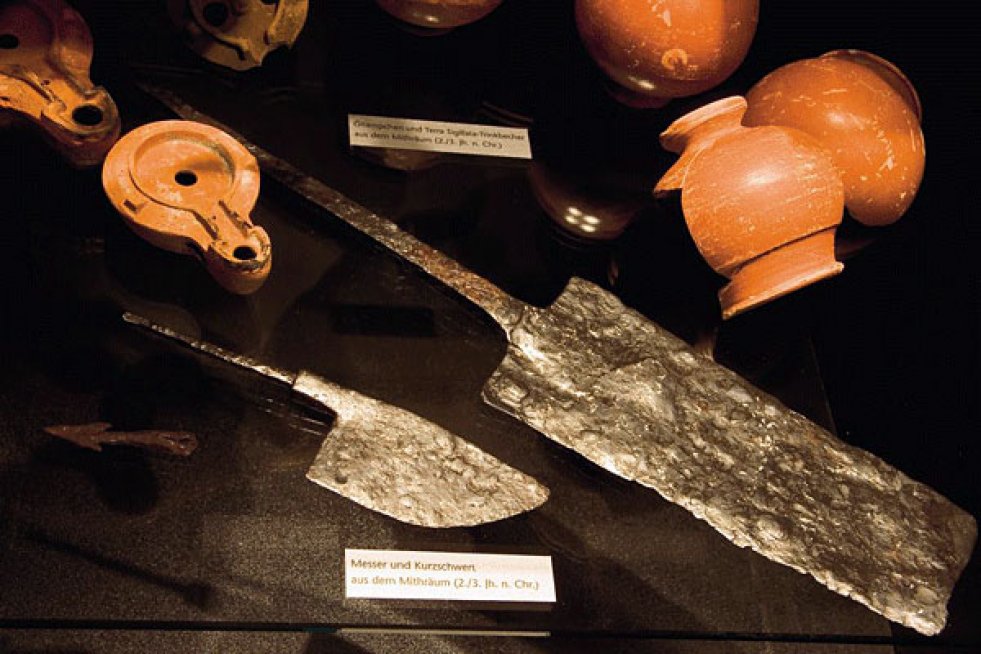
The Mithraeum of Kunzing was an underground building, oriented east-west. The entrance was probably on the east.

This relief of Mithras slaying the bull incorporates the scene of the god carrying the bull and its birth from a rock.
Sicilia connected Italy, North Africa and the eastern Mediterranean through some of the busiest maritime routes of the Roman world.
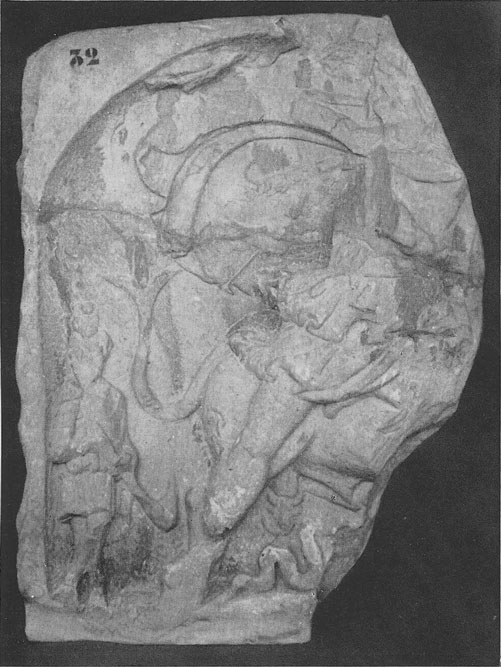
This fragmentary tauroctony relief from Timziouin near Saïda depicts Mithras slaying the bull within a cave-like frame, accompanied by the raven, serpent, scorpion, and Cautopates.
,_found_in_Rome,_2nd_century_AD,_British_Museum_(15545876047).jpg)
The sculpture of Mithras slaying the bull was transported from Rome to London by Charles Standish in 1815.
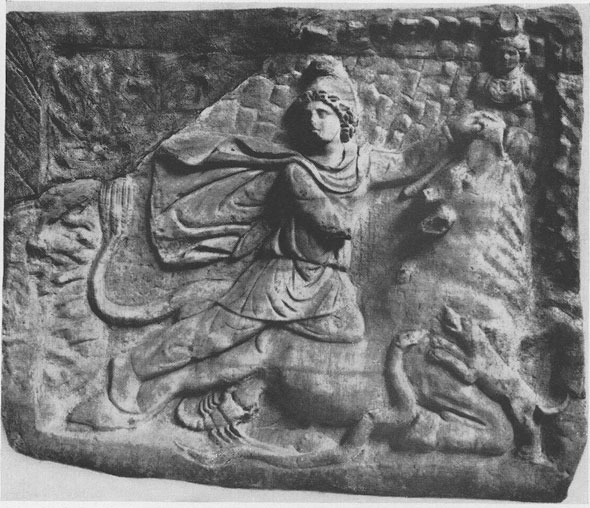
This marble tauroctony relief, probably originating from Naples, depicts Mithras slaying the bull within a cave-like setting, accompanied by the usual animals and celestial busts.
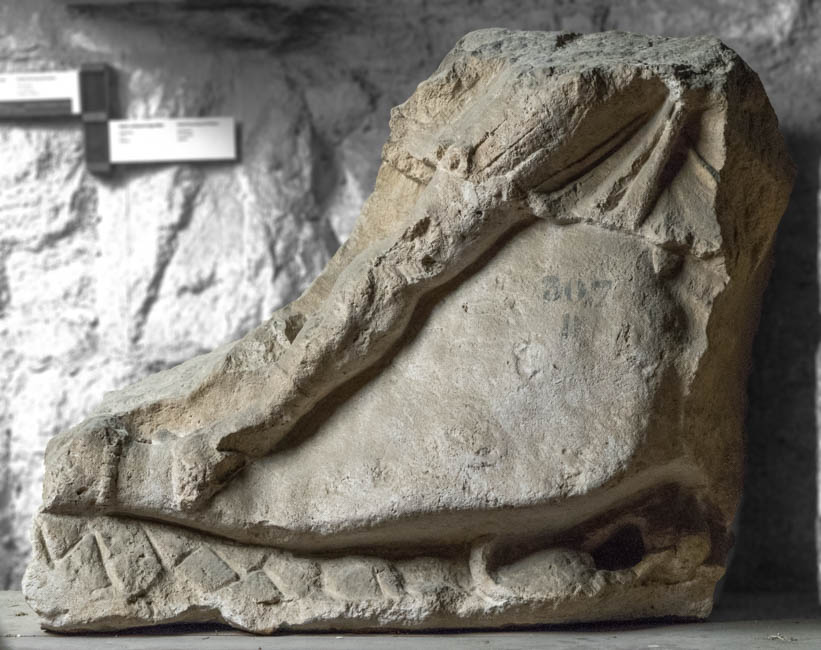
This large limestone fragment from Roman Salona preserves the hind part of the bull together with Mithras’ foot and traces of his red tunic.
