Your search Bu Njem gave 1882 results.

An altar found in the north-east corner of the main room of the Mithraeum at Borcovicium (modern Housesteads) in 1822, bearing on its capital the bust of Sol in a crown of seven rays and the inscription No. 859.
A small four-sided white marble relief of uncertain Mithraic attribution, found at Italica (modern Santiponce, near Seville), depicting a bull walking to the right on the front, a fig-tree on the back, five ears of wheat on the right side, and damaged vine tendrils with grapes on the left…
Preliminary readings of the painted Mithraic texts later revised after additional research and restoration.
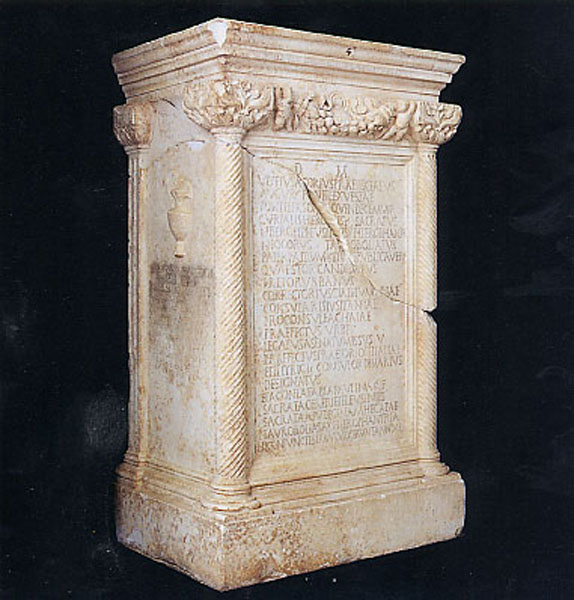
The marble altar mentions Vettius Agrorius Praetextatus as Pater Sacrorum and Patrum and his wife Aconia Fabia Paulina.
Epigraphic testimony catalogued in the Année Épigraphique and Lugli’s Fontes for ancient Rome.
This monument was erected on the occasion of the elevation of a member to the Mithraic grade of Perses.
Marble bust from the south-east slope of the Acropolis at Athens, from the Attic mountain Pentelikon, depicting a man with an uncovered breast and mantle; probably Mithras, though the head is lost.
Inscription found at Škrip on the island of Brač, ancient Brattia in Dalmatia, in 1805, dedicated to Soli invicto Mithrae by Iulius Bubulus.
Large limestone relief from Thun-Allmendingen depicting a bull walking to the left; the head is lost. At approximately 2.91 × 2.43 m one of the largest single-animal reliefs from a Mithraic context.
Two rectangular sandstone reliefs from Zasenhausen near Cannstatt, ancient Clarenna, each depicting a male bust with astral symbols on the forehead, arranged in opposing directions.
A white marble tauroctony group in the round found near the Forum in Rome in 1919, showing Mithras slaying the bull with dog, serpent and scorpion, the bull's tail ending in three ears of grain; possibly identical with No. 605.
Tauroctony relief formerly in the house of the Alterii near S. Marco in Rome, now of unknown whereabouts, described by Gruterus as showing Mithras pressing both knees onto the bull and grasping its horns with the knife in the shoulder, with scorpion, serpent, raven, Sol and Luna…
Fragment of a small tauroctony relief in the Museo Lateranense, Rome, preserving the bull's head and the upper part of Cautopates pointing his torch downwards with both hands, and the bust of Luna with crescent in the upper corner.
Marble relief formerly in the Palazzo Giustiniani showing Mithras slaying the bull while grasping one of its horns, with the dog, serpent, scorpion and torchbearers, and a krater before the feet of Cautes.
Tiburtine stone tablet found in 1740 near S. Balbina, with a dedication by T. Aelius Tryfon, priest of Sol Invictus, to the Invicti and Silvanus, erected after a vision.
Terracotta relief showing Victoria slaying a bull from the S. Prisca Mithraeum; a similar relief was found in 1953 and probably does not belong to the original Mithraic inventory.
Very small relief showing Mithras slaying the bull, with some figures preserved on the broken lower border, from the Aventine sanctuary in Rome.
Two fragments of greyish marble from the Palazzo dei Musei Mithraeum with a partially legible inscription referring to the pontifex maximus and tribunicia potestas for the twentieth time, attributed to Trajan or Hadrian.
Fragments of a small lamp from the Palazzo dei Musei Mithraeum, preserving the lower part of the bust of Luna set within a crescent.
Bust of a man in lorica and paludamentum from the Mithraeum at the Palazzo dei Musei, Rome; the head is lost.
