Your search Cabrera de Mar gave 1568 results.

Foremost portion of a marble tauroctony relief from Mithraeum II at Ptuj, ancient Poetovio, preserving the bull's forepart, the serpent's head, the turning dog, and Cautes raising the torch with both hands.
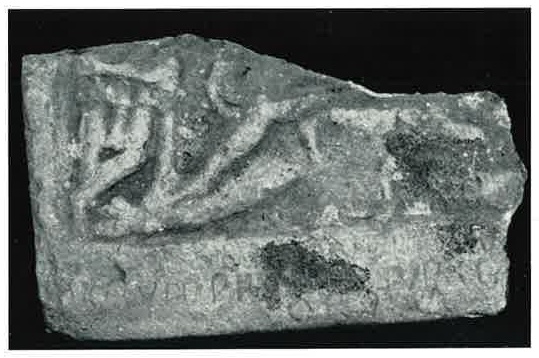
Marble relief from Mithraeum II at Ptuj, ancient Poetovio, preserving the lower part of the tauroctony with a bull in full extension, the scorpion, and a serpent with upraised head, together with Cautopates behind the bull.

Left portion of a marble tauroctony relief from Mithraeum II at Ptuj, ancient Poetovio, preserving the bust of Sol and below it standing Cautopates with a downward torch, together with the bull's hind-leg and Mithras's right leg.
Small marble altar with akroteria from Mithraeum II at Ptuj, ancient Poetovio, dedicated to Deo invicto Mithrae by Secundus Acutus.
Upper portion of a marble altar from Mithraeum II at Ptuj, ancient Poetovio, dedicated to Deo Soli invicto Mithrae for the welfare of Aurelius; the rest of the name is lost.
Marble altar fragment from Mithraeum II at Ptuj, ancient Poetovio, dedicated by a tabularius et vilicus of the statio Confluentes, a customs station at the junction of Pannonia Inferior and Moesia.
Marble altar with akroteria from Mithraeum II at Ptuj, ancient Poetovio, dedicated to Fonti perenni by Epictetus and Viator, vicarii of Quintus Sabinius Veranus, vilicus of the publicum portorium.
Upper portion of a marble altar from Mithraeum II at Ptuj, ancient Poetovio, preserving only the abbreviated dedication to Deo invicto Mithrae.
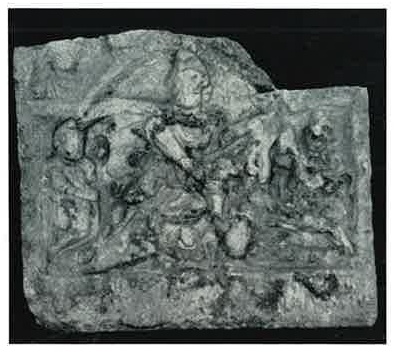
Marble tauroctony relief from Mithraeum II at Ptuj, ancient Poetovio, distinguished by the bull represented with fully stretched legs; Cautopates is shown resting his head on his hand in a pensive posture.
Circular white marble fragment from Mithraeum II at Ptuj, ancient Poetovio, depicting a lion's head with leaves below and a small globe above.
Right lower corner of a marble relief from Mithraeum II at Ptuj, ancient Poetovio, preserving the border of the grotto and, outside it, Luna in a two-horse chariot holding a whip; only the horses' heads are shown.
Marble relief fragment from Mithraeum II at Ptuj, ancient Poetovio, preserving the hindmost part of the bull and the right leg of Mithras with the scorpion in its usual position.
Marble relief fragment from Mithraeum II at Ptuj, ancient Poetovio, preserving the greater part of Cautes in high relief; the head, most of the right arm, and legs below the knee are lost.
Right portion of a marble relief from Mithraeum II at Ptuj, ancient Poetovio, preserving Cautes holding the upraised torch with both hands; not cross-legged; head, feet, right hand, and torch top are lost.
Small marble relief fragment from Mithraeum II at Ptuj, ancient Poetovio, preserving the middle portion of a torchbearer.
Left lower corner of a marble relief from Mithraeum II at Ptuj, ancient Poetovio, preserving Cautopates with downward torch and a staff; not cross-legged; head, left arm, and left foot are lost.
Fragment of a large marble relief from Mithraeum II at Ptuj, ancient Poetovio, preserving the forepart of the bull, the leaping dog, and the serpent approaching the wound.
Left portion of a primitive marble relief from Mithraeum II at Ptuj, ancient Poetovio, preserving the upper part of a figure in Oriental dress holding a downward torch and the bust of Sol in the upper corner.
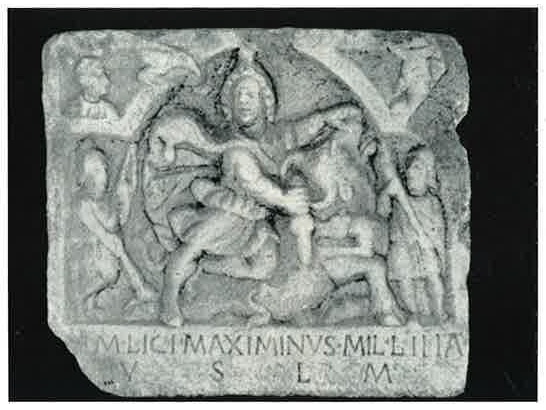
White marble tauroctony relief from Mithraeum II at Ptuj, ancient Poetovio, depicting Mithras in Oriental dress killing the bull with a girdle and the raven perched on the grotto's border.
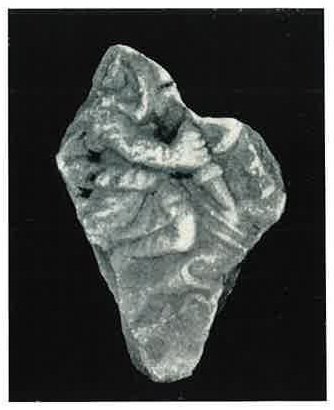
Marble tauroctony relief fragment from Mithraeum II at Ptuj, ancient Poetovio, preserving the central scene with the leaping dog, serpent, and scorpion; the bull's body is encircled by two girdles.
