Your search Carel Claudius van Essen gave 131 results.

The last pagan emperor of Rome, closely associated with Mithras and Neoplatonic interpretations of the Sun God.
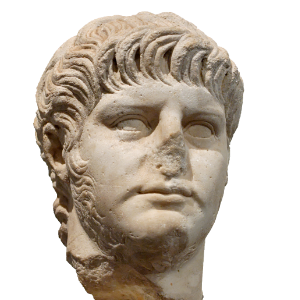
Roman emperor whose ceremonial reception of Tiridates I of Armenia established one of the earliest recorded links between Mithras and the Roman imperial court.
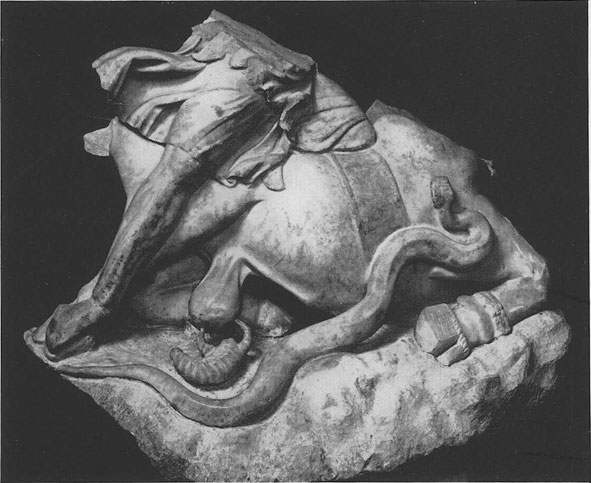
Partial marble statue of Mithras as a bullkiller found near Viale Latino, about 200 meters from Porta San Giovanni.
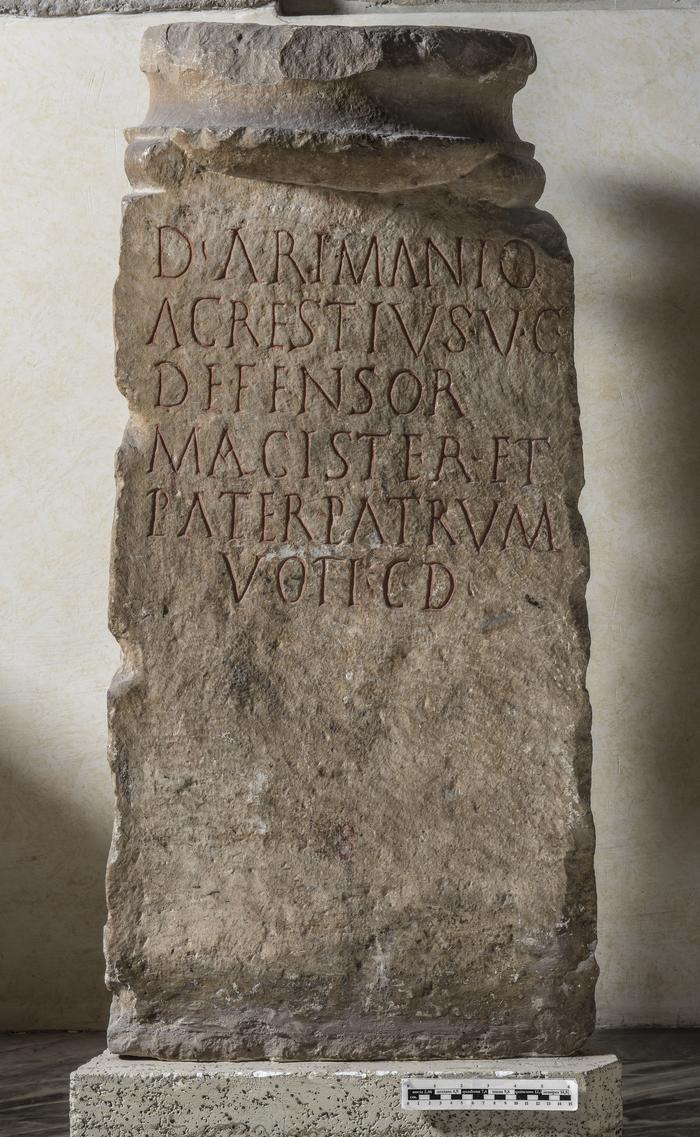
This altar mentioning the god Arimanius was found in 1655 at Porta San Giovanni, on the Esquilino.
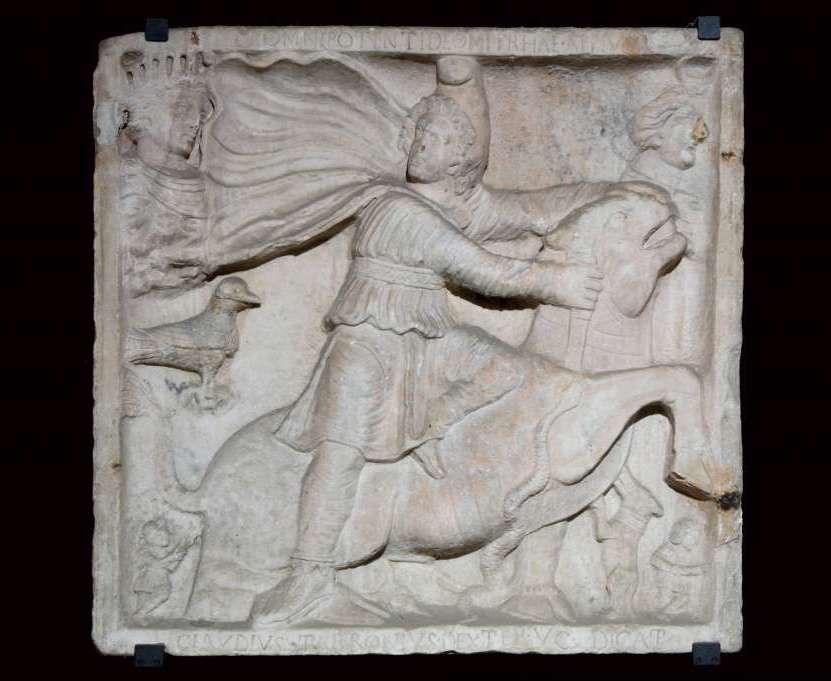
The marble relief of Mithras killing the bull in Naples bears an inscription that calls the solar god omnipotentis.

Two fragments of a sandstone inscription from Gran in the Vosges, dated to the late second century, recording a dedication to Soli deo invicto by a servant of the dedicant, with possible mention of a portico and columns.

The tauroctonic relief from Dragus includes a naked flying figure that Vermaseren has identified as Phosporus or Lucifer.
Altar found in the church of S. Giovanni de Mercato in Rome, with a dedication to the holy Invictus Mithras by C. Tullius Trophimianus.
Altar formerly in the house of the de Vellis family near the Carmelites in Rome and now in the Museo delle Terme, with a dedication to Silvanus on one side and on the reverse a record by M. Aurelius Bassus, priest of Sol, of having made a fountain flow.
Marble altar from the gardens of the Villa Giustiniani near Porta Flaminia, dedicated to Sol Invictus Mithras as a votive offering by Vestalis, servant of the Caesars, and C. Vettius Augustalis.
Large marble altar found near S. Giovanni in Laterano, dedicated by Sextilius Agesilaus Aedesius, pater patrum of Sol Invictus Mithras, to the Great Mother and Attis following his taurobolium and criobolium, dated to 376 A.D.
Tiburtine stone tablet found in 1740 near S. Balbina, with a dedication by T. Aelius Tryfon, priest of Sol Invictus, to the Invicti and Silvanus, erected after a vision.
Coins found in the lower sandy strata of the S. Prisca Mithraeum, ranging from the time of Claudius to the late 4th century, including issues of Commodus, Crispina, Diocletianus, Galerius, Constans and Valens.
Two Mithraic monuments discovered during the 1935 excavations of the Dolichenum on the Aventine, together with statues of Sol, Luna, Venus, Silvanus and Hercules, now in the Museo Capitolino; the only certain Mithraic finds from a Dolichenum.
Deposit of twenty-three coins from the Mithraeum at Schachadorf, Noricum, spanning from Claudius II to Valentinianus II and providing a terminus for the sanctuary's use.
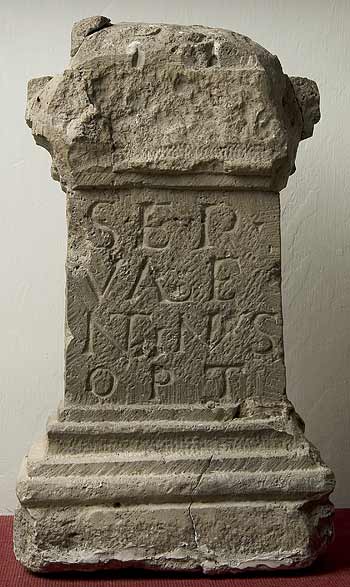
Limestone altar dedicated to Cautes by the Roman optio Septimius Valentinus, discovered in the Mithraeum of Sárkeszi in Pannonia Inferior.
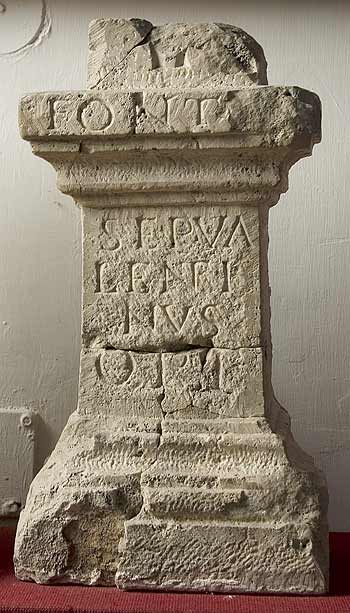
Fragmentary limestone altar dedicated by Septimius Valentinus, an optio, probably discovered in Mithraeum IV at Aquincum.

Arabia connected the Roman Near East to caravan routes, desert frontiers and the commercial networks of the southern Levant.
Lugdunum, currently Lyon, France, was the capital of the Roman province of Gallia Lugdunensis. The city was founded in 43 BC by Lucius Munatius Plancus. Two emperors, Claudius and Caracalla, were born in Lugdunum.
Mampsis or Memphis, today Mamshit, Arabic Kurnub, is a former Nabataean caravan stop and Byzantine city.
