Your search From Rome, Mithreum of Castra Peregrinorum under Santo Stefano Rotondo. gave 548 results.

This white marble relief of Mithras killing the bull was found on the Esquilino near the Church of Saint Lucy in Selci in Rome.
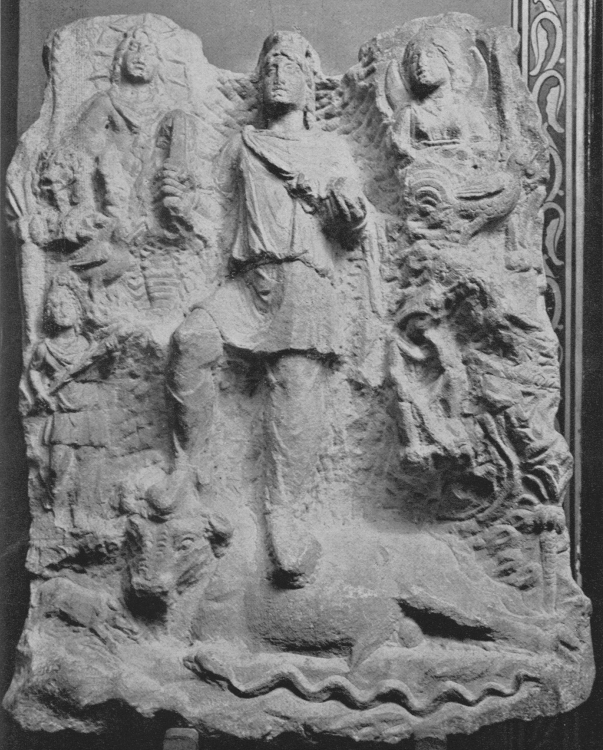
This unusual representation of Mithras standing on a bull was kept in the Casino di Villa Altieri sul Monte Esquilino until the 19th century.

One of the rooms in a sustantive masonry building in Hollytrees Meadow was considered to be a Mithreum, a theory that has now been discarded.

Limestone tauroctony relief found in a quarry at Békásmegyer, ancient Vicus Vindonianus in Pannonia Inferior, together with the upper portion of a sacrificial altar; the standard bull-slaying scene with torchbearers.
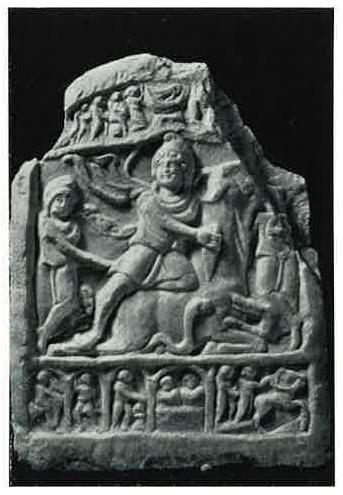
Small limestone tauroctony relief from Enns, ancient Lauriacum in Noricum, found about 100 metres east of the north-east corner of the castra, depicting Mithras killing the bull with dog and serpent and flanking torchbearers.
Underground oblong room at Nyon, ancient Colonia Iulia Equestris, situated on the edge of a second Forum dating to the second half of the first century AD, with a series of pillars along the side walls consistent with Mithraic architecture; its interpretation as a Mithraeum remains tentative…
Two Mithraic monuments received by the Museo Nazionale delle Terme in Rome in 1896, reportedly from Narni: a small head of Mithras tauroctone in Phrygian cap with traces of red and gilding, and a central relief fragment of Mithras slaying the bull.
A marble tauroctony relief fragment probably from Narni (ancient Narnia) in Umbria, now in the Museo Nazionale delle Terme in Rome, preserving Mithras in Eastern dress as a bullkiller with dog and Cautopates standing cross-legged before the bull; the exact find-spot is uncertain…
A marble tauroctony relief, broken in two pieces, found at Sutri in Etruria in 1896 and now in the Museo Nazionale delle Terme in Rome, with raven, dog, serpent and scorpion present, the upper part with the heads of Sol and Mithras broken off and Luna's bust alone preserved…
A white marble relief fragment found with its companion piece near Nomento on the Via Nomentana, showing only the lower body of a cross-legged torchbearer in a short tunic, now in the storerooms of the Museo Nazionale in Rome.
A white marble tauroctony relief fragment found at the hill known as Carnale near Nomento on the Via Nomentana, about twenty kilometres from Rome, now in the storerooms of the Museo Nazionale in Rome, dated to the third century AD.
Base of bluish marble formerly in the Villa Giustiniani near Porta Flaminia and now in the Vatican Musea, Cortile della Pigna, with a round pedestal encircled by a bearded crested serpent biting its own tail, probably supporting a statue of Aion.
Marble head with locks of hair and Phrygian cap, probably depicting Mithras as bull-killer, found under the threshold of the Iseum at Cyrene.
Sepulchral inscriptions from Lycaonia bearing the titles leo and aetos, previously interpreted as Mithraic grades but now understood as referring to tomb architecture.

Sutri is an Ancient town, modern comune and former bishopric in the province of Viterbo, about 50 kilometres from Rome and about 30 kilometres south of Viterbo. The modern comune of Sutri has a few more than 5,000 inhabitants.
Four small painted cups buried in a row under the niche floor at Mithraeum II, Stockstadt, one still containing a piece of sulphur; with coins of Augustus, Hadrian, and Antoninus Pius
Grey sandstone altar from Mithraeum I at Stockstadt decorated with a cornucopia on the left side and an eagle on a thunderbolt on the right
Ciciliano is a comune in the Metropolitan City of Rome in the Italian region of Latium, located about 35 kilometres east of Rome.
Two painted decorative phases from the Santa Prisca Mithraeum whose figures became clearer after later conservation work.
Left upper corner of a marble tauroctony relief from Cinçsor, Dacia, preserving the bust of Sol with a whip and underneath it the head of a torchbearer.
