Your search Mit Rahina gave 2642 results.
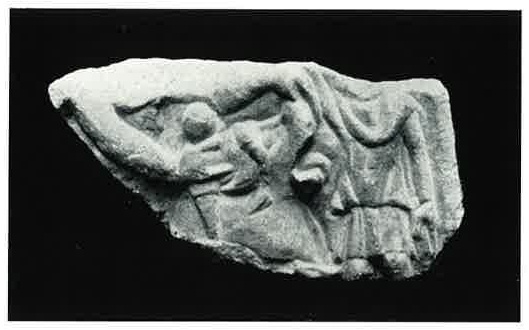
Marble tauroctony relief fragment from an unknown provenance, preserving part of Mithras's body, his right arm and dagger, and his left arm grasping the bull by the nostrils.
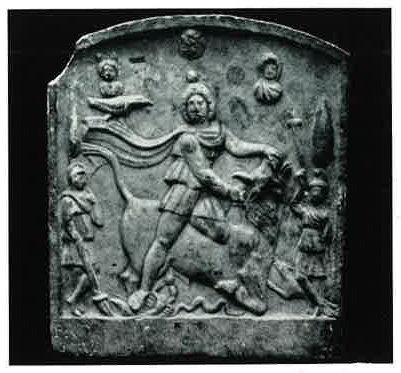
Marble tauroctony relief of uncertain but probably Apulum/Dacian provenance, depicting Mithras tauroktonos with raven, serpent, scorpion, and dog.

Limestone tauroctony relief fragment of unknown provenance, preserving the upper part of Mithras as bull-slayer with the flying cloak on which the raven is perched.
White marble tauroctony relief fragment of unknown provenance, preserving the foremost part of the bull and part of Mithras as bull-slayer.
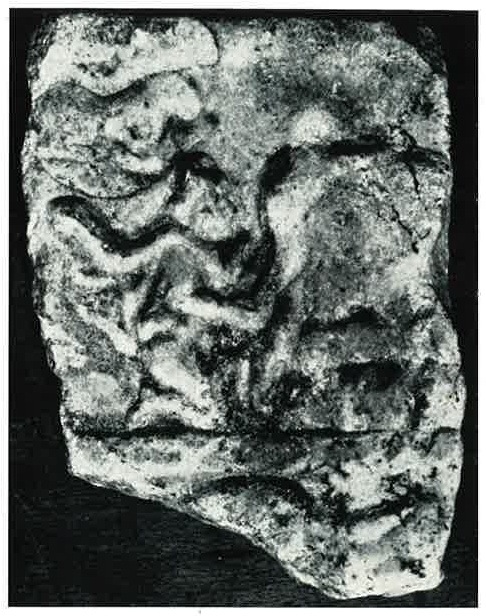
Marble tauroctony relief fragment from Dacia, preserved in Bucharest, with only Mithras's head and part of his flying cloak visible; above this a water-miracle scene and above that the bull in a small boat.

Stein am Rhein occupied a strategic position near the western limits of the Danubian frontier system.
A fragment of a stone relief from Interanum (modern Entrains-sur-Nohain) in Lugdunensis, showing the arched end of Mithras's flying cloak and an ear emerging from the bull's tail, possibly belonging to CIMRM 946.
A fragment of a white stone relief from Interanum (modern Entrains-sur-Nohain) in Lugdunensis, preserving only Mithras's right foot pressing on the bull's hindleg, a visible scorpion, and the shod foot of a torchbearer.
A fragment of a pebble relief showing Mithras as bullkiller, with the collar-wearing dog holding its head near the wound, found in the bed of a stream at Interanum (modern Entrains-sur-Nohain) in Lugdunensis.
An altar from Lucey in Narbonensis, dedicated to the unconquered god under the epithet Nabarze, possibly a variant of Mithras, set up by a dedicant named Severianus.
An inscription from Trento (ancient Tridentum) recording a gift dedicated to the Invincible Mithras by L. Claudius Iustio together with his sons Iustus and Iustinus.
A double-sided limestone relief found near Meclo in Val di Non in 1895, now in the Museo Nazionale at Trento, with a raven and altar scene on the obverse and scenes on the reverse showing a figure attacking a kneeling Phrygian-capped person and Mithras as a bull-carrier…
Two small heads wearing Phrygian caps, probably representing the Mithraic torchbearers Cautes and Cautopates, from Turin (ancient Augusta Taurinorum) and held in the Museum at Turin.
An altar found in 1830 at the ancient site of Industria near Monteu da Po in Liguria, bearing a dedication to the Invincible Mithras by C. Industrius Verus.
A white marble relief fragment found in a house at Ganaceto near Modena in 1845, now in the Museo Lapidario in Modena, showing Cautes in Eastern attire and anaxyrides cross-legged, with a fragment of Mithras' flying cloak according to Cumont.
Roman military settlement in Germania superior, generally identified with present-day Ober-Florstadt and known for its well-preserved Mithraic sanctuary.
Roman settlement on the southern shore of Lacus Verbanus (Lake Maggiore) in Transpadana, known for Mithraic inscriptions and a cave sanctuary traditionally identified as a Mithraeum.
A fragmentary inscription on the lower border of the limestone tauroctony relief from San Zeno di Romedio near Trento, partially reading a dedication to the Invincible Mithras by Marius.
