Your search Roman cemetery of St. Matthias gave 3406 results.

Histria was one of the earliest Greek colonies established on the western shores of the Black Sea.
Eisenstadt belongs to the western Pannonian region historically connected with the Roman frontier zone.
Jiu valley site associated with the defensive system linking Dacia to the southern Danubian regions.
The locality of Botoșești-Paia has yielded material connected with the Danubian provincial landscape.
Augusta Rauricorum became one of the principal urban centres of the Upper Rhine region.

A head in a Phrygian cap, possibly belonging to a torchbearer statue, formerly kept at St. Wendel in Belgica but possibly transported to the Provinzialmuseum in Trier, where it may be identical with CIMRM 993.
A fragmentary inscription from Scaleby Castle near Cambeckfort (ancient Petrianae), preserving a partial dedication to Sol Mithras.
A small ara from Longovicium (modern Lancaster), bearing a fragmentary dedication to the Invincible God and decorated on the left side with a relief of a boar.
A small altar from Longovicium (modern Lancaster), bearing a brief inscription dedicated to Deus Mithras, Cautopates and Sol Invictus.
A marble relief found in 1851 built into the adjoining hall of White Friars at Chester (ancient Deva), now in the Grosvenor Museum, depicting a standing dressed figure with a sheep-hook in his left hand and possibly a downward-pointing torch in his right…
A stone relief from Chester (ancient Deva), now in the Grosvenor Museum, depicting a cross-legged torchbearer in Eastern attire pointing his torch downwards with his right hand.
A small stone statue found at Chester (ancient Deva) in 1853 built into a cellar wall in White Friars, still seen by Stukeley in 1725 but now lost, depicting a standing torchbearer in Eastern attire and cross-legged, holding a torch downwards with both hands…
A brief inscription reading "Soli deo", found on an old stone architrave in Turin (ancient Augusta Taurinorum) in Liguria.
An altar found in 1830 at the ancient site of Industria near Monteu da Po in Liguria, bearing a dedication to the Invincible Mithras by C. Industrius Verus.
A marble statue from Augusta Emerita (modern Mérida), depicting a standing woman in a long chiton, now in the museum at Mérida, with head lost.
A marble statue found at Augusta Emerita (modern Mérida) in 1913, depicting a standing woman in a long chiton, now in the museum at Mérida, with head lost.
A marble statue from Augusta Emerita (modern Mérida), depicting a standing dressed male person whose right leg leans against a tree-trunk and whose raised right arm once held a lance or trident, tentatively identified as Poseidon.
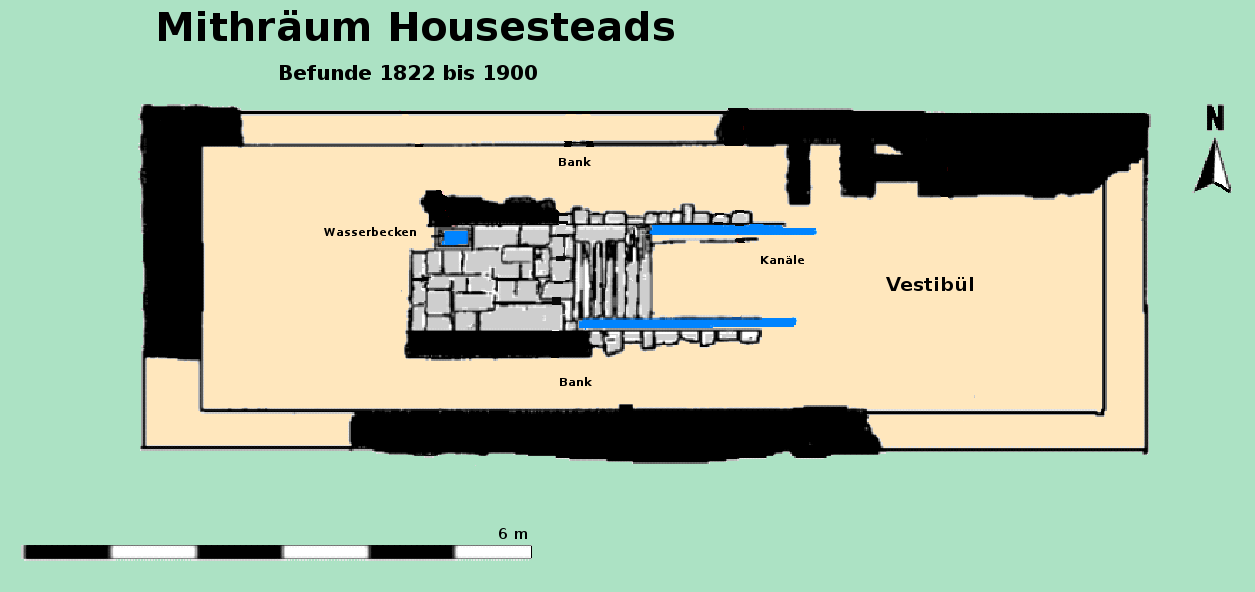
The Housesteads Mithraeum is an underground temple, now burried, discovered in 1822 in a slope of the Chapel Hill, outside of the Roman Fort at the Hadrian's Wall.

Marble tauroctony relief in five fragments from Ruse, ancient Sexantaprista in Moesia Inferior, found near the confluence of the river Lom with the Danube, depicting the standard bull-slaying.
