Your search San Giovanni al Timavo gave 3161 results.

Inscription from Trojane, ancient Atrans in Pannonia Superior, recording that Quintilianus, beneficiarius consularis of Legio II Italica, restored a Mithraic temple that had collapsed through age, at his own expense.
Limestone slab from the Mithraeum at Pohanica, Noricum, elaborately carved on both faces; a metal plate originally attached by pins to its interior was removed, probably by the Mithraists themselves — paralleled at Poetovio.
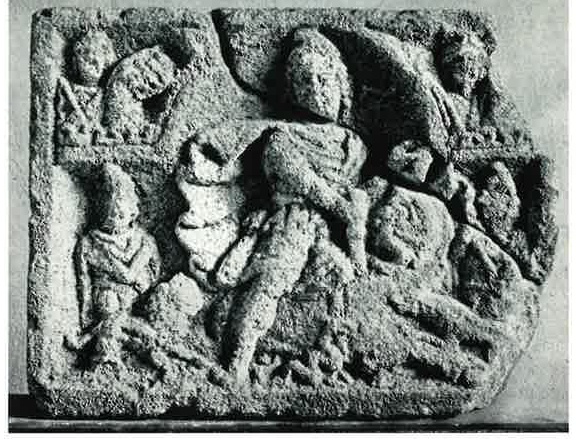
Bachern marble tauroctony relief from the Mithraeum at Pohanica, Noricum, notable for the prominent inclusion of a lion entering from the left — an unusual compositional element — alongside the standard dog, serpent, and torchbearers.
Left upper corner of a sandstone tauroctony relief from Celje, ancient Celeia in Noricum, preserving the bust of Sol, the head of a torchbearer, and the head of Mithras himself.
Small marble head in Phrygian cap of unknown provenance, associated with the Waggendorf find-group, Noricum; may represent Attis or Mithras.
Small marble head from Saifnitz, Noricum, wearing a Phrygian cap; possibly representing Attis or a Mithraic torchbearer.
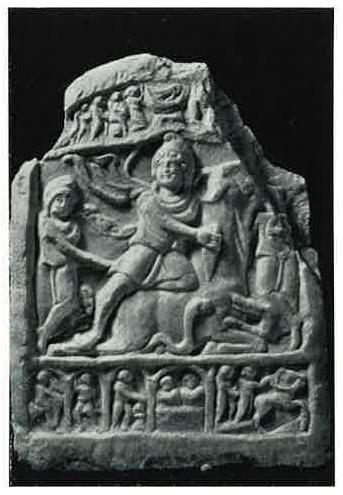
Small limestone tauroctony relief from Enns, ancient Lauriacum in Noricum, found about 100 metres east of the north-east corner of the castra, depicting Mithras killing the bull with dog and serpent and flanking torchbearers.
Carbonised plant remains (4,210 g) from the third room of the Mithraeum at Linz, ancient Lentia, comprising vine, prunes, hedge- and cornelberries, apple pips, walnuts, and millet; interpreted as a ritual food offering to the god.

Three-fragment terracotta plate from the Mithraeum at Linz, ancient Lentia, with a seven-hole border and a graffito in the centre invoking Iupiter Optimus Maximus; found in the second room of the sanctuary.
Pottery assemblage from the cult room of the Mithraeum at Linz, ancient Lentia, including glazed dishes, three-handled serpent-vases, and related fragments; a vessel type closely associated with Mithraic ritual in the Danubian provinces.
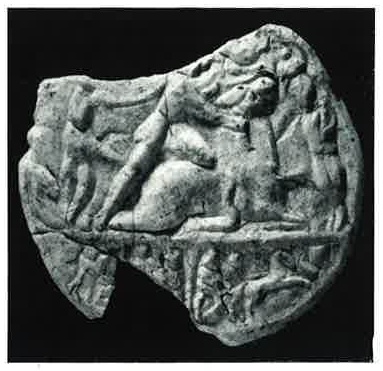
Small circular marble tauroctony relief from the Mithraeum at Linz, ancient Lentia, depicting Mithras killing the bull with dog, serpent, and scorpion, flanked by cross-legged torchbearers with a lion behind Cautopates; the lower section is divided into three subsidiary scenes…
Small Phrygian-capped head of Mithras from the Mithraeum at Moosham, Noricum, probably belonging to the cult relief.
Marble epistylium in three fragments from the Mithraeum at Moosham, Noricum, decorated with a central tree, a flying hind pursued by a dog and an Amazon, a walking lion, and a horseman; bearing an identical inscription on both lateral tabulae.
Life-sized sandstone head with long curly hair and Phrygian cap, found at the foot of the Hohenklingen near Stein am Rhein, Raetia; probably belonging to a statue of Cautes or Cautopates.
Limestone statue fragment from Nyon, ancient Colonia Iulia Equestris, depicting a lion encircled by a serpent with schematic scorpions engraved in small triangles on each flank; a composition associated with Mithraic lion symbolism.
Underground oblong room at Nyon, ancient Colonia Iulia Equestris, situated on the edge of a second Forum dating to the second half of the first century AD, with a series of pillars along the side walls consistent with Mithraic architecture; its interpretation as a Mithraeum remains tentative…
Dark-red clay vase from the refuse pit of the Roman camp at Windisch, ancient Vindonissa, with three handles each encircled by a coiling serpent; a vessel type closely associated with Mithraic ritual.
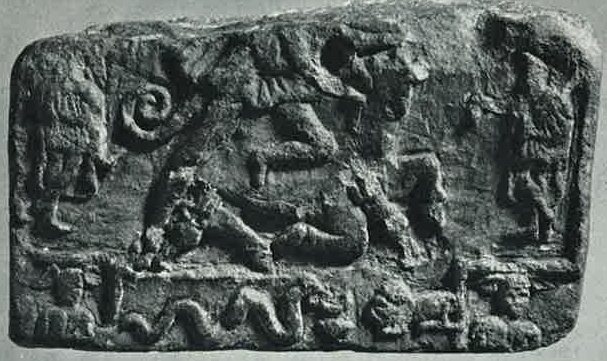
Small limestone tauroctony relief from Augst, ancient Augusta Rauricorum, depicting the bull-slaying with dog and scorpion, flanked by cross-legged torchbearers in Oriental dress; Cautes holds a pedum alongside the upraised torch.
Round perforated bronze plaque from Augst, ancient Augusta Rauricorum, bearing a dedication of an aurichalcum image of Sol to Deo invicto; interpreted by Cumont as evidence for identifying the dedicatee as Mithras.
Two fragments of a sandstone inscription from Gran in the Vosges, dated to the late second century, recording a dedication to Soli deo invicto by a servant of the dedicant, with possible mention of a portico and columns.
