Your search San Giovanni al Timavo gave 3665 results.

A fragmentary inscription from Scaleby Castle near Cambeckfort (ancient Petrianae), preserving a partial dedication to Sol Mithras.
An altar mentioned by Stukeley as being kept in his garden at Stanford (ancient Hattwifel), bearing the inscription Deo Soli Invicto.
A small ara from Longovicium (modern Lancaster), bearing a fragmentary dedication to the Invincible God and decorated on the left side with a relief of a boar.
A small altar from Longovicium (modern Lancaster), bearing a brief inscription dedicated to Deus Mithras, Cautopates and Sol Invictus.
A large inscription from Olisipo (modern Lisbon), recording a dedication to the Eternal Sol and Luna for the perpetuity of the empire and the welfare of Septimius Severus, Caracalla and Geta, executed under the supervision of Drusus Valerius Coelianus and others, dated to the Severan period…

San Zeno is a locality near Tuenno in the Val di Non, where Mithraic material attributed to Roman Raetia was discovered.
An altar found not far from the eastern entrance of the cult-room at Borcovicium (modern Housesteads), bearing a brief dedication to Deus Sol.
An altar found in 1822 at Borcovicium (modern Housesteads), recording a vow fulfilled by Valerianus, a soldier of the Sixth Victrix Legion, to Cocidius and the Genius of the garrison.
Ceramic finds from both excavations of the Mithraeum at Borcovicium (modern Housesteads), comprising red and thin black-glazed pottery fragments together with a silver coin of Faustina Minor, indicating the sanctuary was in use before 253 A.D. and was most likely destroyed by fire…
A group of four altars from the Mithraeum at Borcovicium (modern Housesteads): two found in 1822 bearing inscriptions Nos. 863 and 864, and two more found in 1898, one dedicated to Mars and Victoria (No. 865) and one to Cocidius (No. 866), the last possibly belonging to an adjacent shrine…
An altar found in the north-east corner of the main room of the Mithraeum at Borcovicium (modern Housesteads) in 1822, bearing on its capital the bust of Sol in a crown of seven rays and the inscription No. 859.
A small marble statuette of naked Mercury from the Mithraeum at Walbrook in London, sitting on a rock with the stumps of wings in his hair and a purse in his left hand, with a ram lying at his feet beside which is a tortoise.
A marble head of a woman from the Mithraeum at Walbrook in London, originally crowned with a diadem.
A fragment of a circular plaque from the Mithraeum at Walbrook in London, showing the Danubian horsemen and leaping dogs.
A marble torso of a male figure from the Mithraeum at Walbrook in London, flattened at the back, probably one of the attendant deities of Mithras, which would have stood about 2 ft. in complete height.
A relief fragment from the Mithraeum at Walbrook in London, preserving the lower part of a cross-legged figure of Cautopates pointing his torch downwards.
A fragment of a white marble statue from the Mithraeum at Walbrook in London, preserving the naked torso of a reclining figure with long hair and beard, with the end of a staff visible near his left shoulder, identified as Oceanus.
A white marble statue from the Mithraeum at Walbrook in London, depicting Bonus Eventus standing in a long hanging cloak, leaning on a ship's stem, holding a cornucopia against his shoulder and a patera above a burning altar from the back of which a…
Sculptural fragments from the Mithraeum at Augusta Emerita (modern Mérida), comprising a naked foot beside tree-trunk remnants and fragments of a marble seat or table decorated with an acanthus-leaf from which emerge the head and neck of a lion.
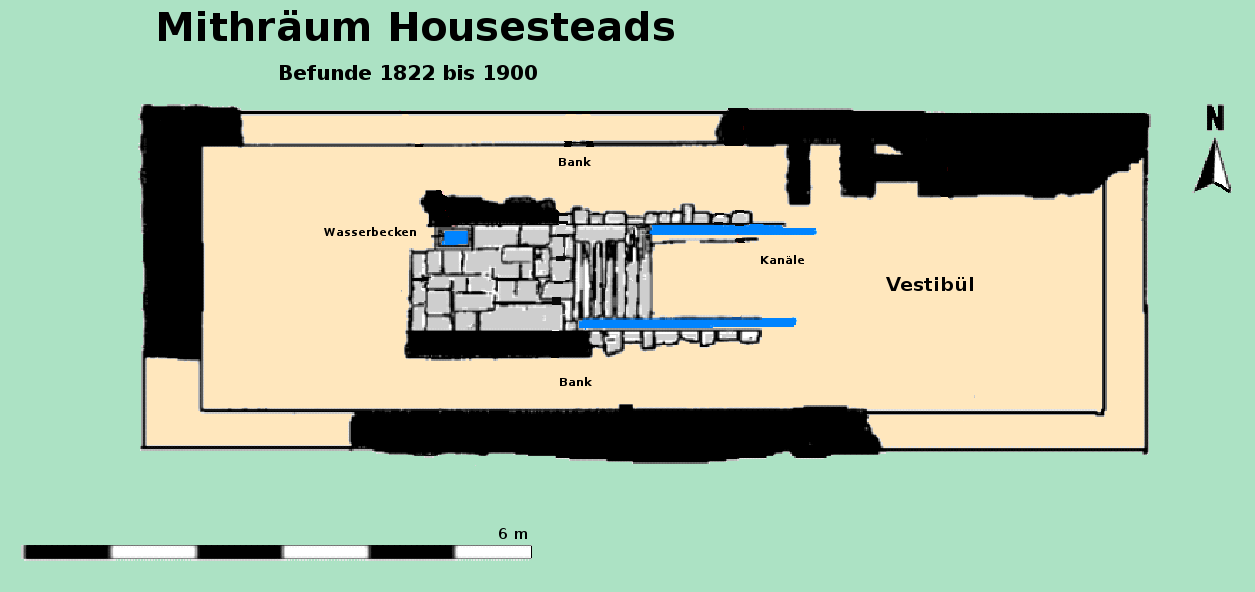
The Housesteads Mithraeum is an underground temple, now burried, discovered in 1822 in a slope of the Chapel Hill, outside of the Roman Fort at the Hadrian's Wall.
