Your search Sidi Ali Belkacem (سيدي علي بلقاسم) gave 1194 results.

Two painted decorative phases from the Santa Prisca Mithraeum whose figures became clearer after later conservation work.
Fragmentary relief from the area of the Porticus of Pompey once interpreted as Mithraic but later identified as a representation of Victoria.
Archaeological remains connected with the Praetorian camp and the presence of Mithraic worship among the imperial guard.
Marble inscription discovered near the Via Cupa mentioning an offering to the invincible Mithras by Apollonius Tetes Syras of Marcianopolis.
Inscription now preserved in the Palazzo Ducale of Urbino whose wording may point to the existence of a Mithraic community.
Series of small bronze plaques depicting zodiac signs and planetary figures discovered in Ostia and possibly connected with the decoration of a Mithraic sanctuary.
Relief featuring an enigmatic agricultural implement interpreted either as a scythe or an early type of plough.
Fragment of a small altar from Ljubljana, ancient Emona in Pannonia Superior, preserving a dedication to Invicto Mithrae by a dedicant whose name ends in -quartus; the Mithraic attribution is not entirely certain.

Painted Parthian inscription on a ceramic sherd possibly referring to Mithras as a bull-slayer.
Greek ritual graffito scratched on wall plaster in the Mithraeum of Dura-Europos, mentioning the “fiery exhalation” and the “sacred nitre” of the Magi.
Fragmentary Greek graffito from Dura-Europos recording the prices of everyday goods such as wine, meat, wood and lamp wicks.
A probable Mithraic sanctuary near Santa Maria in Domnica on the Caelian Hill, known from a group of dispersed reliefs formerly owned by Ottaviano Zeno.

In this relief of Mithras as bull slayer, recorded in 1562 in the collection of A. Magarozzi, Cautes and Cautopates have been replaced by trees still bearing the torches.
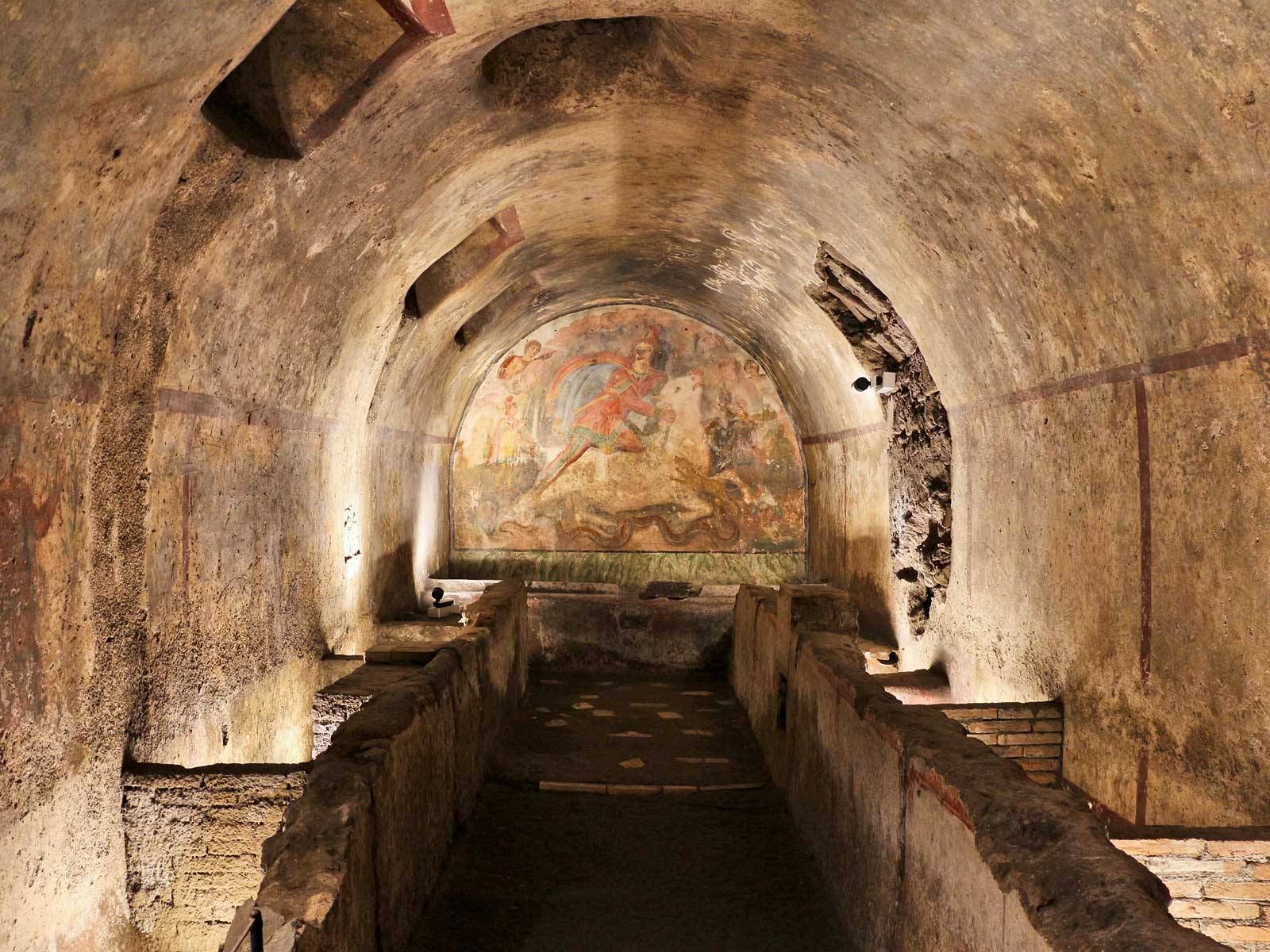
One of Roman Italy’s most important Mithraic sanctuaries, the Mithraeum at S. Maria Capua Vetere preserves a remarkable painted cycle of initiation scenes, offering rare visual evidence for the ritual life of Roman Mithaism.
This marble tablet found at Portus Ostiae mentions a pater, a lion donor and a series of male names, probably from a Mithraic community.
,_found_in_Rome,_2nd_century_AD,_British_Museum_(15545876047).jpg)
The sculpture of Mithras slaying the bull was transported from Rome to London by Charles Standish in 1815.
This small Greek dedication from the island of Aenaria invokes Helios Mithras under the epithet “unconquered”.
This marble dedication from Puteoli was offered to Sol Invictus and the genius of the colony by Claudius Aurelius Rufinus together with his wife and son.
This lost Mithraic relief, formerly kept near the church of the Santissima Annunziata in Naples, was probably a large tauroctony associated with the area of Puteoli or Pausilypon.
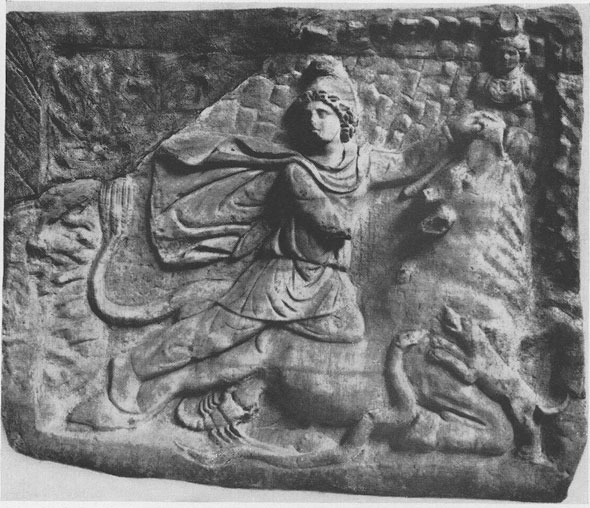
This marble tauroctony relief, probably originating from Naples, depicts Mithras slaying the bull within a cave-like setting, accompanied by the usual animals and celestial busts.
