Your search St Albans gave 2750 results.

Two female stone heads of varying sizes, found in the Mithraeum at Pons Saravi (modern Saarburg) in Belgica.
A bronze statuette of a lion with an open mouth, in which a hole connects to another hole in the stomach, suggesting use as a fountain or conduit, from the Mithraic sanctuary at Angleur near Liège in Belgica.
A bronze statuette of a standing naked youth wearing a necklace and with outstretched hands, the thumb of the right hand touching the index finger, with a hole in the back for fastening, possibly representing Apollo, from the Mithraic sanctuary at Angleur near Liège in Belgica…
Two bronze statuettes of youthful women in flying cloaks with outstretched hands holding an object, possibly representing the Seasons, from the Mithraic sanctuary at Angleur near Liège in Belgica.
A torch end held by a hand in the pose of a dadophore, and another hand holding a small offering, found at the south-east cemetery adjacent to the Mithraeum of Les Bolards (ancient Venetonimagus) in Lugdunensis.
Three epigraphical fragments that together form the word magister, with traces of fire, found at the Mithraeum of Les Bolards (ancient Venetonimagus) in Lugdunensis.
A fine white marble bust of Venus, a head of a helmeted deity possibly Minerva, small female heads, and bronze eye-plaques analogous to those from the temples of Sequana and Apollo Vindonnus, found at the building south-west of the Mithraeum at Les…
Fragmentary remains of a statuette of Cautopates in a short tunic, including a thigh, knee, and hand holding the end of a torch, found near the entrance of the Mithraeum at Les Bolards (ancient Venetonimagus) in Lugdunensis.
A white marble statuette of Cautes, dressed in a long cloak and raising his torch with both hands without being cross-legged, found near Eauze (ancient Elusa) in the Armagnac region of Aquitania.
A sandstone bowl and a large part of a stone laver or washing bowl from the Mithraeum at Walbrook in London, ritual vessels forming part of the sanctuary's furnishings.
A small marble statuette of naked Mercury from the Mithraeum at Walbrook in London, sitting on a rock with the stumps of wings in his hair and a purse in his left hand, with a ram lying at his feet beside which is a tortoise.
A white marble statue from the Mithraeum at Walbrook in London, depicting Bonus Eventus standing in a long hanging cloak, leaning on a ship's stem, holding a cornucopia against his shoulder and a patera above a burning altar from the back of which a…
A fragmentary epistyle from Aquileia preserving part of the inscription [Deo In]victo [Mi]th[rae], indicating the presence of a Mithraic sanctuary in the city.
An inscription from Aquileia recording a vow fulfilled to Sol Invictus Mithras by C. Calidius Agathopus, a member of the college of the seviri Augustales of Aquileia.

Housesteads Roman Fort is the remains of an auxiliary fort on Hadrian's Wall, at Housesteads, Northumberland, England, south of Broomlee Lough.
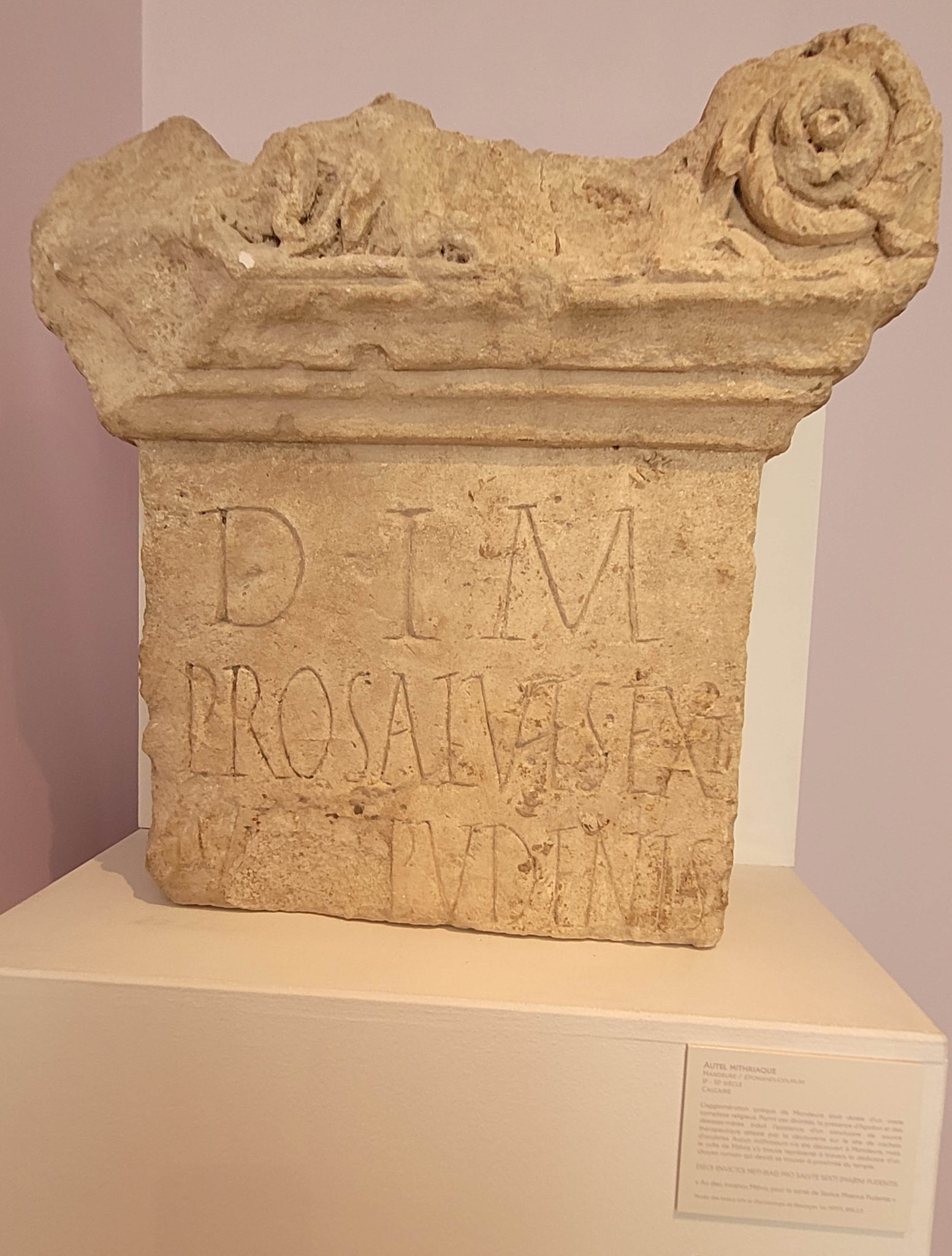
Stela dedicated to Mithras Invictus, found in 1895–1896 at Epamantodurum (modern Mandeure), in the territory of the civitas Sequanorum (Gallia Belgica). The inscription records a vow to Mithras Invictus made for the welfare of Sextus Maenius Pudens.
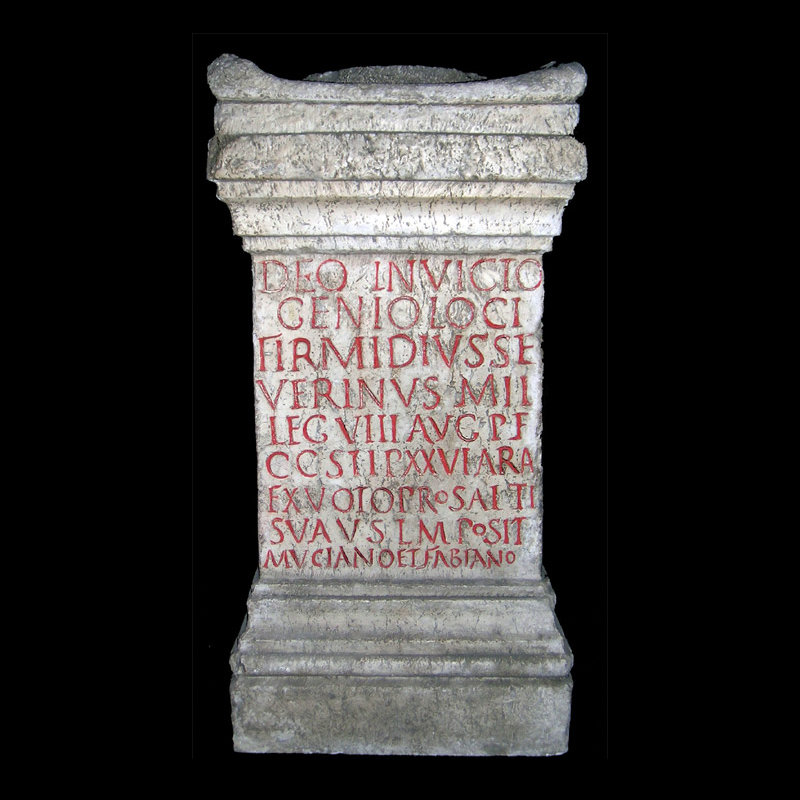
This limestone altar bears an inscription from its donor, Firmidius Severinus, in honour of Mithras after 26 years of service in the Legio VIII Augusta.
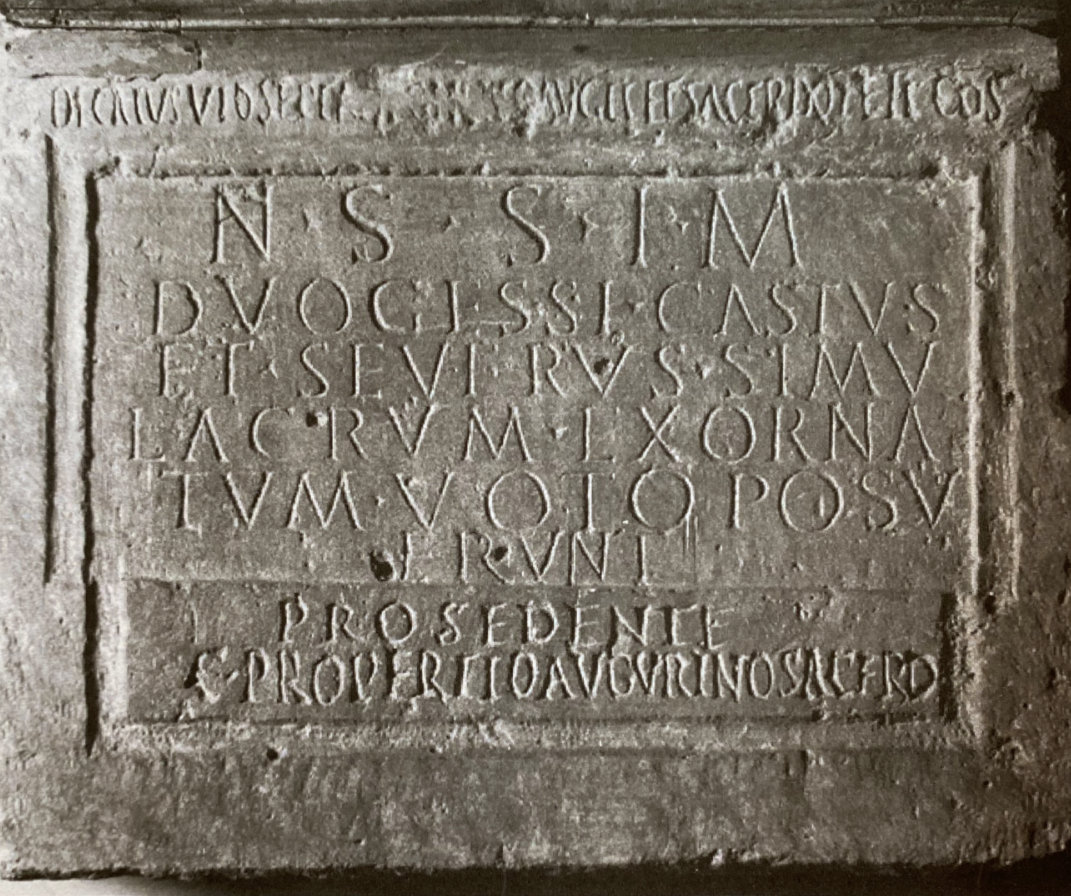
Gessius Castus and Gessius Severus have placed a decorated stutue and left testimony on this inscription below.
A subterranean room with a stucco depiction of Mithras slaying the bull, probably from the fourth century, discovered at Agurzano near Ponte Mammolo on the Via Tiburtina outside Rome.
A marble funerary cippus from the Vigna Dionigi at Torre Pignatara outside Rome, dedicated to Sextineius Restitutus as most indulgent pater sacrorum by his children and mother, with a crown carved to the left of the final line.
