Your search St Albans gave 2762 results.
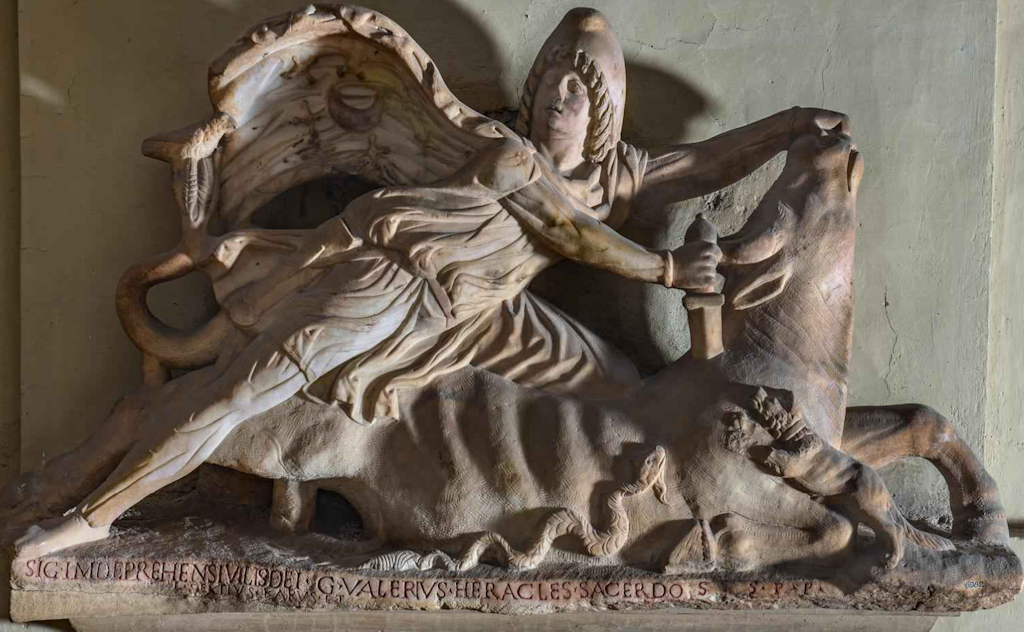
This sculpture of Mithras killing the bull was dedicated to the “incomprehensible god” by a certain priest called Gaius Valerius Heracles.

The Fagan Mithraeum, also known as the Mithraeum of Tor Boacciana, yielded remarkable sculptures of lion-headed deities, several of which are now preserved in the Vatican Museums.
The Sacello delle Tre Navate near the Therms of the Sette Sapienti at Ostia, whose identification as a Mithraeum remains uncertain, with a decorated cult-niche but lacking typical Mithraic iconography.

Marble relief fragments from the cult niche of the Mitreo della Planta Pedis at Ostia, preserving the bust of Sol in radiate crown, the raven's tail, the bust of Luna in crescent, and parts of the rocky border.
Mosaic-paved floor of the central aisle of the Mitreo delle Sette Porte at Ostia, with a krater flanked by serpent and eagle, standing Jupiter and Saturn, torchbearers at the podia, and planetary gods Mars, Luna, Venus, and Mercury.
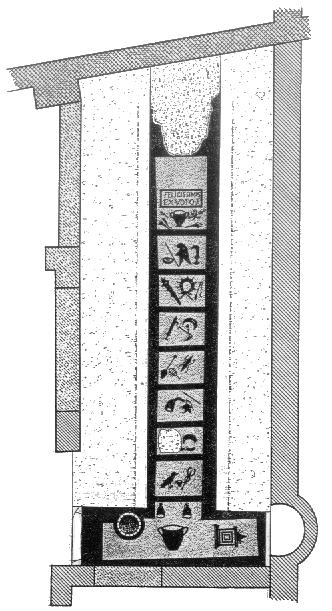
The Mithraeum Felicissimus has a floor mosaic depicting the seven mithraic grades.

Marble torso found at Ostia in 1912 between the Decumanus and the Via dei Molini, dedicated to Mithras by a certain Atilius Glyco.
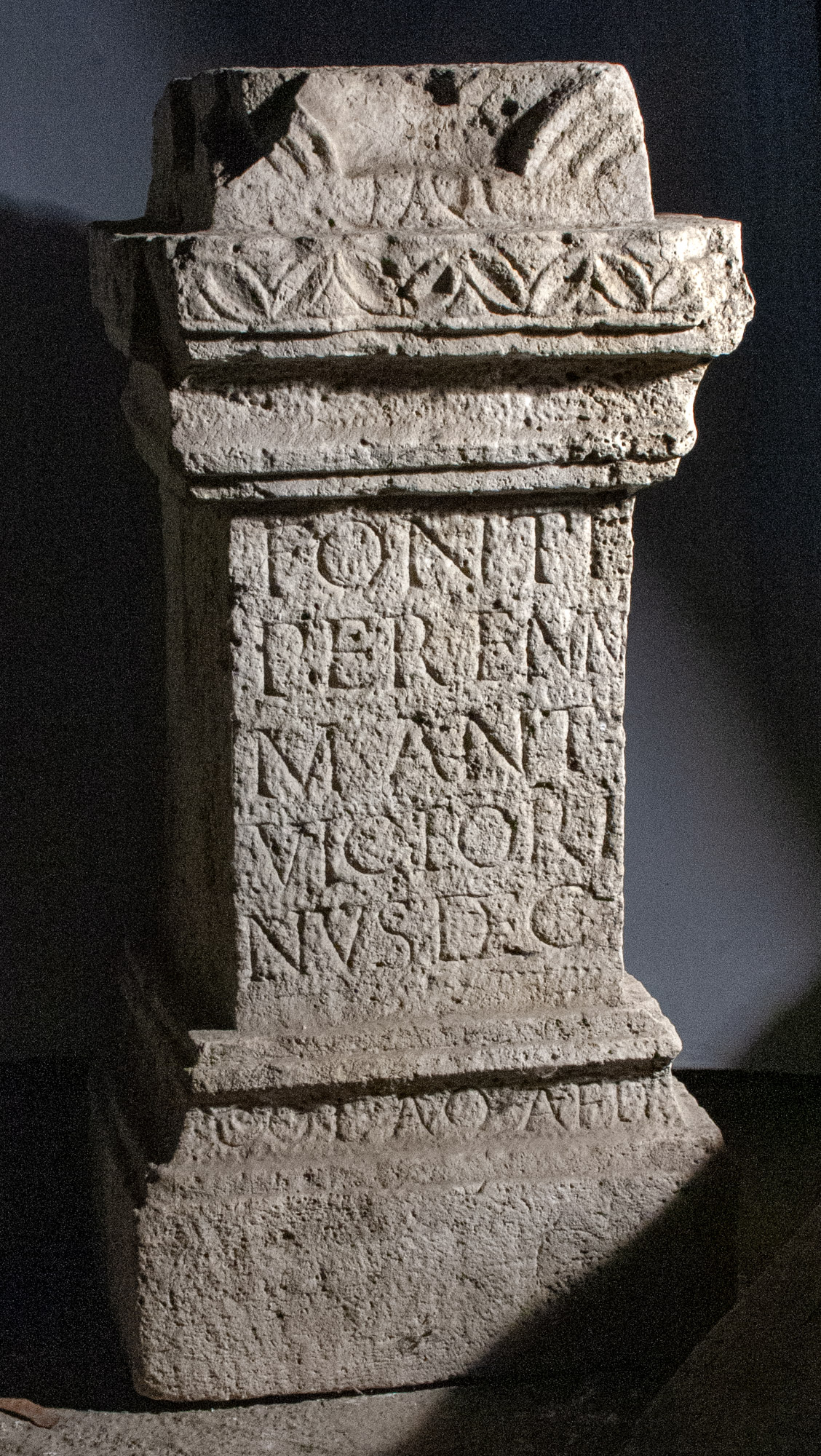
One of several dedications commissioned by the duumvir Marcus Antonius Victorinus in his Mithraeum of Aquincum, modern Budapest.

The last pagan emperor of Rome, closely associated with Mithras and Neoplatonic interpretations of the Sun God.
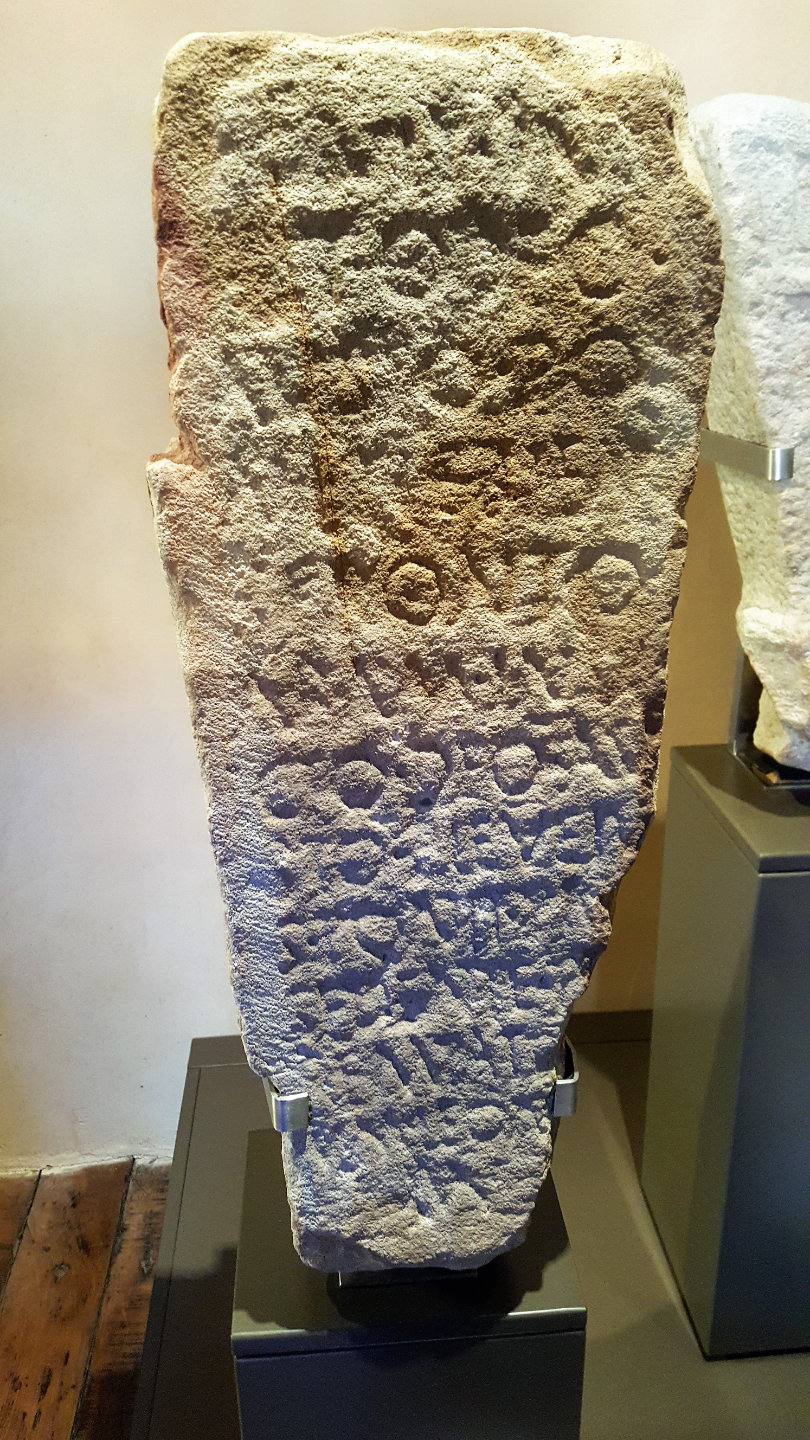
The monument of San Juan de la Isla (Asturias) devoted to Mithras was preserved in the portico of the main church until 1843.
Graffito on a wall of the Caseggiato del Sole adjacent to the Mitreo dei Serpenti at Ostia, reading "Dominus Sol hic avitat" (Lord Sun dwells here).
Small bronze statuette in Phrygian cap from Catunele de Motru, Dacia, possibly a torchbearer; the Mithraic attribution is not certain as no torch survives.
Two marble frieze fragments with incised busts of Sol, Luna, Mars, Jupiter, and Venus, one found in 1890 in the outer porticus of the Theatre and one found in 1938 near the Mithraeum at Ostia.
Base in the form of an altar with five small bacchic herms and eleven lamps, from the Mitreo Sabazeo at Ostia.
Inscription dedicated to Sol Invictus, Omnipotent and Holy Caelestis, with Fortuna Lares and Tutelae, found near the Mitreo Sabazeo at Ostia, dedicated by Venerandus.
Inscription dedicated to the Numen Caelesti by P. Clodius Flavius Venerandus, sevir augustalis, who acted in response to a dream, from the Mitreo Sabazeo at Ostia.
Marble slab with a vow to Iuppiter Sabazius made by imperial command, dedicated by L. Aemilius, from the Mitreo Sabazeo at Ostia.
Marble slab recording the exedra of Arpocrates, reused in the pavement of the floor of the Mitreo Sabazeo at Ostia.
Small undecorated altar of travertine without inscription, from the Mitreo dei Serpenti at Ostia.
Fragments of a green-glazed maiolica krater with silver sheen, probably decorated with a dodekatheon showing Minerva, Jupiter, Dionysus, and Hercules, from the Mitreo delle Sette Porte at Ostia.
