Your search Stein am Rhein gave 2070 results.
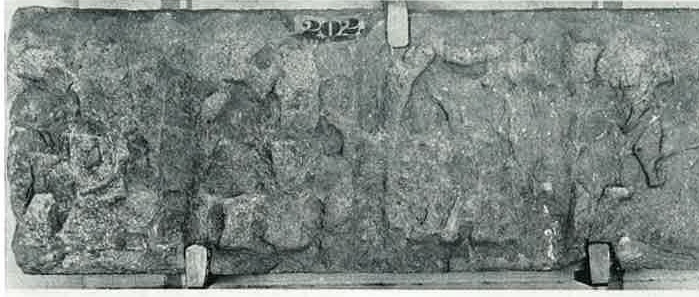
Badly damaged red sandstone relief from Hölzern, Germania Superior, depicting the standard bull-slaying scene; possibly forming part of the border zone of a larger composition.

Small yellow sandstone fragment from the Mithraeum at Dieburg showing the foremost part of an animal, probably a dog or ram, with head turned right
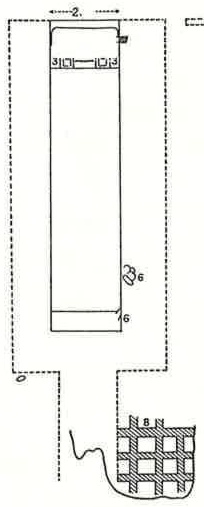
Mithraic sanctuary discovered behind the west part of a Roman cemetery near the camp at Gross-Krotzenburg in 1881, finds destroyed in World War II
Fragmentary ceramic mould preserving the lower part of a cross-legged Mithraic torchbearer.
Decorated ceramic vessel showing Mithras slaying the bull together with torchbearers, zodiacal motifs and figures of abundance.
A marble statue fragment found at Sentinum (modern Sassoferrato) in ancient Umbria, walled in the atrium of the Palazzo Raccamadoro-Ramelli, showing Mithras tauroctone with dog, serpent and scorpion, one foot pointing towards a torchbearer; the bull's head, tail and Mithras'…
A badly damaged marble torso from Rome, carved from Luna marble, possibly representing a Mithraic torchbearer dressed in tunic, long cloak and anaxyrides.
Marble base formerly in the Villa Negroni and then the Museo Borgia at Velletri, with bas-reliefs on three sides showing Sol in a quadriga, initiates in Oriental dress and other Mithraic scenes; the collection is now dispersed among museums in Naples and Rome…
Marble altar from the gardens of the Villa Giustiniani near Porta Flaminia, dedicated to Sol Invictus Mithras as a votive offering by Vestalis, servant of the Caesars, and C. Vettius Augustalis.
Marble cippus from the Villa Giustiniani near Porta Flaminia with a dedication to Sol Invictus Mithras by M. Aurelius Euprepes, erected after a vision through the presidents Bictorinus pater and Ianuarius, dated to 184 A.D.
Base of bluish marble formerly in the Villa Giustiniani near Porta Flaminia and now in the Vatican Musea, Cortile della Pigna, with a round pedestal encircled by a bearded crested serpent biting its own tail, probably supporting a statue of Aion.
Miscellaneous small finds from the S. Prisca Mithraeum including a marble mortar, pieces of glass, plates, dishes and lamps dating from the first four centuries A.D.
Under-layer wall-paintings in the S. Prisca Mithraeum on the Aventine showing a further procession of Mithraic initiates in different colours, with partially legible dipinti including liturgical verses and acclamations.
Small marble base apparently found in the same Aventine sanctuary during former excavations, with a dedication to Jupiter Optimus Maximus Dolicheno and Sol digno praestantissimo.
Marble statue of Venus entirely naked in the act of leaving her bath, wringing her hair which streams over her shoulders, with a dolphin by her side, found in the small room of the Caracalla Mithraeum; the head is lost.
Bust of a man in lorica and paludamentum from the Mithraeum at the Palazzo dei Musei, Rome; the head is lost.
Fragment of a small white marble relief showing Cautes in tunica manicata and long cloak with an upraised flaming torch, from the Mithraeum at the Palazzo dei Musei, now at Via Portico d'Ottavia 29, Rome.
Marble statue of the naked Mithras emerging from the rock, holding a dagger in his right hand and a torch in his left, visible to the knees, from the Mithraeum of S. Lorenzo in Damaso; the head is lost.
Marble statue of Cautopates in Eastern attire, cross-legged, leaning against a trunk and rocky stone with a cock beside his left foot, from the Mithraeum of S. Lorenzo in Damaso; the greater part of his arms and torch are lost.
Fragments of a marble relief preserving only the lower part, with Mithras slaying the bull, dog and serpent licking blood, a large scorpion, and Cautopates behind the bull pointing his torch downwards, from the Mithraeum of S. Lorenzo in Damaso.
