Your search Tulln an der Donau gave 577 results.


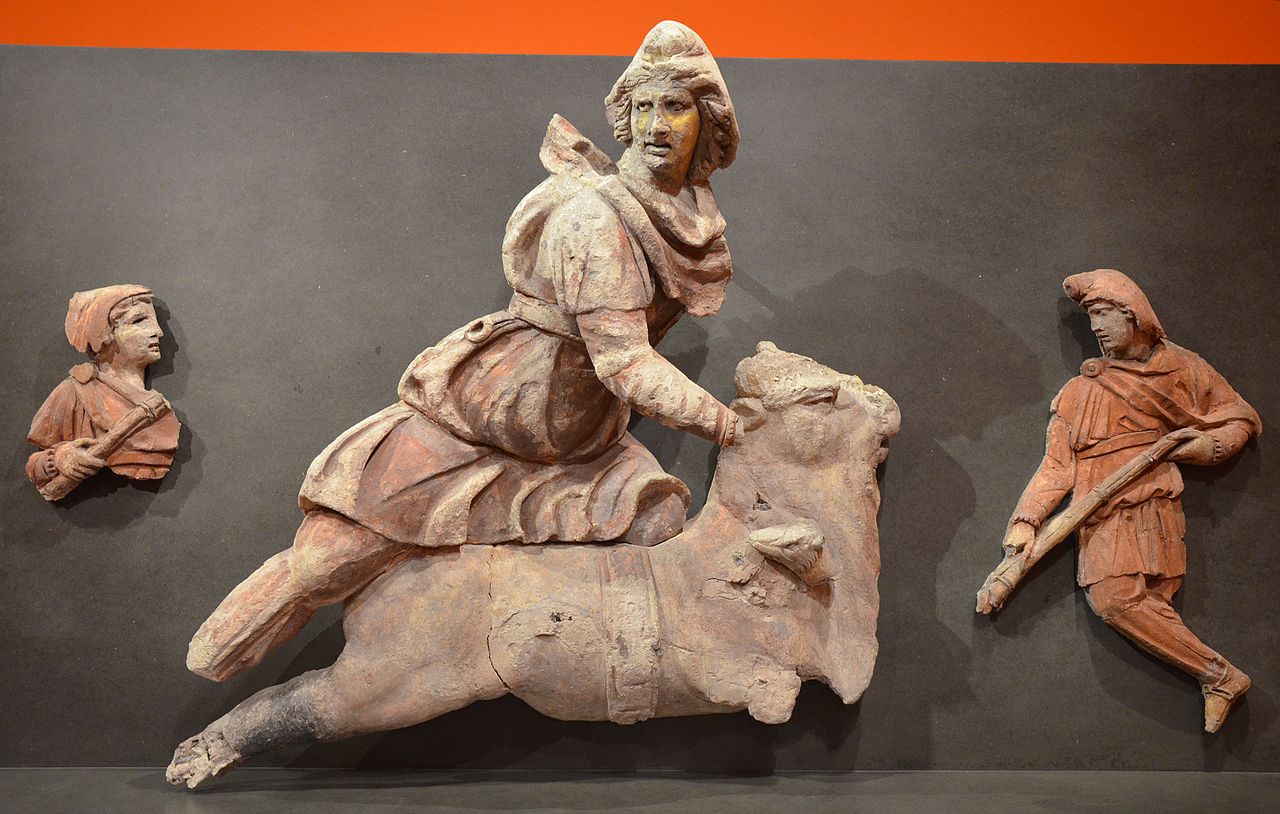
This relief was found under the Palazzo Montecitorio, in Rome, and bought by the Liebighaus at Frankfort.


India, beyond all other countries on the face of the earth, is preeminently the home of the worship of the Phallus—Linga puja. It has been so for ages and remains so still.

Pater of the Mithraeum of Lucretius Menander at Ostia, honoured by a dedication from Diocles in the late second or early third century CE.

A votive altar dedicated to Deus Invictus Mithras by Paterna, among the few women explicitly associated with Mithraic worship.
Fragment of a sandstone relief from Nida-Heddernheim depicting the torchbearer Cautopates.

The Neusiedl lake region formed part of the western frontier landscape of Roman Pannonia.
A large inscription from Olisipo (modern Lisbon), recording a dedication to the Eternal Sol and Luna for the perpetuity of the empire and the welfare of Septimius Severus, Caracalla and Geta, executed under the supervision of Drusus Valerius Coelianus and others, dated to the Severan period…
An inscription recording the completion and dedication of the Temple of Sol at Como by T. Flavius Postumius Titianus, corrector of Italy, by order of the emperors Diocletian and Maximian, with Axilius the Younger as curator of the city of the Comenses.
Two embroidered pieces from an Egyptian grave, dated to the early centuries AD, now in the Benaki Museum in Athens, depicting a Mithraic procession with figures on horseback and attendants.
Fragment of the border of a marble vase from Axiopolis, Moesia Inferior, bearing an inscription dedicated to Deo Soli invicto Mithrae.
Limestone altar from Stojnik, Moesia Superior, found at a house at Guberevci, dedicated to Deo Mithrae Soli for the welfare of Emperor Severus Alexander.
Two fragments of a larger circular marble relief from the Mithraeum at Linz, ancient Lentia, preserving only the legs of the torchbearers and the outer border, with subsidiary scenes including the rock-birth and an ibex.
Fragmentary head wearing a Phrygian cap discovered with a Mithraic relief.
Marble stele relief with bull-slaying scene and subsidiary Mithraic episodes including the sacred banquet.
Under-layer wall-paintings in the S. Prisca Mithraeum on the Aventine showing a further procession of Mithraic initiates in different colours, with partially legible dipinti including liturgical verses and acclamations.
