
Biography
of Gaius Lucretius Menander
- Gaius Lucretius Menander, a freedman, is attested as a Pater at the Mitreo di Lucrezio Menandro.
- Attested at Ostia, Latium, Italia in early 3rd century (TNMM 534).
TNMP 162
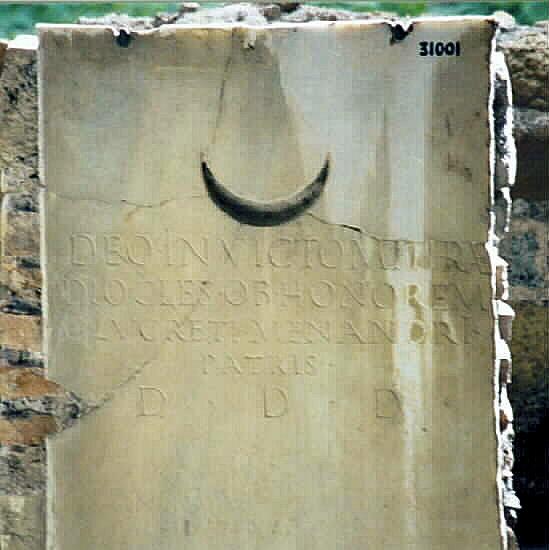
Caius Lucretius Menander is known from a marble inscription attached to the masonry altar of the Mithraeum of Lucretius Menander at Ostia. The dedication records that a man named Diocles offered and dedicated the monument ob honorem C(ai) Lucreti Menandri, patris, explicitly identifying Menander as a pater, the highest attested grade within the Mithraic hierarchy. The inscription reads: Deo Invicto Mithrae / Diocles ob honorem / C(ai) Lucreti Menandri / patris / d(onum) d(edit) d(edicavit), “To the Unconquered God Mithras. Diocles gave and dedicated this gift in honour of Caius Lucretius Menander, pater.” The monument was installed on the front of the principal altar positioned against the rear wall of the sanctuary and is generally dated between the last quarter of the second century and the beginning of the third century CE.
The onomastic evidence suggests that Menander was probably a freedman of Greek origin. Marchesini has noted that both the dedicant Diocles and the pater bear Greek names, with Diocles likely being a slave and Menander a freedman. The altar itself incorporated a crescent-shaped opening aligned with a cavity inside the structure, apparently designed to hold a lamp whose light would shine through the lunar aperture during ritual activities. Similar lighting devices are known from several other Ostian mithraea, including those of the Casa di Diana, the Sette Porte and the Pareti Dipinte.
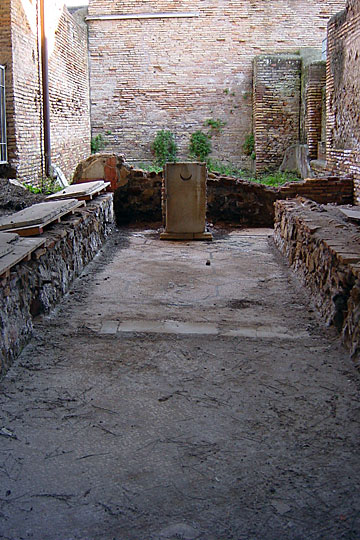
Menander’s importance extends beyond the inscription itself. The sanctuary takes its modern name from the adjacent Caseggiato di Lucrezio Menandro, within which the mithraeum was established through a substantial reorganisation of existing domestic spaces. The inscription honouring him is the principal evidence for the community’s leadership and confirms the presence of an organised Mithraic congregation under a pater during the final decades of the second century or the opening years of the third century CE.
References
- Ostia-Antica.org (2021) Regio I - Insula III - Mitreo di Menandro (I,III,5).
Attestations
Altar of the Mitreo Menandro
TNMM 534
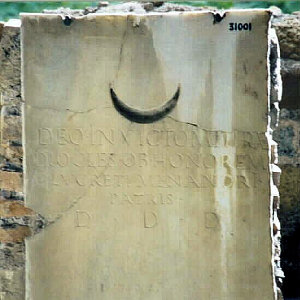
The brick altar of the Mithraeum Menander was covered with marble slabs bearing a crescent and an inscription.
Mitreo di Lucrezio Menandro
TNMM 6
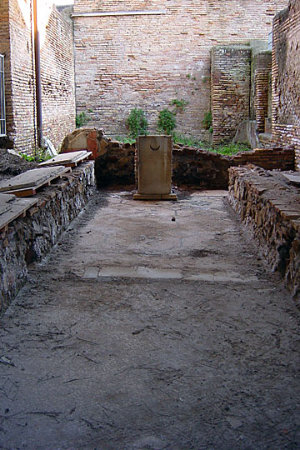
The Mithraeum of Lucretius Menander was installed in the early 3rd century in an alley to the east of a Hadrianic building named after the solar god temple.
