
Biography
of Anttiocus
- Anttiocus is attested as a member of a Mithraic community (syndexios) at the Mithréum des Bolards.
- Attested in the 3rd century.
- Attested at Les Bolards, Lugdunensis, Gallia (TNMM 451).
TNMP 34
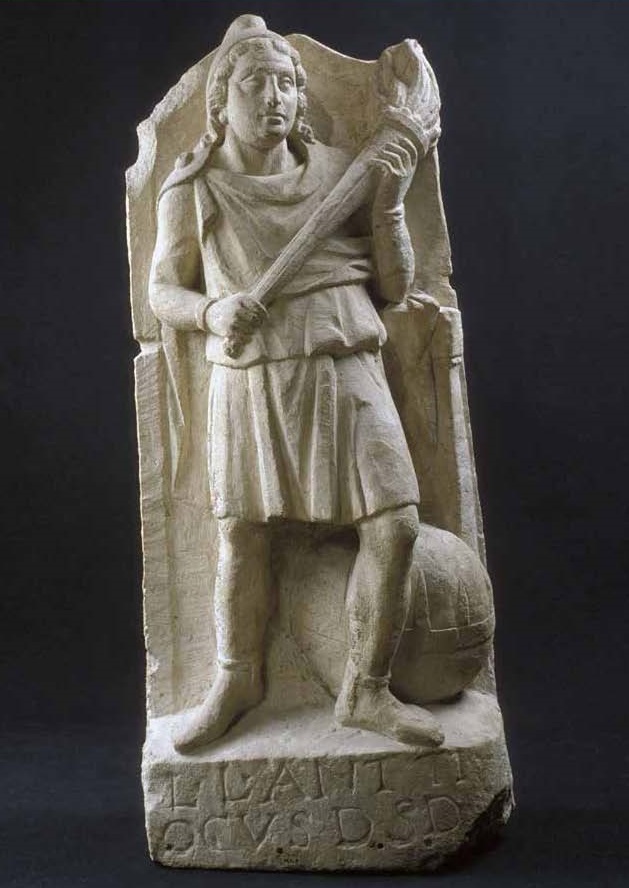
Anttiocus was a Mithraic dedicant active at the sanctuary of Mithras at Les Bolards, near Nuits-Saint-Georges in Gallia Lugdunensis, probably during the 3rd or 4th century CE. He is known solely from a brief inscription engraved on the base of a limestone statue representing the torchbearer Cautes, discovered inside the mithraeum during the excavations conducted between 1932 and 1939 and later investigated by Émile Thévenot.
The inscription reads:
L(ibens) l(aetus) Anttiocus d(e) s(uo) d(edit).
The text states that Anttiocus dedicated the monument willingly and joyfully, and at his own expense. The statue, carved in local limestone, depicts Cautes standing upright with uncrossed legs, raising a flaming torch with both hands. Behind the figure appears a spiked globe, a rare astral attribute associated with solar and cosmic symbolism within Mithraic iconography.
The name Anttiocus, written with an unusual double T, was already noted by Thévenot as an irregular spelling (sic!). Modern scholars generally interpret the name as being of eastern Mediterranean, possibly Syrian, origin, while the orthographic anomaly probably reflects the poor literacy of the stone-cutter rather than a genuine variant of the name Antiochus. Thévenot regarded the inscription as evidence for the presence of eastern elements within the religious milieu of Les Bolards.
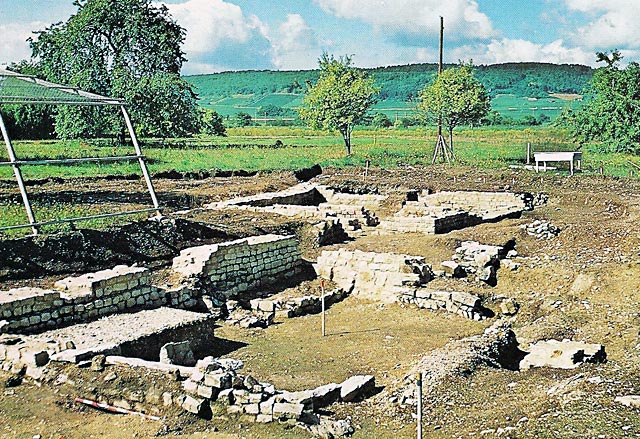
The mithraeum itself formed part of a broader sacred and commercial complex situated near one of the principal communication routes of Roman Gaul, linking Lyon with Trier and Cologne. The sanctuary appears to have been partially subterranean, with an eastern entrance, western apse, lateral benches and annex spaces possibly connected with instruction or initiation rituals. Archaeological evidence suggests that the cult site flourished from at least the reign of Commodus until the late 4th century CE.
Although nothing else is known about Anttiocus, his dedication offers a glimpse into the cosmopolitan and mobile character of Mithraic communities established along the roads of Roman Gaul, where local traditions, long-distance trade and eastern religious influences intersected.
Attestations
Cautes from Les Bolards
TNMM 451
This monument representing Cautes with uncrossed legs was consecrated by a certain Anttiocus.
Mithréum des Bolards
TNMM 81
The Mithraeum des Bolards was integrated into a therapeutic cultural complex related to healing waters.
