This site uses cookies to offer you a better browsing experience.
Find out more on how we use cookies in our privacy policy.

 
Region

Mithras in Gallia

Roman Gallia preserves one of the largest and most geographically diverse corpora of Mithraic evidence in the western empire.

The Mithraic evidence documented in Roman Gallia reflects the strong implantation of the cult across urban centres, military environments and major communication routes linking the Rhine frontier to the interior of Gaul. The region preserves a particularly rich body of monuments, inscriptions and mithraea illustrating the western development of Mithraic communities.
Mithraic monuments of Gallia


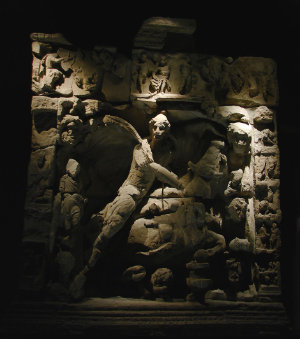
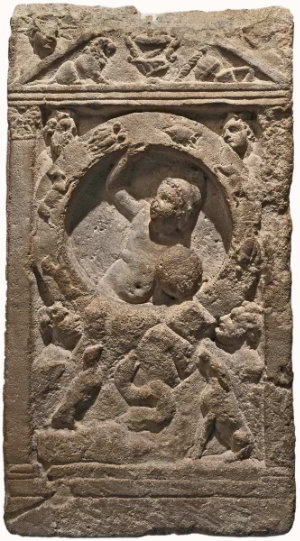
Mithras rock-birth of Trier

The relief depicts the birth of Mithras, holding a globe, surrounded by the zodiac.

CIMRM 985


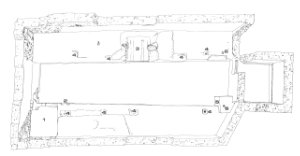
Mithraeum of Tienen

The temple contained hundreds of ceramic vessels and animal bones, which may indicated that a grand Mithraic feast was celebrated before its closing.


Mithréum de Bordeaux

C’est en 1986, à l’occasion de la restructuration de l’ancien magasin Parunis, qu’une fouille de sauvetage archéologique fut réalisée cours Victor Hugo.


Mithréum de Septeuil

In the second half of the 4th century, a Mithraic temple was established within an earlier spring sanctuary at Septeuil, where the cult of the nymphs and Mithraic practices appear to have coexisted.


Mithréum de Bourg-Saint-Andéol

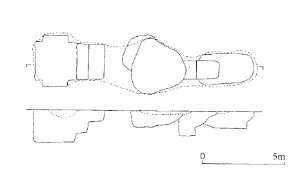
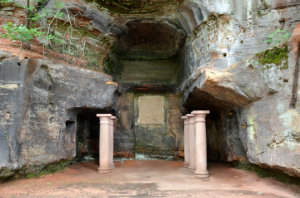
The Mithréum de Bourg-Saint-Andéol was built against a rock where the main Tauroctony was chiseled.

CIMRM 895


Terra sigillata bowl depicting the Mithraic cult meal from Trier

This terra sigillata was found in 1926 in a grave on the Roman cemetery of St. Matthias, Trier. An eyelet indicates that it could have been hung on a wall.

CIMRM 988


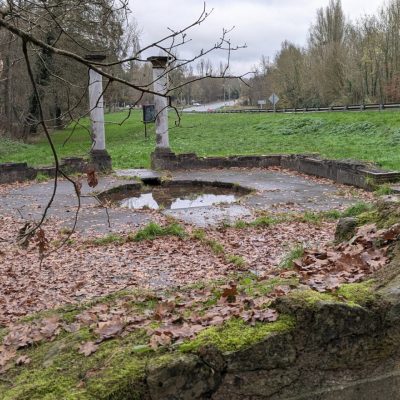
Mithräum von Saarbrücken

The Mithraeum in Halberg hill, near Saarbrücken, is one of the oldest historical places in the area.

CIMRM 1001


Cautes from Les Bolards

This monument representing Cautes with uncrossed legs was consecrated by a certain Anttiocus.

CIMRM 918


Tauroctony from Sarrebourg

The Tauroctony of Saarbourg (Sarrebourg, ancient Pons Sarravi), France, contains most of Mithras deeds known in a single relief.

CIMRM 966


Mithréum des Bolards

The Mithraeum des Bolards was integrated into a therapeutic cultural complex related to healing waters.

CIMRM 917


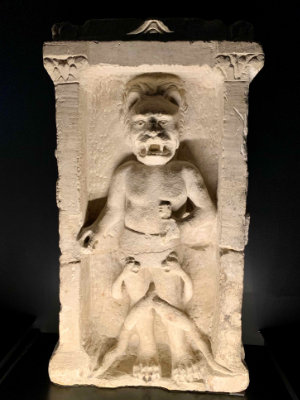
Aion altar of Bordeaux

The altar depicting a lion-headed figure from Bordeaux includes a sculpted ewer and a patera on the sides.


Mithréum d’Angers

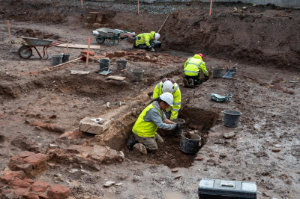
The Mithraeum of Angers, excavated during a preventive operation and subsequently dismantled in 2010, yielded numerous objects, including coins, oil lamps, and a ceramic vessel bearing a votive inscription to the invincible god Mithras.

See all Mithraicmonuments in Gallia

Places in Gallia


[Soulan]

Soulan is a commune in the Ariège department in southwestern France.


Apta Julia

Apt is a commune in the Vaucluse department in the Provence-Alpes-Côte d'Azur region in southeastern France.


Aquae Sextiae

Aix-en-Provence or simply Aix, is a city and commune in southern France, about 30 km north of Marseille.


Arelate

The Romans took Arelate from the Ligurians in 123 BC and made it an important city by building a canal towards the Mediterranean. Present-day Arles has preserved many Roman buildings.


Augusta Treverorum

Augusta Treverorum, today's Trier in Rhineland-Palatinate, is considered to be the oldest city in Germany.


Bergoiata

Bourg-Saint-Andéol is a commune in the Ardèche department in the Rhône Valley in southern France.


Burdigala

Around 300 BC, Burdigala was the settlement of a Celtic tribe, the Bituriges Vivisci. The Romans conquered the area in 60 BC and made Burdigala the capital of the Roman province of Aquitania during the reign of Emperor Vespasian.


Divio

Dijon is the prefecture of the Côte-d'Or department and of the Bourgogne-Franche-Comté region in eastern France. The earliest archaeological finds within the city limits of Dijon date to the Neolithic period.


Dyo

Dyo is a commune in the Saône-et-Loire department in the region of Bourgogne-Franche-Comté in eastern France.


Elusa

Eauze is a commune in the Gers department in southwestern France.


Epamantodurum

Mandeure is a commune in the Doubs department in the Bourgogne-Franche-Comté region in eastern France.


Fürth

Fürth is a city in northern Bavaria, Germany, in the administrative division of Middle Franconia.

See all Mithraic sites in Gallia

Inscriptions from Gallia

Cautes from Les Bolards

L[ibens] l[aetus] Antti/ocus [sic] d[e] s[uo] d[edit].
Of his own free will, with joy, Anttiocus, at his own expense, offered.

Tauroctony from Sarrebourg

In h[onorem] d[omus] d[ivinae] deo inv[ict]o Marceleus Marianus / d[e] / s[uo] p[osuit]
In honour of the divine house, Marceleus Marianus set [this] up to the god Invictus at his own expense.

Mithréum de Vienne

Deo Cau/te.
God Cautes.

Funerary urn of Chyndonax

Μίθρης εν οργάδ[ι] χώμα το σώμα καλύπτει Χννδόνακτος ίερεω[ς] αρχηγού, δνσεβ[ίας] απέχον λύσι[ον] οίκον ὁρώ[ν].
Here, in the sacred land of Mithras, a mound covers the body of Chyndonax, high priest. Refrain from impiety at the sight of his redemptive tomb.

Relief de Bourg-Saint-Andéol

Num[ini] . . . . V . . | deum Invictum | T Fur[ius] Iu[stus?] d[e] s[ua] p[ecunia] f[ecit].
To the numina of Augustus. Titus Aurelius… has made this at his own expense.

Inscription of Secundinus of Lyon

Deo invicto / Mithr[ae] / Secundinus dat.
To the unconquered god Mithras, Secundinus gives [it].

Altar with Phrygian cap from Altbachtal

D[eo] I[nvicto] M[ithrae] / Martius / Martia/lis pater / in suo / posuit.
To the invincible god Mithras, Martius Martialis, Pater, in his domain, has deposited.

Cautes and Cautopates of Sarrebourg

ar / ... marli ... Marc/ellius Maria[nu]s de / suo posuit.
[— ar / … marli …] Marcellius Marianus set [this] up at his own expense.

Inscriptions of Eauze

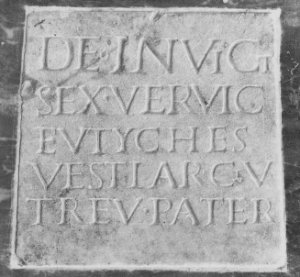
Deo Invict[o] / Sex[tus] Vervic[ius] / Eutyches / vestiar[ius] civ[is] / Trev[er] pater.

V/ervi/cius Eutyc/hes pa/ter.
To the Unconquered God, Sextus Vervicius Eutyches, textile merchant, citizen of Treveri, and Father.

Vervicius Eutyches, Pater.

Altar of Firmidius Severinus from Geneva

Deo invicto / genio loci / Firmidius Se/verinus mi[les] /leg[ionis] VIII aug[ustae] p[iae] f[idelis] / c[onstantis] C[ommodae] stip[endiorum] XXVI aram / ex voto pro salute / sua v[otum] s[olvit] l[ibens] m[erito]. Posita / Muciano et Fabiano co[n]s[ulibus].
Firmidius Severinus, a soldier of the 8th legion of Augustus, pious and loyal to Commodus, erected this altar to the invincible god and genius of this place for his salvation after 26 years of service, following a vow he willingly fulfilled. During the consulate of Mucianus and Fabianus.

Goblet from Angers

---]M [---]Deo[ inuic]to Mytrh[ae
]s Genialis ciues Ambian[in]us [or Ambian[ic]us] exuoto d[edit
frat]ribus, omni loco, [ N]ama!.
--- To the unconquered god Mytrha, [...]s [? son of] Genialis, Ambian citizen, gave in accordance with his vow, for his brethren[, ] in all places [...]. Glory!.

Altar with Sol’s head from Altbachtal

D[eo] i[nvicto] S[oli] / Martius Martialis / pater / in suo posuit.
To the invincible god Sol, Pater Martius Martialis put it in his own [expense].

See all Mithraicinscriptions from Gallia

References

Back to Top