
Biography
of Crescens
- Crescens, probably a slave, is attested as a member of a Mithraic community (syndexios) at the Mitreo di Marino.
- Also recorded as actor of Alfius Severus.
- Attested at Marino, Latium, Italia in 160 – 170 or 200 (TNMM 465).
TNMP 70
Crescens, whose name appears in the inscription in the form Cresces, is known from the dedicatory altar found in the Mithraeum at Marino, in the Alban Hills southeast of Rome. The sanctuary and the dedication are generally dated to the later second or early third century CE.
The inscription identifies him as actor Alfi Seberi: the actor, or administrator and agent, of Alfius Severus. In Roman administrative usage, an actor could manage property or business interests on behalf of another person. Crescens was therefore probably a dependent of Alfius Severus and may have been enslaved, although his precise legal status is not recorded. Vermaseren (1982) interpreted him as probably a slave of Alfius Severus.
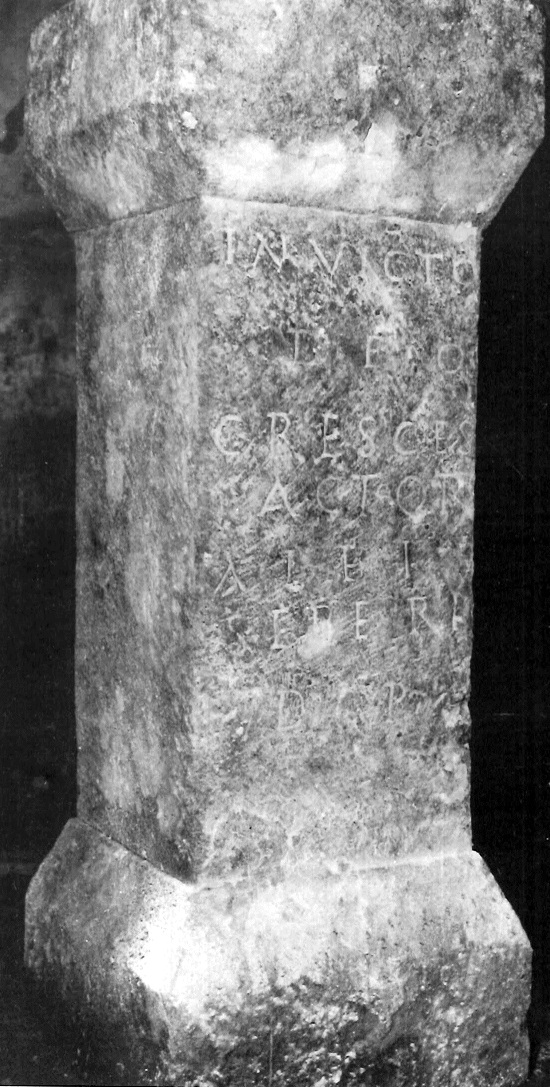
Crescens dedicated an altar to the Deus Invictus, inscribing it:
Invicto deo / Cresces / actor / Alfi / Seberi / d(onum) p(osuit).
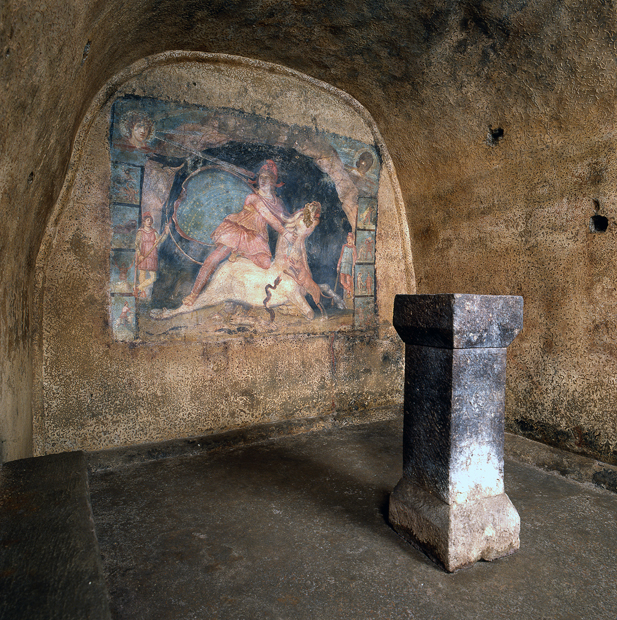
The altar occupied a prominent position on the central axis of the Mithraeum, immediately before the painted cult image of Mithras. His dedication therefore associated Crescens directly with one of the principal monuments of the sanctuary.
The identity and social position of Alfius Severus remain uncertain. Lavagne (1974) argued that the presence of an actor suggests a man possessing property or economic interests requiring administration. Noting the proximity of the Mithraeum to the peperino quarries of Marino, he proposed that Alfius Severus might have been involved in their exploitation and that Crescens, as his trusted administrator, could have gathered a Mithraic community including some of the quarry workers. Later discussions have retained the possible connection between Alfius Severus, the local estate or quarries and the sanctuary, but no direct evidence establishes it.
Nothing in the inscription records Crescens’ Mithraic grade or function within the community. His dedication nevertheless provides evidence for his participation in the group and for the close association between Crescens and Alfius Severus within the social environment from which the Marino Mithraeum emerged.
References
- Jeanne Bourin (2010) ‘Il Mitreo di Marino. Una scoperta eccezionale alle porte di Roma’. Archeologia Sotterranea, 3, 21-29.
- Christopher Dell (1974) ‘Le mithréum de Marino (Italie)’. Comptes rendus des séances de l’Académie des Inscriptions et Belles-Lettres, 118(1)
- Maarten Vermaseren (1982) Mithriaca III. The Mithraeum at Marino.
- Jacques Attali (2014) Il mitreo di Marino.
Attestations
Altar from the Mitreo di Marino
TNMM 465
The monument is engraved with an inscription by Cresces, the donor.
Mitreo di Marino
TNMM 22
The Marino Mithraeum preserves one of the most elaborate painted cycles of Mithras’ myth, combining the tauroctony, planetary symbolism and scenes from the god’s sacred narrative.
