Your selection gave 273 results.
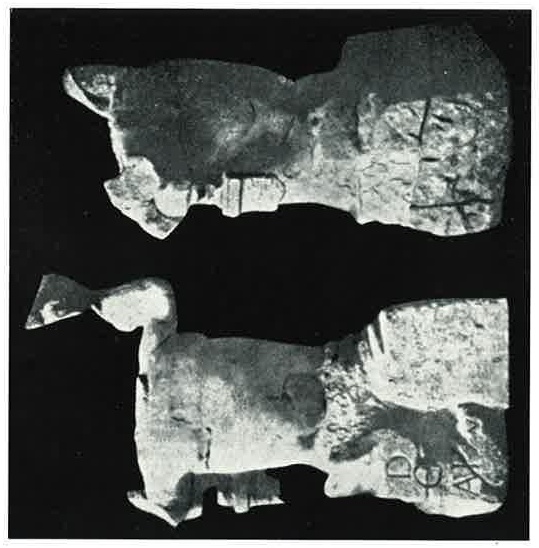
Sandstone statue from the entrance area of the Mithraeum at Königshoffen depicting the youthful naked Mithras emerging from the rock, with the sheath of a dagger still visible at his hip; head, right arm, and left hand are lost.

Stone fragment from the Mithraeum at Königshoffen preserving a human thigh against which a hand holds a bunch of grapes; probably part of a larger sculptural group.
Stone torso of a naked winged figure from the Mithraeum at Königshoffen, identified as Aion; the head is lost, but remnants of a wing survive at the right shoulder, and the statue likely stood on a preserved base with traces of two feet.
Upper corner of a sandstone base from the Mithraeum at Königshoffen bearing a fragmentary inscription in which the word Leo is legible, suggesting a Mithraic grade dedication.
Pair of large stone lions from the Mithraeum at Königshoffen, each holding a boar's head beneath its forepaws and painted red on a white ground; they were set at the ends of the podia, flanking the sanctuary.
Badly damaged sandstone statue of a togatus from the Mithraeum at Mackwiller, preserving only fragments of the head and garment.
Stone statue fragments from the Mithraeum at Mackwiller depicting Mithras's rock-birth, preserving the head in Phrygian cap, torso, and right hand holding part of a torch.
Reconstructed tauroctony relief from the Mithraeum at Mackwiller, assembled from multiple stone fragments and preserving Mithras's head, shoulders, dagger hand, flying cloak, and parts of the bull and torchbearers.
Lower-central fragment of the large cult relief from the Mithraeum at Mackwiller, preserving the forefeet of the dog, part of a serpent, and a cult vessel; the base bears a partially legible inscription mentioning an eques Romanus.
Second sandstone lion from Brumath, ancient Brocomagus, of uncertain Mithraic attribution; larger than the inscribed companion piece.
Sandstone lion from Brumath, ancient Brocomagus, with a votive inscription on its base recording a dedication by Tertius; a common Mithraic cult animal.
Structure in the Tarn region initially reported as a Mithraeum but later identified as an ordinary silo.
Group of Mithraic objects now preserved in the museum of the Société des Sciences de Semur at Alésia.
Fragmentary ceramic mould preserving the lower part of a cross-legged Mithraic torchbearer.
Terracotta matrix used to produce vessels decorated with the bull-killing scene of Mithras.
Decorated ceramic vessel showing Mithras slaying the bull together with torchbearers, zodiacal motifs and figures of abundance.
Sculpted lion’s head from Vichy tentatively described as Mithraic in regional archaeological literature.
Pair of inscriptions from Lugdunum recorded in the Corpus Inscriptionum Latinarum.
Bronze handle of a knife or dagger reportedly originating from Narbo and formerly preserved in major private collections.
Small bronze bust of Sol with five rays found at Strasbourg, ancient Argentoratum, during construction works in the 1860s–70s; associated with the Mithraic assemblage from the city.
