Your search Al-Bahnasa gave 3013 results.

Rough-hewn statuette found at Emir Ghasi in Lycaonia, once thought to represent a Mithraic soldier; according to Cumont, a modern forgery.
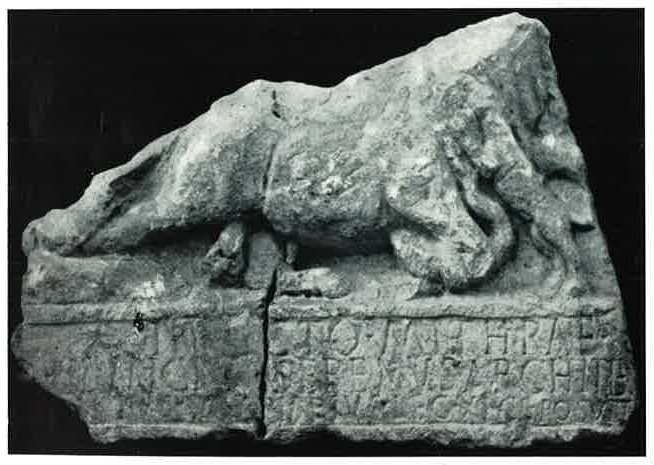
Sandstone tauroctony relief from Balcic, ancient Dionysopolis in Moesia Inferior, depicting the standard bull-slaying scene; the attribution to Dionysopolis rather than another site is disputed.

Small relief found in 1956 at Oarda de Sus near Alba Julia, Dacia, framed by a border; the upper part depicts the dressed bust of Mithras in Phrygian cap, the lower portion the bull-slaying scene.
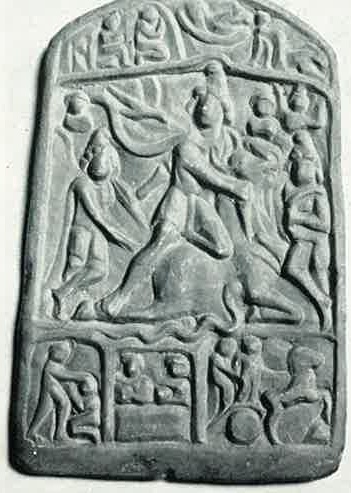
Limestone tauroctony relief found in a grotto at Nagy-Kovácsi, Pannonia Inferior, depicting the standard bull-slaying with flanking torchbearers and divine busts in the upper register.
Group of Mithraic monuments preserved in the museums of Liège.
Fragmentary ceramic mould preserving the lower part of a cross-legged Mithraic torchbearer.
Terracotta matrix used to produce vessels decorated with the bull-killing scene of Mithras.
A marble statue fragment found at Sentinum (modern Sassoferrato) in ancient Umbria, walled in the atrium of the Palazzo Raccamadoro-Ramelli, showing Mithras tauroctone with dog, serpent and scorpion, one foot pointing towards a torchbearer; the bull's head, tail and Mithras'…
An earthen lamp bearing the name of C. Dessi along with two coins of Constantine and one of Gratianus, found in the Mithraeum at Spoleto in Umbria.
A small bone statuette from the Mithraeum at Spoleto, depicting a youth dressed in tunic and long cloak with a laurel wreath around the head.
Two surviving wall paintings from the side-benches of the Mithraeum at Spoleto, out of an original six, depicting a cloaked bearded man identified as Saturn holding a sickle and a youth in a red shoulder-cape holding a money-bag, probably representing the seven planets…
A cone-shaped piece of stone with a square hole found to the left of the altar in the Mithraeum at Spoleto, unlikely to have supported a representation of Mithras's rock-birth despite earlier suggestions, given that the stone tapers slightly.
Two Mithraic monuments received by the Museo Nazionale delle Terme in Rome in 1896, reportedly from Narni: a small head of Mithras tauroctone in Phrygian cap with traces of red and gilding, and a central relief fragment of Mithras slaying the bull.
A marble tauroctony relief fragment probably from Narni (ancient Narnia) in Umbria, now in the Museo Nazionale delle Terme in Rome, preserving Mithras in Eastern dress as a bullkiller with dog and Cautopates standing cross-legged before the bull; the exact find-spot is uncertain…
A small marble cippus found in an old wall near the church of San Niccolò in Arezzo (ancient Arretium), bearing a dedication by Myron, a slave, to the Invincible Holy and Safe god for the welfare of his master Prunicianus.
A white marble tauroctony relief found near a Roman villa on the northern slope of Mount Ciminus near Soriano nel Cimino in Etruria, showing Mithras slaying the bull with dog, serpent and scorpion, the bull's tail ending in three ears of grain, the god's resting leg abnormally small…
A brief dedicatory inscription carved in the lower corner of the tauroctony relief from near Vicus Matrini on the Via Cassia in Etruria, recording L. Avillius Rufinus as dedicant.
A marble tauroctony relief, broken in two pieces, found at Sutri in Etruria in 1896 and now in the Museo Nazionale delle Terme in Rome, with raven, dog, serpent and scorpion present, the upper part with the heads of Sol and Mithras broken off and Luna's bust alone preserved…
A Sol statue headless and lacking arms and feet, mentioned by Martelli as existing at Nersae alongside a fragmentary inscription, with no further details obtainable by Vermaseren or Cumont.
A statue found along the Via Cassia about six kilometres from Rome, tentatively identified as an Aion entwined by a serpent but possibly representing Atargatis according to Vermaseren, now in the Museo Nazionale delle Terme.
