Your search Al-Bahnasa gave 3013 results.

Mithraic statue from Vindobala discovered in 1844 and subsequently broken up.
Group of Mithraic and other cult remains possibly originating from several neighbouring sanctuaries destroyed or abandoned in Late Antiquity.
Mithraic material whose correct archaeological attribution belongs to Regio XII of ancient Rome.
Archaeological remains connected with the Praetorian camp and the presence of Mithraic worship among the imperial guard.
Marble cippus from the Quirinal residence of Ceionius Iulianus Kamenius preserving references to his Mithraic and other priestly functions.
Inscription now preserved in the Palazzo Ducale of Urbino whose wording may point to the existence of a Mithraic community.
Relief featuring an enigmatic agricultural implement interpreted either as a scythe or an early type of plough.
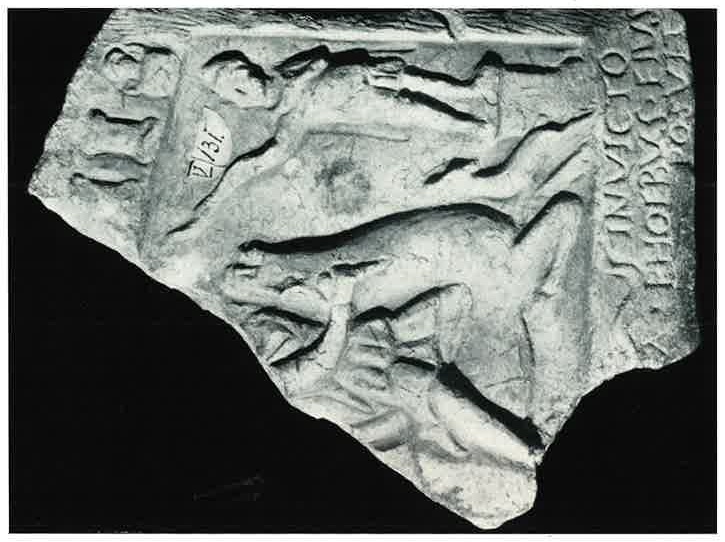
White marble tauroctony relief fragment from Romula, Dacia, now in Turnu Severin; the composition is partially preserved.
Inscription from Apulum, Dacia, dedicated to Deo bono puero Phosphoro — the Good Boy who Brings Light — a Mithraic epithet attested in several inscriptions from Apulum.
Lost tauroctony relief from Apulum, Dacia, formerly at the Palace of the Prince at Alba Julia, recorded only in early modern sources.
Small Mithras relief from Apulum, Dacia, mentioned by Buday but not published; a design shows the bust of Sol with one ray pointing towards Mithras.
Author's observation that several inscriptions from Apulum, Dacia (CIL III 1096, 1095, 1154, 1002) may belong to a sanctuary of Diana rather than to a Mithraeum.
Large marble base from near Kutyamál at Apulum, Dacia, dedicated ex iussu dei Apollinis and naming the Fons Aeternus — the eternal spring — by Ulpius Proculinus, speculator of Legio XIII Gemina.
Limestone base from near the Kutyamál vineyard south of the fortress at Apulum, Dacia, decorated with Bacchic vine scrolls and grapes at the top.
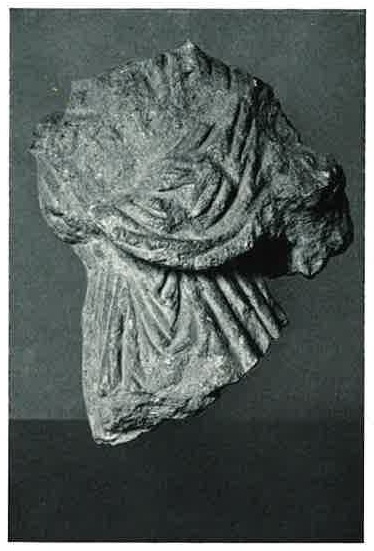
Limestone statue torso from the Mithraeum at Apulum, Dacia, found with the preceding piece, depicting a person in Oriental dress carrying a bull's head in his left hand; head, arms, and legs are lost.
Triple-part sanctuary at Saalburg whose Mithraic interpretation remains uncertain despite serpent-vases and possible Aion fragments.
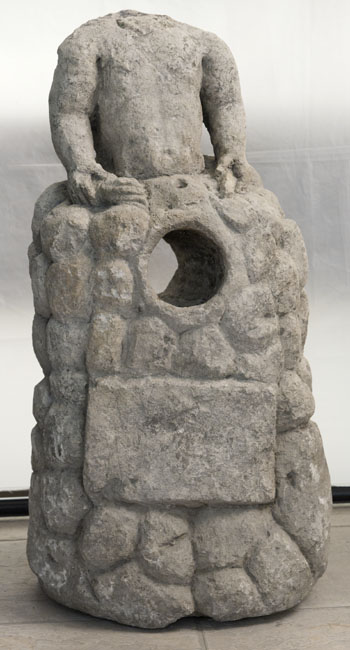
This sculpture from Dobrosloveni, Romania, depicts the petrogenesis of Mithras, with a hole through the generative rock from which water flowed.
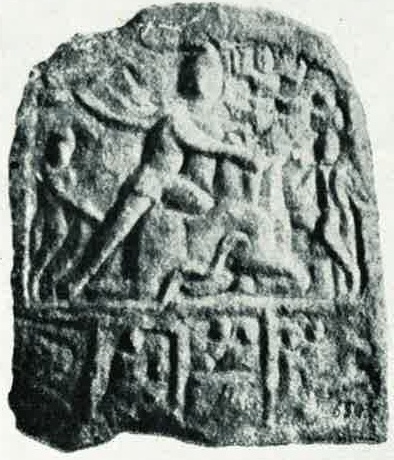
Small arched marble tauroctony relief from Philippovtsi near Sofia, Thracia, divided into two parts by a horizontal rim.
Altar inscription from Sahin invoking the most high heavenly god and Mithras in the Alawite Mountains.

Painted Parthian inscription on a ceramic sherd possibly referring to Mithras as a bull-slayer.
