Your search Arsha wa Qibar - Qaybar - Qeibar - Qibare, al-Hawa gave 3160 results.

Emperor Caracalla ordered one of Rome’s largest temples to the god Mithras to be built in the baths bearing his name.

Jabal al-Druze, officially Jabal al-Arab, is an elevated volcanic region in the As-Suwayda Governorate of southern Syria.
Pessinus was an Ancient city and archbishopric in Asia Minor, a geographical area roughly covering modern Anatolia.
The Bad Ischl area has been inhabited since the time of the prehistoric Hallstatt culture. Documentary evidence of the settlement dates back to 1262, when it was referred to as Iselen.
Waidbruck is a comune in South Tyrol in northern Italy, located about 20 kilometres northeast of Bolzano.
Skelani (Serbian Cyrillic: Скелани) is a village in the municipality of Srebrenica, in the Republika Srpska entity of Bosnia and Herzegovina.
Palaiopoli is an ancient city on the west coast of Andros in the Cyclades Islands, Greece, and was the capital of Andros, called Andros, during the Classical period.
Around 300 BC, Burdigala was the settlement of a Celtic tribe, the Bituriges Vivisci. The Romans conquered the area in 60 BC and made Burdigala the capital of the Roman province of Aquitania during the reign of Emperor Vespasian.
Vindobala, now a hamlet of Rudchester, was the fourth Roman fort on Hadrian's Wall.
Solin is a town in Dalmatia, Croatia, developed on the location of ancient city of Salona, which was the capital of the Roman province of Dalmatia and the birthplace of Emperor Diocletian.
Salona was an ancient city and the capital of the Roman province of Dalmatia. It was founded in the 3rd century BC and was mostly destroyed in the invasions of the Avars and Slavs in the 7th century AD.
Icosium was a Berber city that was part of Numidia which became an important Roman colony and an early medieval bishopric in the casbah area of actual Algiers.
Caetobriga, now Setúbal of Proto-Celtic *Caetobrix, became a Turdetani settlement which passed under Roman rule. In the time of Al-Andalus the city was known as Shaṭūbar.
Apulum, now within Alba Iulia, was a Roman settlement first mentioned by the mathematician, astrologer and geographer Ptolemy. Its name comes from the Dacian Apoulon.
Within the southern sectors of Roman Dacia, Dacia Malvensis preserves evidence linked to military mobility and provincial urbanisation.

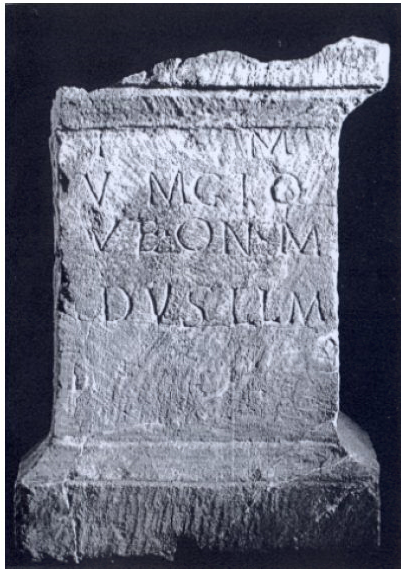
This fragmented monument bears an inscription of a certain veteran named Valerius Magio.
Syria-Palestina occupied a complex religious landscape shaped by imperial administration, pilgrimage and eastern Mediterranean mobility.
Galatia occupied the central Anatolian crossroads through which military movement and eastern provincial networks intersected.
Dalmatia connected the Adriatic world to the Balkan interior through maritime routes, military mobility and provincial urban networks.
