Your search Ay-Todor gave 1062 results.

Deva was a major Roman legionary fortress in northern Britannia, today Chester.
Pausilypum, modern Posillipo, overlooked the Bay of Naples and became renowned for its elite villas and coastal setting.
The hill fort of Epiacum, known today as Whitley Castle, occupied a strategic upland position south of Hadrian’s Wall.
Thagaste was a Roman-Berber city in present-day Algeria, now called Souk Ahras.
Zaraï was a Berber, Carthaginian, and Roman town at the site of present-day Aïn Oulmene, Algeria.
Roman Carthage was an important city in ancient Rome, located in modern-day Tunisia.

A fragment of a stone relief from Interanum (modern Entrains-sur-Nohain) in Lugdunensis, showing the arched end of Mithras's flying cloak and an ear emerging from the bull's tail, possibly belonging to CIMRM 946.
A suggestion by H. Corot that a Mithraeum may have existed near the sources of the Seine (ancient Sequana) in Lugdunensis, a hypothesis awaiting archaeological confirmation.
Two small marble heads in Phrygian caps from the Castle at Cataio in the Veneto, cited by Dütschke, which may belong to torchbearer figures.
Roman military settlement in Germania superior, generally identified with present-day Ober-Florstadt and known for its well-preserved Mithraic sanctuary.
A scholarly note recording that finds at Heiligkreuz, including a lion's head and leg fragment, the head of a genius, and a knife with a gold handle, support the hypothesis of a Mithraeum at that location in Augusta Treverorum (modern Trier) in Belgica…
A large limestone tauroctony relief in several fragments from the Mithraeum at Borcovicium (modern Housesteads), the vaulted main fragment showing Mithras slaying the bull with Cautes raising his torch beside the bull's foreleg, a crescent of Luna in the upper corner…
A small four-sided white marble relief of uncertain Mithraic attribution, found at Italica (modern Santiponce, near Seville), depicting a bull walking to the right on the front, a fig-tree on the back, five ears of wheat on the right side, and damaged vine tendrils with grapes on the left…
A fragmentary inscription from Aquileia, probably dedicated to Cautopates, recording a soldier named Marcianus, optio of the Second Adiutrix Legion, who fulfilled his vow for the welfare of himself and his family.
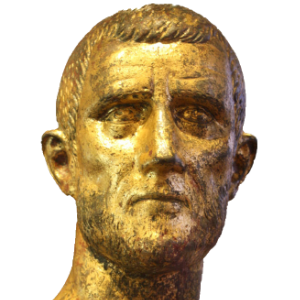
Roman emperor who established the state cult of Sol Invictus and promoted solar worship throughout the Roman Empire.

The last pagan emperor of Rome, closely associated with Mithras and Neoplatonic interpretations of the Sun God.
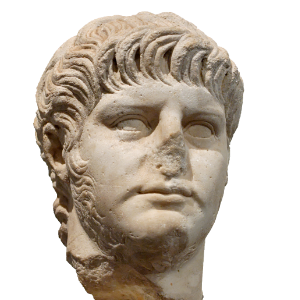
Roman emperor whose ceremonial reception of Tiridates I of Armenia established one of the earliest recorded links between Mithras and the Roman imperial court.
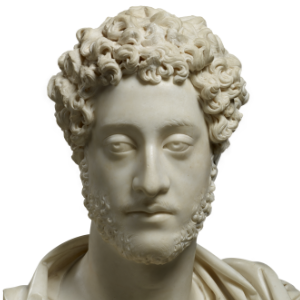
Roman emperor traditionally regarded as the first ruler initiated into the Mysteries of Mithras.
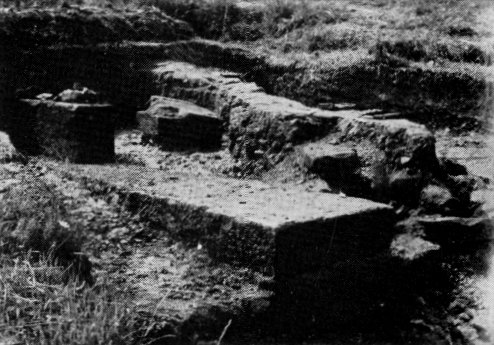
The Mackwiller Mithraeum was built in the middle of the 2nd century, during the reign of Antoninus the Pious, on the site of a spring already worshipped by the natives.
Roman settlement of Dacia superior located in the area of present-day Sibiu in Romania. The site became an important urban and military centre, later developed into the medieval city known as Hermannstadt in German and Nagyszeben in Hungarian.
