Your search Bad Ischl im Salzkammergut gave 2085 results.

Well with a drainage pipe and two oblong brick-built tombs in the room to the left of the entrance of the Mithraeum of San Clemente, one tomb filled with refuse and a large number of animal bones, particularly swine.
Marble slab with a vow to Iuppiter Sabazius made by imperial command, dedicated by L. Aemilius, from the Mitreo Sabazeo at Ostia.
A small two-wick lamp and a larger twelve-wick lamp inscribed Serapiodori inny, from the Mitreo del Palazzo Imperiale at Ostia.
Marble lion's head fastened into a wall, its flat square back indicating it was set into masonry, from the Mitreo del Palazzo Imperiale at Ostia.
A few pieces of tuff worked as rocks, forming a cone representing the remnants of the rock-birth of Mithras, found around the altar in the Mitreo del Palazzo Imperiale at Ostia.
Two marble fragments of a statue of Mithras as bull-killer, preserving the head in Phrygian cap and right hand with dagger, with traces of red paint, from the Mitreo del Palazzo Imperiale at Ostia.
Finds discovered near the crossing of the criptoporticus of the Mithraeum at Capua, including marble plate fragments, a tuff base, red lamps, and animal bones.
Badly damaged fresco fragment showing a person in red attire in a kneeling position, from the initiation sequence of the Mithraeum of Capua.
Marble plate recording the construction of a centenarium Solis by the governor Septimius Flavianus, found at Bir Haddada in the Ager Sitifensis, dated 315/316 A.D.
Fragment of a white marble relief depicting the head of Mithras with Phrygian cap and nimbus, found on the Syrian coast between Lattakieh and Tartous, first half of 2nd century A.D.
Limestone base bearing a dedication to Helios Mithras by Midon son of Solon, with a bust of Mithras in Phrygian cap, found at Savçilar on the border of Phrygia and Mysia, 78/77 A.D.
Similar red painted vase from Mithraeum II at Stockstadt, preserving only the serpent's body and tail
Three fragments of a cone-shaped sandstone mortar with a handled rim, from Mithraeum I at Stockstadt
Yellow sandstone altar from Mithraeum I at Stockstadt dedicated to Iovi optimo maximo et Iunoni reginae, with inscription largely obliterated
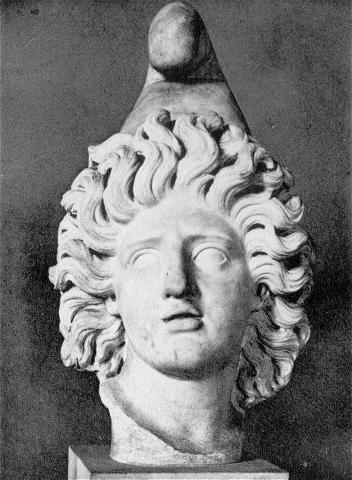
The head of Mithras had seven holes made for fastening rays.
White limestone fragment from the Mithraeum at Biljanovac, Moesia Superior, preserving the upper part of Mithras as bull-slayer in a sleeveless tunic.
Relief featuring an enigmatic agricultural implement interpreted either as a scythe or an early type of plough.
Reworked limestone altar dedicated by the governor of Numidia during the period of the Diocletianic persecutions.
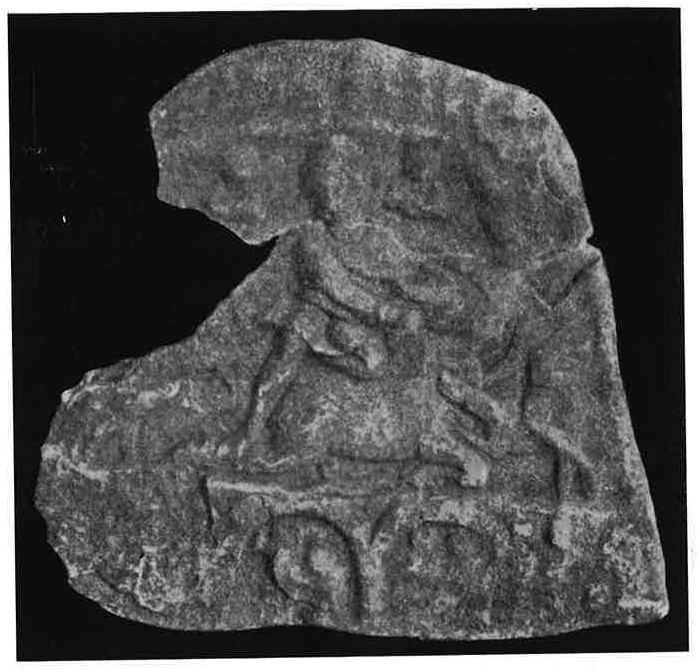
Arched marble tauroctony relief in two fragments from Sofia, ancient Serdica in Thracia, divided into three parts, with Mithras killing the bull in the centre and subsidiary scenes on either side; the weathered surface limits identification.
Greek inscription from Serdica, Thracia, dedicated to the invincible god by Caius Iulius Maximus for himself and his children.
