Your search Bu Njem gave 1882 results.
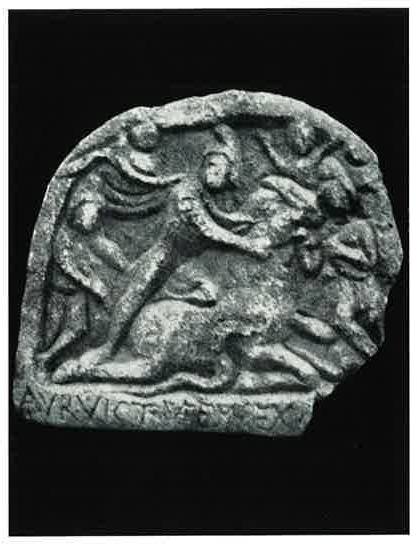
Arched white marble tauroctony relief of unknown provenance, depicting the standard bull-slaying in the usual attitude with dog and serpent.
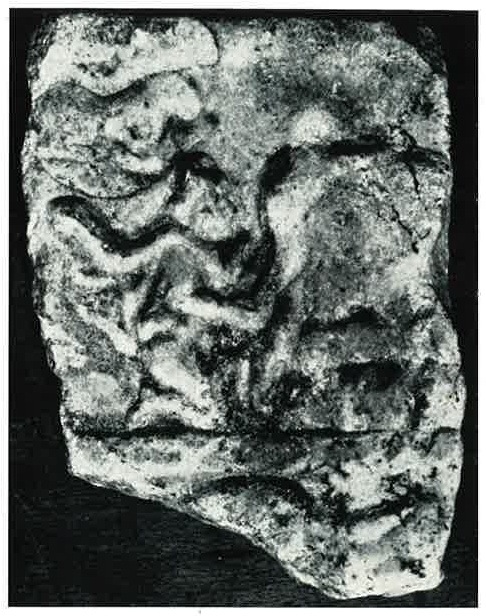
Marble tauroctony relief fragment from Dacia, preserved in Bucharest, with only Mithras's head and part of his flying cloak visible; above this a water-miracle scene and above that the bull in a small boat.

The locality of Kirk-Bunar is associated with the frontier landscape of Moesia Inferior.
Eburacum, modern York, served as one of the principal administrative and military centres of northern Britannia.
Burnum served as an important legionary centre controlling routes between the Adriatic coast and the Dalmatian interior.
Abudiacum occupied a position along the important road network linking Raetia with the Alpine regions.
Thuburnica was an ancient Roman-Berber city in the Maghreb.

A fragment of a limestone relief from Interanum (modern Entrains-sur-Nohain) in Lugdunensis, with the bull best preserved showing a belt round its body, together with traces of polychromy and remnants of the dog and serpent.
A fragment of a white stone relief from Interanum (modern Entrains-sur-Nohain) in Lugdunensis, preserving only Mithras's right foot pressing on the bull's hindleg, a visible scorpion, and the shod foot of a torchbearer.
A fragment of a pebble relief showing Mithras as bullkiller, with the collar-wearing dog holding its head near the wound, found in the bed of a stream at Interanum (modern Entrains-sur-Nohain) in Lugdunensis.
A marble relief found in 1851 built into the adjoining hall of White Friars at Chester (ancient Deva), now in the Grosvenor Museum, depicting a standing dressed figure with a sheep-hook in his left hand and possibly a downward-pointing torch in his right…
A small stone statue found at Chester (ancient Deva) in 1853 built into a cellar wall in White Friars, still seen by Stukeley in 1725 but now lost, depicting a standing torchbearer in Eastern attire and cross-legged, holding a torch downwards with both hands…
Two terracotta lamps formerly in the Coll. Passeri and now probably in the Museo Olivieri at Pesaro: the first showing Mithras as a bullkiller, the second in the shape of a bull's head inscribed Μέθρα ἱερός on the horns, both regarded as probably forged…
An inscription on the altar base from the Mithraeum at Angera, recording that M. Calvius Satullio dedicated a base to Jupiter Optimus Maximus on behalf of the inhabitants of the vicus Sebuinus.
A black marble cippus from Val Camonica with clear but inelegant lettering, dedicated to Cautopates by G. Munatius Tiro, a duovir iure dicundo, and his son G. Munatius Fronto.
A limestone low-relief tauroctony fragment found in 1869 near the entrance of the valley of San Zeno di Romedio in the Trentino, now in the Museum at Trento, showing a primitive Mithras bullkiller with Cautes upraised, the bust of Luna and an inscription on the lower border…
A coarse-grained yellowish-white marble tauroctony relief fragment found walled in at San Zeno am Nonsberg in the Trentino in 1911, now in the Museum Ferdinandeum at Innsbruck, showing part of Mithras slaying the bull and Cautes raising a flaming torch.
Three fragments of a pottery plate bearing a relief of Mithras as bullkiller, with Cautes holding an upraised torch and sickle-shaped object and the bust of Luna above, found in the pottery workshops along the Ziegelstrasse at Augusta Treverorum (modern Trier) in Belgica…
Five fragments of a red terra-sigillata vessel showing Cautopates with his torch pointing downwards, in Eastern attire and cross-legged, with the hoof of the bull's hindleg before him, found at Alesia (Mont-Auxois) in Lugdunensis.
A large red and white granite marble disc surrounded by rays, possibly representing the sun, found at the building south-west of the Mithraeum at Les Bolards (ancient Venetonimagus) in Lugdunensis.
