Your search Farid ud-Din Attar gave 893 results.

Arabia connected the Roman Near East to caravan routes, desert frontiers and the commercial networks of the southern Levant.
Peltuinum was a Roman town of the Vestini on the Via Claudia Nova, founded in the mid-1st century BC. It developed into a regional centre with city walls, a sanctuary, a theatre and an amphitheatre, and was monumentalised in the early Imperial period
Settlement of prehistoric origin that developed into the Roman Vicus Vetonianus, modern Dieburg, incorporated into the civitas Auderiensium in Germania Superior and attested as an active centre during the Roman period.
Lugdunum, currently Lyon, France, was the capital of the Roman province of Gallia Lugdunensis. The city was founded in 43 BC by Lucius Munatius Plancus. Two emperors, Claudius and Caracalla, were born in Lugdunum.
Palermo is a city in southern Italy, the capital of both the autonomous region of Sicily and the Metropolitan City of Palermo, the city's surrounding metropolitan province.
Plovdiv is the second-largest city in Bulgaria, standing on the banks of the Maritsa river in the historical region of Thrace, behind the state capital Sofia.
Groß-Gerau is the district seat of the Groß-Gerau district, lying in the southern Frankfurt Rhein-Main Region in Hesse, Germany, and serving as a hub for the surrounding area.
Mount Nemrut or Nemrud is a 2,134-metre-high mountain in southeastern Turkey, notable for the summit where a number of large statues are erected around what is assumed to be a royal tomb from the 1st century BC.
Sarrebourg is a commune of northeastern France. In 1895 a Mithraeum was discovered at Sarrebourg at the mouth of the pass leading from the Vosges Mountains.
Pamphylia was a region in the south of Asia Minor, between Lycia and Cilicia, extending from the Mediterranean to Mount Taurus.
Ostia may have been Rome's first colony. According to legend, Ancus Marcius, the fourth king of Rome, destroyed the area and founded the colony. An inscription seems to confirm the foundation of the ancient castrum of Ostia in the 7th century BC.
Ituro, now Cabrera de Mar, was an important trading town and the capital of the Laietani, an Iberian people, until Roman times.
Argentoratum or Argentorate was the ancient name of Strasbourg. Its name was first mentioned in 12 BC, when it was a Roman military outpost established by Nero Claudius Drusus. The Legio VIII Augusta was stationed there from 90 AD.
The Romans took Arelate from the Ligurians in 123 BC and made it an important city by building a canal towards the Mediterranean. Present-day Arles has preserved many Roman buildings.
Tripolitania connected the southern Mediterranean coast to caravan routes and maritime exchange networks of Roman North Africa.

Slave and vilicus in the household of Tiberius Claudius Livianus, linked to the earliest known Mithraic tauroctony.
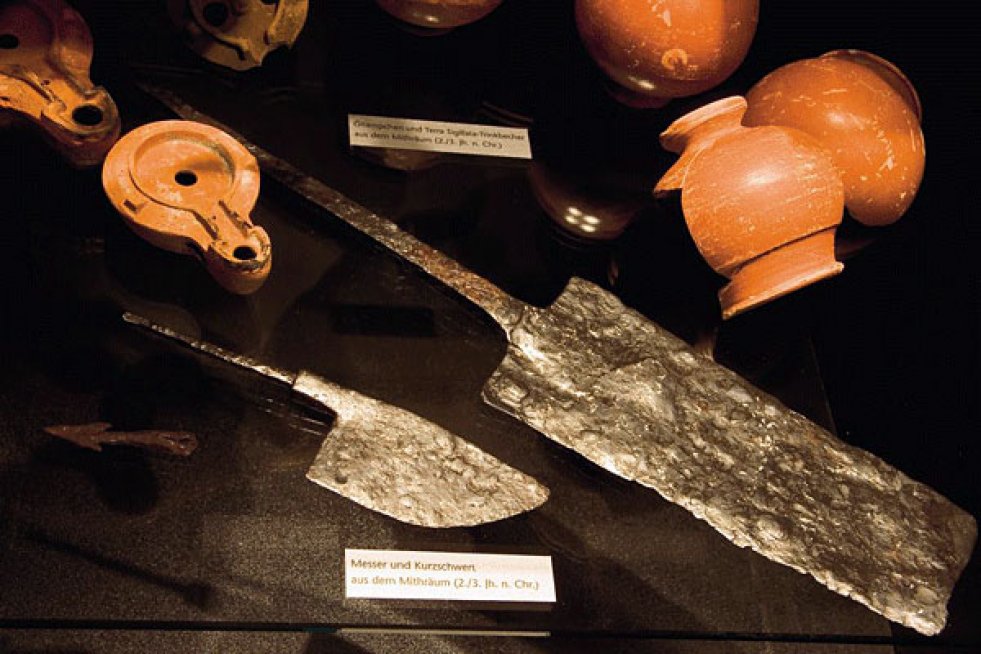
The Mithraeum of Kunzing was an underground building, oriented east-west. The entrance was probably on the east.
Cyrene linked North Africa to the Greek East through long-standing urban traditions and eastern Mediterranean maritime exchange.
Aemilia connected northern and central Italy through prosperous urban centres and major communication routes of the Roman Peninsula.
