Your search Farid ud-Din Attar gave 1805 results.

One of the rooms in a sustantive masonry building in Hollytrees Meadow was considered to be a Mithreum, a theory that has now been discarded.
Rough-hewn statuette found at Emir Ghasi in Lycaonia, once thought to represent a Mithraic soldier; according to Cumont, a modern forgery.
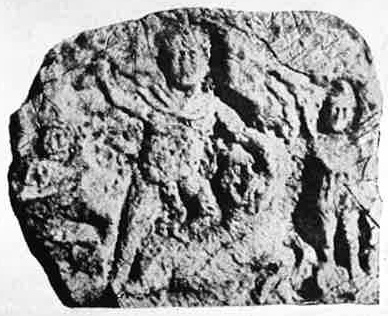
Rough relief from Gaganica, Thracia, depicting Mithras as bull-slayer in an unusual frontal attitude, wearing only a shoulder-cape and holding the dagger upwards; with dog, serpent, scorpion, and a non-cross-legged Cautes.
Inscription from Lopata, Moesia Superior, recording that Apollonides, imperial slave and scrutator of the statio Lamud, restored a Mithraic temple that had collapsed through age at his own expense; dated to the consulship of Gentianus and Bassus, AD 211.
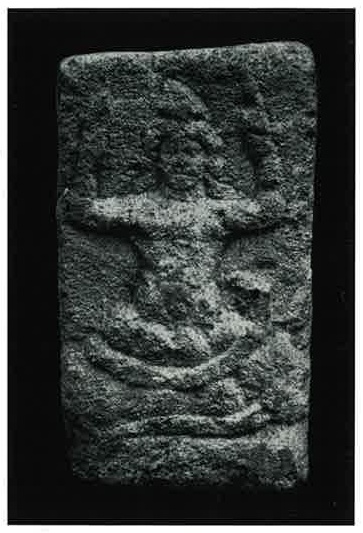
White sandstone altar from Decea Mureșului near Aiud, ancient Bruckla in Dacia, depicting on its front the naked Mithras being born from the rock, holding a torch in his right hand and a dagger in his left, with a coiled serpent below.

First Mithraic sanctuary in the potter's quarter of Aquincum, Pannonia Inferior; destroyed during the Marcoman wars; the rectangular building is known only from the four altars found side by side.
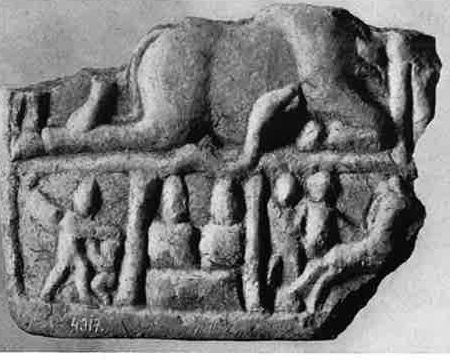
Altar from Eisenstadt, Pannonia Superior, dedicated to Deo invicto Mithrae by Titus Claudius Frontinus, centurion of Legio XIIII Gemina.
Marble altar from the Mithraeum at Modrič, Pannonia Superior, dedicated to Deo invicto Mithrae by Ulpius Secundinus, beneficiarius consularis.
Small altar preserved in the castle of Freudenberg at St. Thomas am Zeiselberg, Noricum, recording a dedication to Hermes invicto Mitrae — an unusual conflation of Hermes and the invincible Mithras.
Pottery assemblage from the cult room of the Mithraeum at Linz, ancient Lentia, including glazed dishes, three-handled serpent-vases, and related fragments; a vessel type closely associated with Mithraic ritual in the Danubian provinces.
Sandstone plate from Beihingen in the Neckar valley, depicting on one side a youth in Oriental dress with a bow in an arched niche, and on the other a corresponding figure; both may represent torchbearers or Mithraic grades.
Red sandstone fragment of a standing woman in a mantle from the Mithraeum at Dieburg, head and lower body lost, probably Minerva
Marble stele relief with bull-slaying scene and subsidiary Mithraic episodes including the sacred banquet.
Mithraic dedication by Lucius Candidinius Verus from Bonna.
Group of inscriptions from Umbria including one entry reassigned to Interamna Lirenas in Latium.

The tauroctonic relief from Dragus includes a naked flying figure that Vermaseren has identified as Phosporus or Lucifer.
Two surviving wall paintings from the side-benches of the Mithraeum at Spoleto, out of an original six, depicting a cloaked bearded man identified as Saturn holding a sickle and a youth in a red shoulder-cape holding a money-bag, probably representing the seven planets…
A white marble tauroctony relief fragment, in the seventeenth century at the Palazzo Caesiani near the Vatican and later in the Villa Ludovisi in Rome, showing Mithras slaying the bull with dog, serpent and raven, with a cross-legged torchbearer on a base; now lost…
Partially legible altar from a cardinal's vineyard in Rome, bearing a fragmentary dedication to the Invictus God Mithras Sol.
Fragment of a small white marble relief showing Mithras slaying the bull with the dog, serpent and scorpion, formerly walled in the inner court of the Palazzo Rondinini (now Palazzo Sanseverino), Corso No. 518.
