Your search Han Potoci gave 881 results.

Fragment of a large dolium from the Palazzo dei Musei Mithraeum, decorated with two small columns supporting a facade and a youth standing between them playing the flute and holding a stick in his left hand.
Small lamp decorated with a flying Victoria holding a crown in her right hand and a palm-branch in her left, from the Mithraeum at the Palazzo dei Musei, Rome.
Lower part of a small statuette of Minerva in a long chiton, leaning on a shield with her left hand, from the Mithraeum at the Palazzo dei Musei, Rome.
Fragments of a marble relief preserving only the lower part, with Mithras slaying the bull, dog and serpent licking blood, a large scorpion, and Cautopates behind the bull pointing his torch downwards, from the Mithraeum of S. Lorenzo in Damaso.
Wall-painting on the last column but one of the Palazzo Barberini Mithraeum, showing a standing person in a short tunic with a wreath of ivy, carrying fruits in his left hand.
Possible Mithraeum discovered in 1869 near the previous sanctuary in Muti's gardens, described by Lanciani as a spelaeum cut in tufa with vestibule and cell with niches and altar, at the corner of the Via Nazionale and Via Venezia.
Mosaic-paved floor of the central aisle of the Mitreo delle Sette Porte at Ostia, with a krater flanked by serpent and eagle, standing Jupiter and Saturn, torchbearers at the podia, and planetary gods Mars, Luna, Venus, and Mercury.
Marble altar bearing a bust of Sol in radiate crown with Cautopates on the right and Cautes on the left, both cross-legged, from the Mitreo delle Pareti Dipinte at Ostia.
Marble cap mentioned by Visconti, subsequently identified as certainly belonging to the finds of the Mitreo degli Animali rather than the Mitreo del Palazzo Imperiale, Ostia.
Two marble fragments of a statue of Mithras as bull-killer, preserving the head in Phrygian cap and right hand with dagger, with traces of red paint, from the Mitreo del Palazzo Imperiale at Ostia.
Two small tuff altars walled into the corners of the benches, each bearing a representation of a jug, from the Mitreo delle Sette Sfere at Ostia.
Fresco showing a mystagogus pressing down the shoulders of a kneeling myste, attended by a third figure in Phrygian cap, from the initiation sequence of the Mithraeum of Capua.
Fresco showing two persons standing behind each other, from the initiation sequence of the Mithraeum of Capua.
Clay tablets recording a treaty between the Hittites and Mitanni invoking Mitra among the divine witnesses, excavated at Boğazkale (ancient Boghaz-Koï), 14th century B.C.

Sutri is an Ancient town, modern comune and former bishopric in the province of Viterbo, about 50 kilometres from Rome and about 30 kilometres south of Viterbo. The modern comune of Sutri has a few more than 5,000 inhabitants.
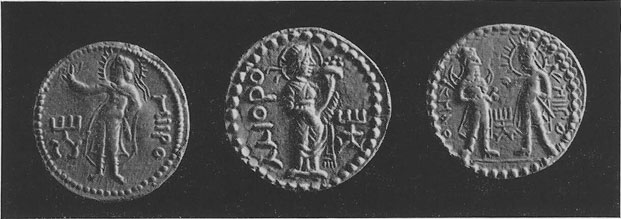
Gold coin of the Scythian king Hooerkes, reverse showing MIOPO (Mithras) as a goddess with cornucopia, north-west India, c. 87–129 A.D.

Fragment of a silvered bronze plate from Mithraeum II at Stockstadt depicting Mithras grasping the bull for the kill
Yellow sandstone altar from Mithraeum I at Stockstadt bearing a bust of Sol in radiate crown holding a whip, with a pierced square hole at the base
Small red sandstone fragment from Mithraeum I at Stockstadt depicting the ritual hand-clasp, iunctio dextrarum
Red sandstone relief from Mithraeum I at Stockstadt depicting Diana in a long garment drawing an arrow from her quiver, with a deer at her feet
