Your search Pula gave 87 results.

Pola developed into one of the principal urban and maritime centres of the northern Adriatic.

A small limestone votive altar from Pola (modern Pula) bearing on its front face a damaged relief head of a youthful Sol with long curly hair, above which is carved the inscription Soli and below the dedicatory text by Atticus (No. 757).
A fragmentary limestone tauroctony relief found on the south slope of the Castellhügel at Pola (modern Pula) during the demolition of a wall, now in the Lapidary Museum at Pula, preserving the bull's body, the dog, the serpent, the scorpion and a standing cross-legged torchbearer…
A brief inscription reading D(eo) M(ithrae), found inside a fullonica at Pola (modern Pula) in a room that had once served as a vestibule.
The inscription on the votive altar No. 756 from Pola (modern Pula), reading Soli above the head of Sol and Milace / Atticus under the head, recording the dedication by a person named Atticus.
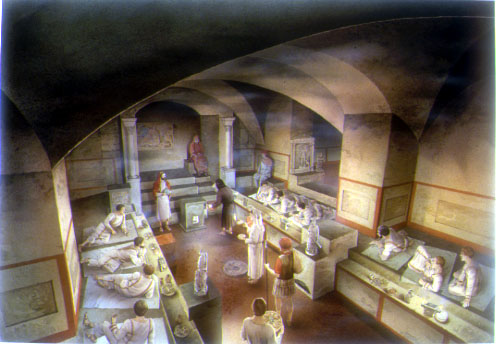
The Mithraeum of the Crypta Balbi was locted in the middle of a densely populated insula near the theatre of Cornelius Balbus.

A conversation between Peter Mark Adams and Christophe Poncet on the esoteric tarot, in relation to the elite and Saturnian Sola-Busca tarocchi and the popular and luminous Tarot de Marseille.

Ernest Renan suggested that without the rise of Christianity, we might all have embraced the cult of Mithras. Nevertheless, it has had a lasting influence on secret societies, religious movements and popular culture.

A Romano-Germanic woman whose inscription became central to debates on female participation in the Mithraic cult.
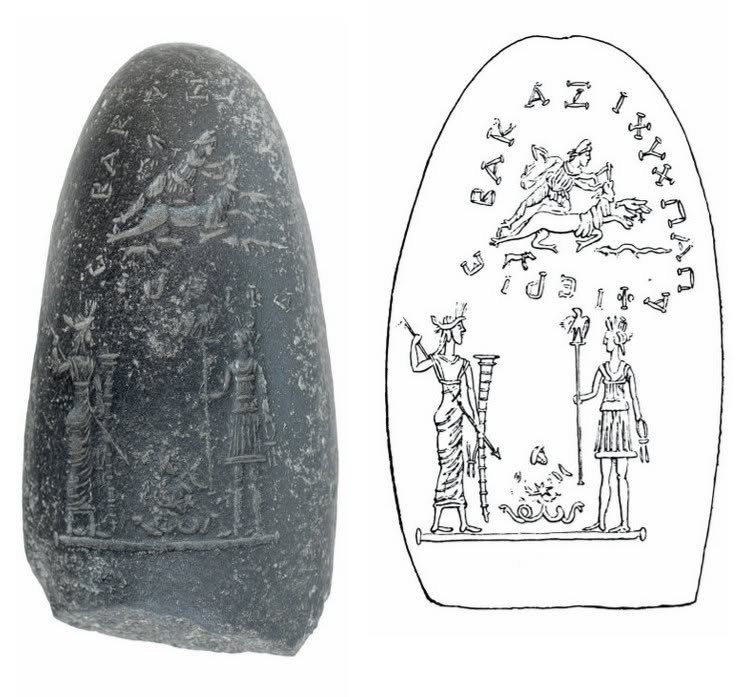
Black polished cone-shaped prehistoric axe from Argolis, now in the Athens National Museum, interpreted by some scholars as having Mithraic votive associations.
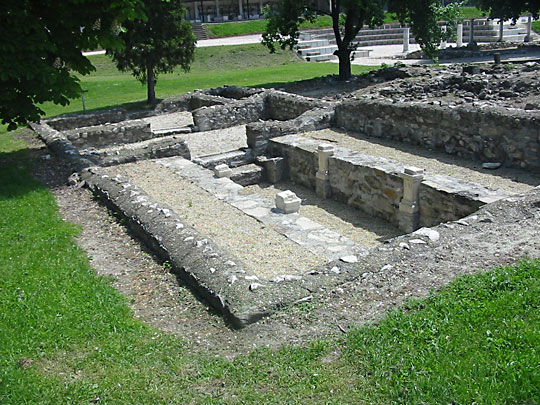
This temple of Mithras in Aquincum was located within the private house of the decurio Marcus Antonius Victorinus.
Palestrina is a modern Italian city and comune with a population of about 22,000, in Lazio, about 35 kilometres east of Rome.
Tauroctony relief formerly in the house of the Alterii near S. Marco in Rome, now of unknown whereabouts, described by Gruterus as showing Mithras pressing both knees onto the bull and grasping its horns with the knife in the shoulder, with scorpion, serpent, raven, Sol and Luna…
Large marble altar found near S. Giovanni in Laterano, dedicated by Sextilius Agesilaus Aedesius, pater patrum of Sol Invictus Mithras, to the Great Mother and Attis following his taurobolium and criobolium, dated to 376 A.D.
Ancient region of the Crimean Peninsula associated with the Greek colonies and Roman presence in Taurica.
The area was populated by Iberians, but the origins of Baetulo date back to the 1st century BC, when the Romans founded the city on the Rosés hill. Baetulo was famous for its vineyards, which produced wine for export throughout the Empire.
Aquileia, now a small municipality in north-eastern Italy, was one of the largest cities in the world in the 2nd century AD, with a population of 100,000.

Clarissimus knight and legate born in Poetovio that helped to disseminate the cult of Mithras in the African provinces.
Macedonia formed a major crossroads between the Greek world, the Balkans and the communication routes of the eastern Roman empire.

