Your search Roma gave 961 results.

Ceramic finds from both excavations of the Mithraeum at Borcovicium (modern Housesteads), comprising red and thin black-glazed pottery fragments together with a silver coin of Faustina Minor, indicating the sanctuary was in use before 253 A.D. and was most likely destroyed by fire…
A group of four altars from the Mithraeum at Borcovicium (modern Housesteads): two found in 1822 bearing inscriptions Nos. 863 and 864, and two more found in 1898, one dedicated to Mars and Victoria (No. 865) and one to Cocidius (No. 866), the last possibly belonging to an adjacent shrine…
The inscription on the altar No. 858 from the Mithraeum at Borcovicium (modern Housesteads), recording a vow willingly and with merit fulfilled by Herion to Sol.
An altar found in the north-east corner of the main room of the Mithraeum at Borcovicium (modern Housesteads) in 1822, bearing on its capital the bust of Sol in a crown of seven rays and the inscription No. 859.
A limestone statue from the Mithraeum at Borcovicium (modern Housesteads), depicting Cautes in Eastern attire and cross-legged, raising his torch.
A limestone statue from the Mithraeum at Borcovicium (modern Housesteads), depicting Cautopates in Eastern attire standing cross-legged on a base and pointing his torch downwards, with head lost.
A limestone statue from the Mithraeum at Borcovicium (modern Housesteads), representing a standing male figure in short tunic with bare legs and feet, arms held tight along the body with clenched fists once holding attributes now lost, with part of a snake on his right arm…
A large limestone tauroctony relief in several fragments from the Mithraeum at Borcovicium (modern Housesteads), the vaulted main fragment showing Mithras slaying the bull with Cautes raising his torch beside the bull's foreleg, a crescent of Luna in the upper corner…
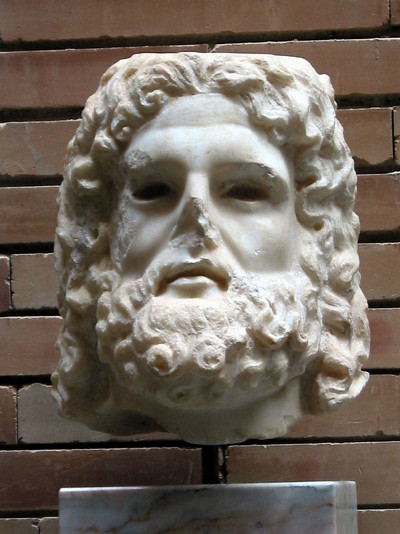
This head of Serapis from Cerro de San Albín may be unrelated to Mithras worship.
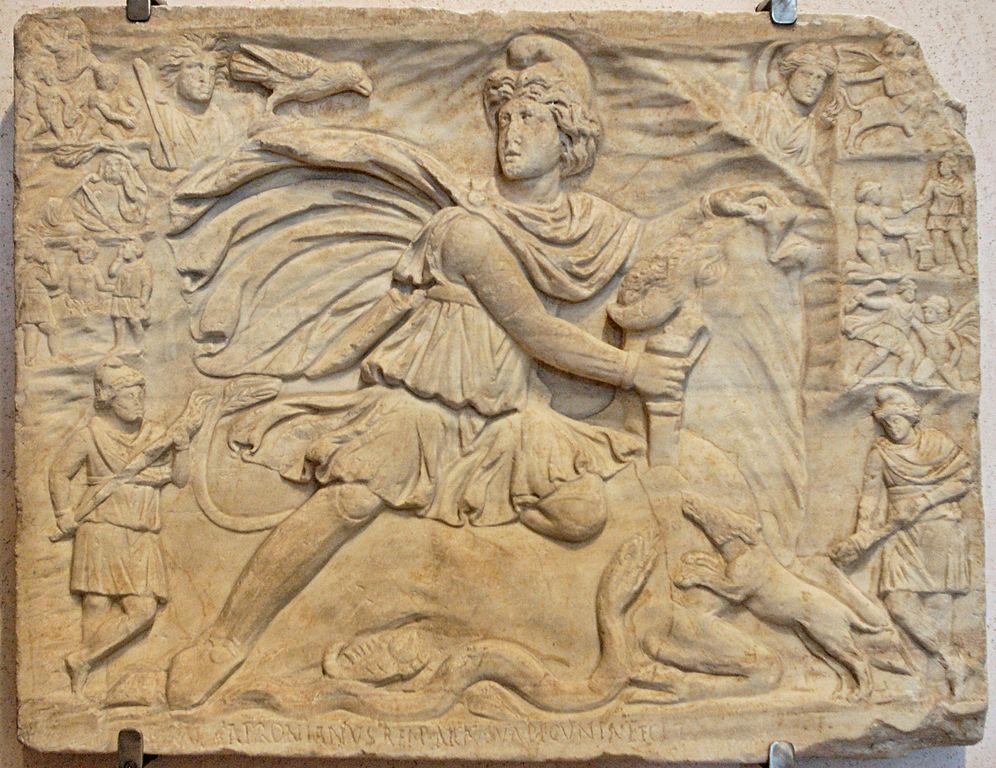
The relief of Mithras slaying the bull of Nersae includes several episodes from the exploits of the solar god.
A marble inscription fragment found in the cemetery at the Duos Lauros along the Via Labicana outside Rome, commemorating a sacerdos of Sol Invictus Mithras who lived forty years.
A marble altar found in 1873 between the Baths of Diocletian and the Via di Porta Pia in Rome, dedicated to Sol Invictus Mithras by Sextus with Titus Flavius Ianuarius as antistes.
An inscription to Sol Invictus Mithras found in the Vigna Patritii outside the Porta Pia in Rome, dedicated by Aelius Victorinus, a veteran of the emperors honourably discharged, with M. Aurelius Romulus as antistes and sacerdos of the cult.
A marble slab reused as a tombstone in Comodilla's catacombs near the Via Ostiense in Rome, originally inscribed by Titus Flavius Eutychus as a gift to the Invincible and Holy god.
A marble dedication tablet found in the Vigna Curtii Palloni outside the Porta Sant'Agnese near the Praetorian Camp in Rome, recording the construction of a sacrarium dedicated to Sol Invictus by Q. Pompeius Primigenius, pater and sacerdos, under Septimius Severus and Caracalla…
A marble funerary cippus from the Vigna Dionigi at Torre Pignatara outside Rome, dedicated to Sextineius Restitutus as most indulgent pater sacrorum by his children and mother, with a crown carved to the left of the final line.
A funerary inscription found in the Vigna Nari outside Rome in 1734, set up by Iunia Thallusa for her husband Equitius Arescon, who held the rank of pater sacrorum in the Mithraic mysteries.
A tauroctony statue once in the Collection Santa Croce near the Piazza Giudea in Rome, showing Mithras as bullkiller with a broad belt around the bull's body, the arms of the god and the bull's horns broken off.
A tauroctony relief from Rome, formerly in the Hoffmann Collection, showing Mithras slaying the bull with dog, serpent and scorpion, with the god's pupils fashioned from white enamel and the whole piece heavily restored.
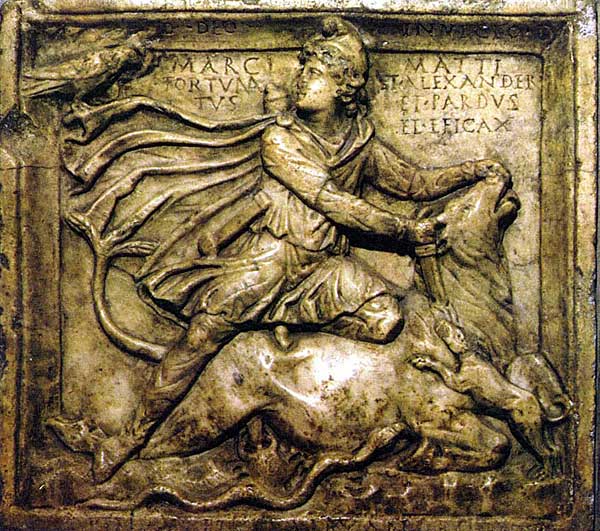
The relief marble of Mithras sacrifying the bull, exposed on the Hermitage Museum comes from Rome.
