Your search San Giovanni al Timavo gave 3157 results.

Fragments of a slab bearing an inscription mentioning Sol Aeternus and cohors II, found at the Mithraeum of Les Bolards (ancient Venetonimagus) in Lugdunensis.
Fragmentary remains of a statuette of Cautopates in a short tunic, including a thigh, knee, and hand holding the end of a torch, found near the entrance of the Mithraeum at Les Bolards (ancient Venetonimagus) in Lugdunensis.
A vase or plate bearing a representation of Mithras, reported to be in the Archaeological Seminary of the University of Vienne (ancient Colonia Iulia Vienna Allobrogum) in Narbonensis, but unpublished at the time of Vermaseren's catalogue.
An inscription found in the church of San Felice at Aquileia, recording a vow fulfilled to Sol Deus Invictus by Feronius Censor, with a head of Sol carved between the first two words.
A fragmentary epistyle from Aquileia preserving part of the inscription [Deo In]victo [Mi]th[rae], indicating the presence of a Mithraic sanctuary in the city.
A military inscription from Aquileia, dedicated to the Invincible Mithras by Flavius Exuperatus and several soldiers from the Third Italic and Thirteenth Gemina legions, acting as lustration agents for their commanders Flavius Sabinus and Aurelius Zeno, dated to around 244 A.D…
An inscription copied at San Marco's in Venice in 1829, recording a dedication by Q. Baienus Proculus, pater nomimus, to Sol.
A small relief fragment from Aquileia, now in the Lapidary Museum at Trieste, preserving part of Mithras' flying cloak and the head of one of the torchbearers.
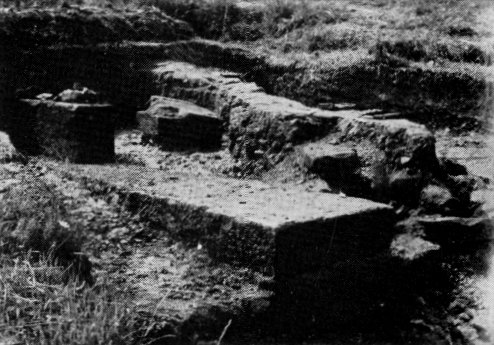
The Mackwiller Mithraeum was built in the middle of the 2nd century, during the reign of Antoninus the Pious, on the site of a spring already worshipped by the natives.
A marble inscription fragment found in the cemetery at the Duos Lauros along the Via Labicana outside Rome, commemorating a sacerdos of Sol Invictus Mithras who lived forty years.
A marble slab reused as a tombstone in Comodilla's catacombs near the Via Ostiense in Rome, originally inscribed by Titus Flavius Eutychus as a gift to the Invincible and Holy god.
A marble funerary cippus from the Vigna Dionigi at Torre Pignatara outside Rome, dedicated to Sextineius Restitutus as most indulgent pater sacrorum by his children and mother, with a crown carved to the left of the final line.
A funerary inscription found in the Vigna Nari outside Rome in 1734, set up by Iunia Thallusa for her husband Equitius Arescon, who held the rank of pater sacrorum in the Mithraic mysteries.
A tauroctony statue once in the Collection Santa Croce near the Piazza Giudea in Rome, showing Mithras as bullkiller with a broad belt around the bull's body, the arms of the god and the bull's horns broken off.
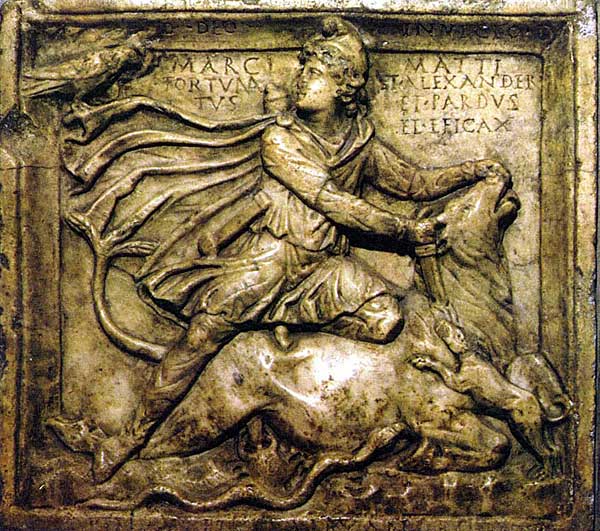
The relief marble of Mithras sacrifying the bull, exposed on the Hermitage Museum comes from Rome.

Mithraic relief from Rome reproduced in figure 169 of the corpus.

Roman Mithraic relief illustrated in figure 171 of Vermaseren’s catalogue.
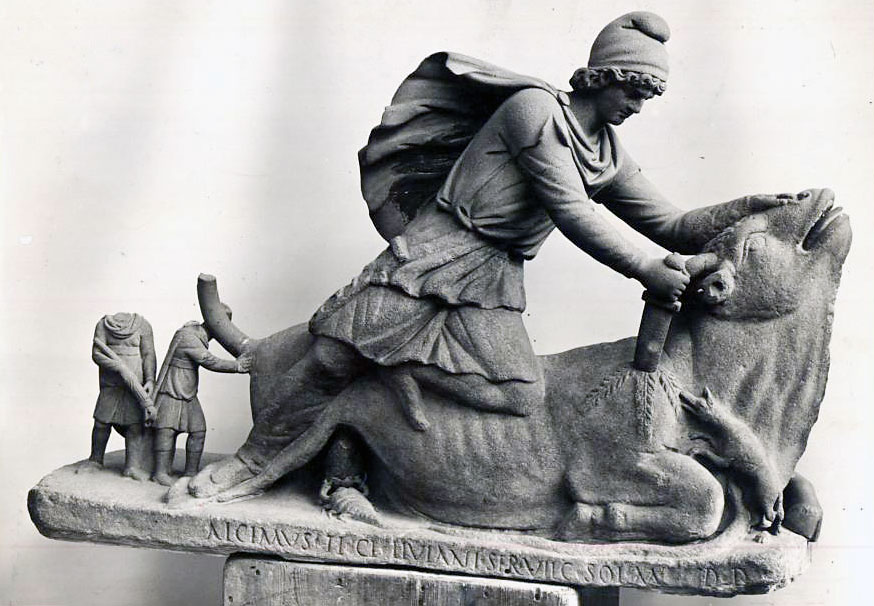
Bronze lamella probably from Rome, found in 1729, bearing a dedication to Sol Sanctissimus by C. Veratius Faustinus, a soldier of the third praetorian cohort.
Marble head in the Museo Baracco, Rome, generally described as an Alexander but very probably representing Mithras with his eyes lifted towards heaven; the back of the head is finished obliquely with a small hole for fastening a Phrygian cap.
