Your search Sankt Johann im Pongau gave 1046 results.

Numerous animal bones including birds, beasts of prey, and the muzzle of a wild boar, found as ritual deposits in the Mithraeum at Pons Saravi (modern Saarburg) in Belgica.
A limestone statue from the Mithraeum at Borcovicium (modern Housesteads), depicting Cautes in Eastern attire and cross-legged, raising his torch.
A limestone statue from the Mithraeum at Borcovicium (modern Housesteads), depicting Cautopates in Eastern attire standing cross-legged on a base and pointing his torch downwards, with head lost.
A limestone statue from the Mithraeum at Borcovicium (modern Housesteads), representing a standing male figure in short tunic with bare legs and feet, arms held tight along the body with clenched fists once holding attributes now lost, with part of a snake on his right arm…
A large limestone tauroctony relief in several fragments from the Mithraeum at Borcovicium (modern Housesteads), the vaulted main fragment showing Mithras slaying the bull with Cautes raising his torch beside the bull's foreleg, a crescent of Luna in the upper corner…
An inscription from Aquileia recording a joint dedication to Deus Sol by the invincible Emperors Diocletian and Maximian, comparable to their dedication to Apollo Belenus elsewhere in the city.
An inscription copied at San Marco's in Venice in 1829, recording a dedication by Q. Baienus Proculus, pater nomimus, to Sol.
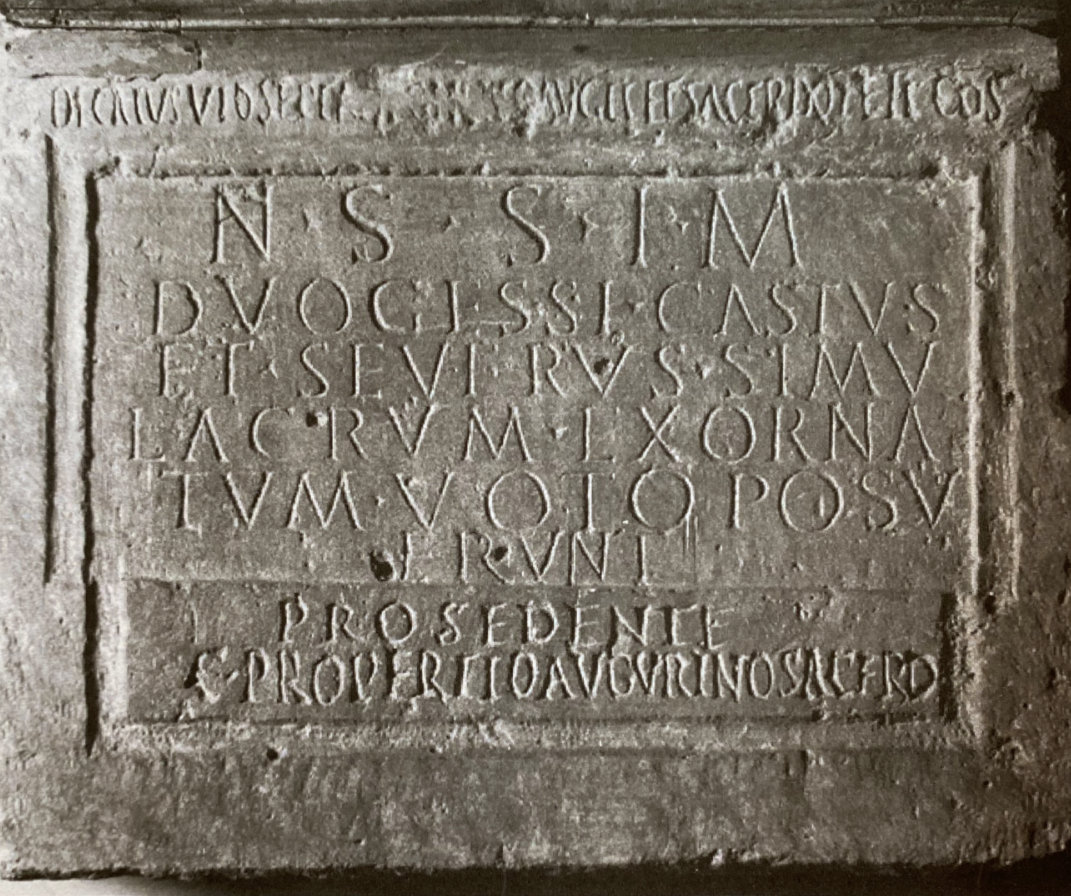
Gessius Castus and Gessius Severus have placed a decorated stutue and left testimony on this inscription below.
A marble dedication tablet found in the Vigna Curtii Palloni outside the Porta Sant'Agnese near the Praetorian Camp in Rome, recording the construction of a sacrarium dedicated to Sol Invictus by Q. Pompeius Primigenius, pater and sacerdos, under Septimius Severus and Caracalla…
Flat marble base from Rome, with fragments of statue feet still resting on it, bearing a dedication to the Lord Sol in fulfilment of a vow by Claudius Amerimnus, a lictor curiatus.
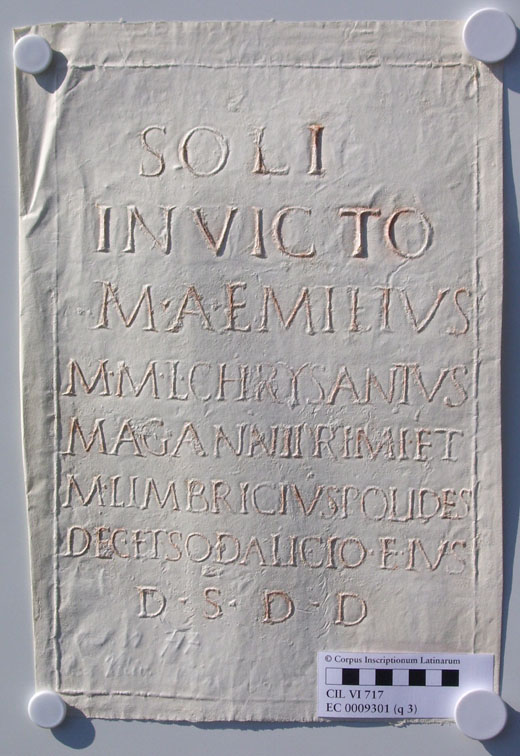
Aemilius Chrysanthus shares the expenses of this monument with a decurio named Limbricius Polides.
Large limestone jar from room Z of the S. Prisca Mithraeum, fitted with a small cylindrical vase and a lid bearing the graffito "Te cauterio i Saturne i Ata[r i] Opi".
Preliminary readings of the painted Mithraic texts later revised after additional research and restoration.
Epigraphic testimony catalogued in the Année Épigraphique and Lugli’s Fontes for ancient Rome.
Small sandstone altar with red-painted lettering from the Mithraeum at Tirgușor, Moesia Inferior, dedicated by Horimos to the god Caute; the last letters of the inscription are uncertain.
Small sandstone altar with red-painted lettering from the Mithraeum at Tirgușor, Moesia Inferior, dedicated to the god by Horimos.
Limestone base from the Mithraeum at Tirgușor, Moesia Inferior, bearing a Greek inscription dedicated to the invincible Mithras by Flavius Horimos.
Inscription from Axiopolis, Moesia Inferior, recording a dedication by a vir perfectissimus dux limitis provinciae Scythiae.
Large marble altar from Ghighen, ancient Oescus in Moesia Inferior, dedicated to Deo invicto Mithrae by Marcus Titius Maximus, duumviralis of the Colonia, with Aelianus as scribe.
Primitive marble tauroctony relief from the Museum at Cluj, Dacia, attributed to Micia but with uncertain provenance; a rough representation of Mithras killing the bull without Phrygian cap.
