Your search Sidi Ali Belkacem (سيدي علي بلقاسم) gave 919 results.

Pescorocchiano is a comune in the Province of Rieti in the Italian region of Latium, located about 60 kilometres northeast of Rome and about 30 kilometres southeast of Rieti. Pescorocchiano borders the following municipalities: Borgorose, Carsoli
Colunga is a municipality in the Autonomous community of the Principality of Asturias, Spain.
Cabra is a municipality in Córdoba province, Andalusia, Spain and the site of former bishopric Egabro.
Tienen is a city and municipality in the province of Flemish Brabant, in Flanders, Belgium.
Centum Prata is the name of a Roman vicus, whose remains are located on the eastern Zürichsee lakeshore in Kempraten, a locality of the municipality Rapperswil-Jona in the canton of St.
Künzing is a municipality in the district of Deggendorf, Bavaria, Germany.
Kalkar is a municipality in the district of Kleve, in North Rhine-Westphalia, Germany.
Aquileia, now a small municipality in north-eastern Italy, was one of the largest cities in the world in the 2nd century AD, with a population of 100,000.
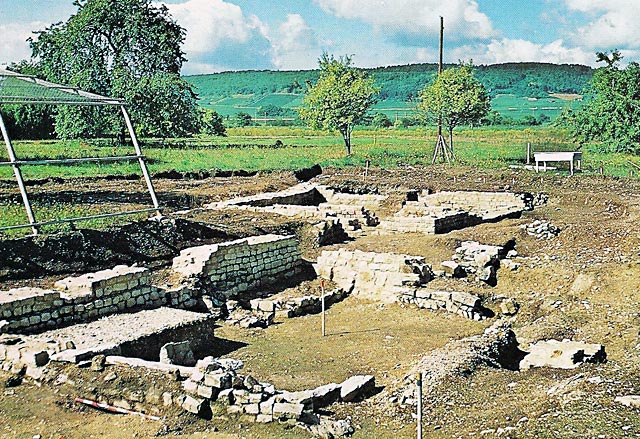
The Mithraeum des Bolards was integrated into a therapeutic cultural complex related to healing waters.

This marble tablet found at Portus Ostiae mentions a pater, a lion donor and a series of male names, probably from a Mithraic community.
Venetia connected northern Italy to the Adriatic and Danubian worlds through trade, mobility and imperial communication routes.
Samnium occupied a mountainous region of central Italy linked to Rome through military movement and regional urban networks.
Bruttium occupied the southernmost reaches of the Italian Peninsula where maritime mobility linked Italy, Sicilia and the wider Mediterranean.
Apulia connected southern Italy to the Adriatic and eastern Mediterranean through maritime trade and regional urban networks.
This fragmentary inscription from Zuccabar, reused in the wall of the Sidi Abd-el-Kader mosque at Affreville, preserves a dedication to Sol Invictus.
,_found_in_Rome,_2nd_century_AD,_British_Museum_(15545876047).jpg)
The sculpture of Mithras slaying the bull was transported from Rome to London by Charles Standish in 1815.
This small Greek dedication from the island of Aenaria invokes Helios Mithras under the epithet “unconquered”.
This marble dedication from Puteoli was offered to Sol Invictus and the genius of the colony by Claudius Aurelius Rufinus together with his wife and son.
This lost Mithraic relief, formerly kept near the church of the Santissima Annunziata in Naples, was probably a large tauroctony associated with the area of Puteoli or Pausilypon.
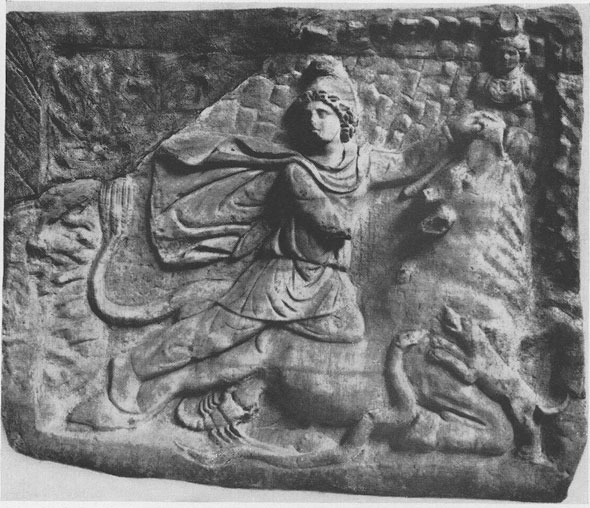
This marble tauroctony relief, probably originating from Naples, depicts Mithras slaying the bull within a cave-like setting, accompanied by the usual animals and celestial busts.
