Your search Stein am Rhein gave 2070 results.

Yellow jasper fragment of unknown provenance, formerly in the Museo Borgiano, with a tauroctony on the obverse and a Mithraic figure on the reverse.
A small limestone votive altar from Pola (modern Pula) bearing on its front face a damaged relief head of a youthful Sol with long curly hair, above which is carved the inscription Soli and below the dedicatory text by Atticus (No. 757).

Camulodunum, modern Colchester, was among the earliest coloniae established in Britannia after the Roman conquest.
Campona occupied a strategic position south of Aquincum along the Danube frontier.
The settlement of Bingerbrück formed part of the Rhine crossing zone opposite the lower Nahe valley.
Amorium, also known as Amorion, was a city in Phrygia, Asia Minor which was founded in the Hellenistic period, flourished under the Byzantine Empire, and declined after the Arab sack of 838.
Arsameia on the Nymphaios is an ancient city located in Old Kâhta in Kâhta district, Adıyaman Province, Turkey.
A fragmentary inscription from Scaleby Castle near Cambeckfort (ancient Petrianae), preserving a partial dedication to Sol Mithras.
A marble relief found in 1851 built into the adjoining hall of White Friars at Chester (ancient Deva), now in the Grosvenor Museum, depicting a standing dressed figure with a sheep-hook in his left hand and possibly a downward-pointing torch in his right…
A marble relief found on the small island of San Michele di Zampanigo near Torcello in the Venetian lagoon, now in the Museum of Torcello, showing a cross-legged figure in Eastern attire resting his head in his right hand and holding a downward-pointing torch (Cautopates), framed by poppies…
Six small marble columns found in the Mithraeum at Angera in northern Italy: two plain-fluted, two carved with palm stems and lion's and Gorgon's heads alternating on the upper ledge, and two with serpentine coils and griffins flanking an amphora…
A small limestone head of Cautopates, facing right, with a damaged nose and a stone pin on the reverse indicating it belonged to a relief, found on the slope of a hill near Heiligkreuz at Augusta Treverorum (modern Trier) in Belgica.
Four small bronze slabs with representations of zodiac signs — a leaping ram, a running lion, a scorpion, and a fish — with remnants of iron hooks, from the Mithraic sanctuary at Angleur near Liège in Belgica.
A small four-sided white marble relief of uncertain Mithraic attribution, found at Italica (modern Santiponce, near Seville), depicting a bull walking to the right on the front, a fig-tree on the back, five ears of wheat on the right side, and damaged vine tendrils with grapes on the left…
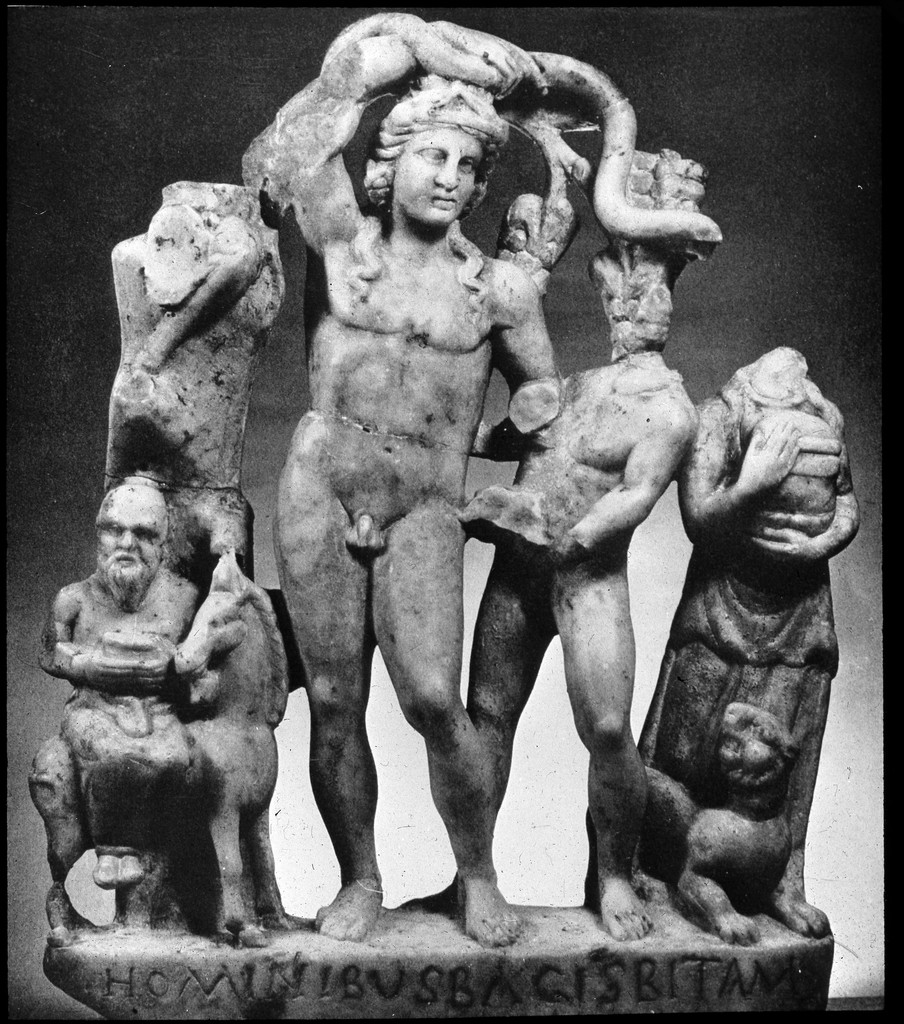
Marble group of Dionysus accompanied by a Silenus on a donkey, a satyr and a menead.
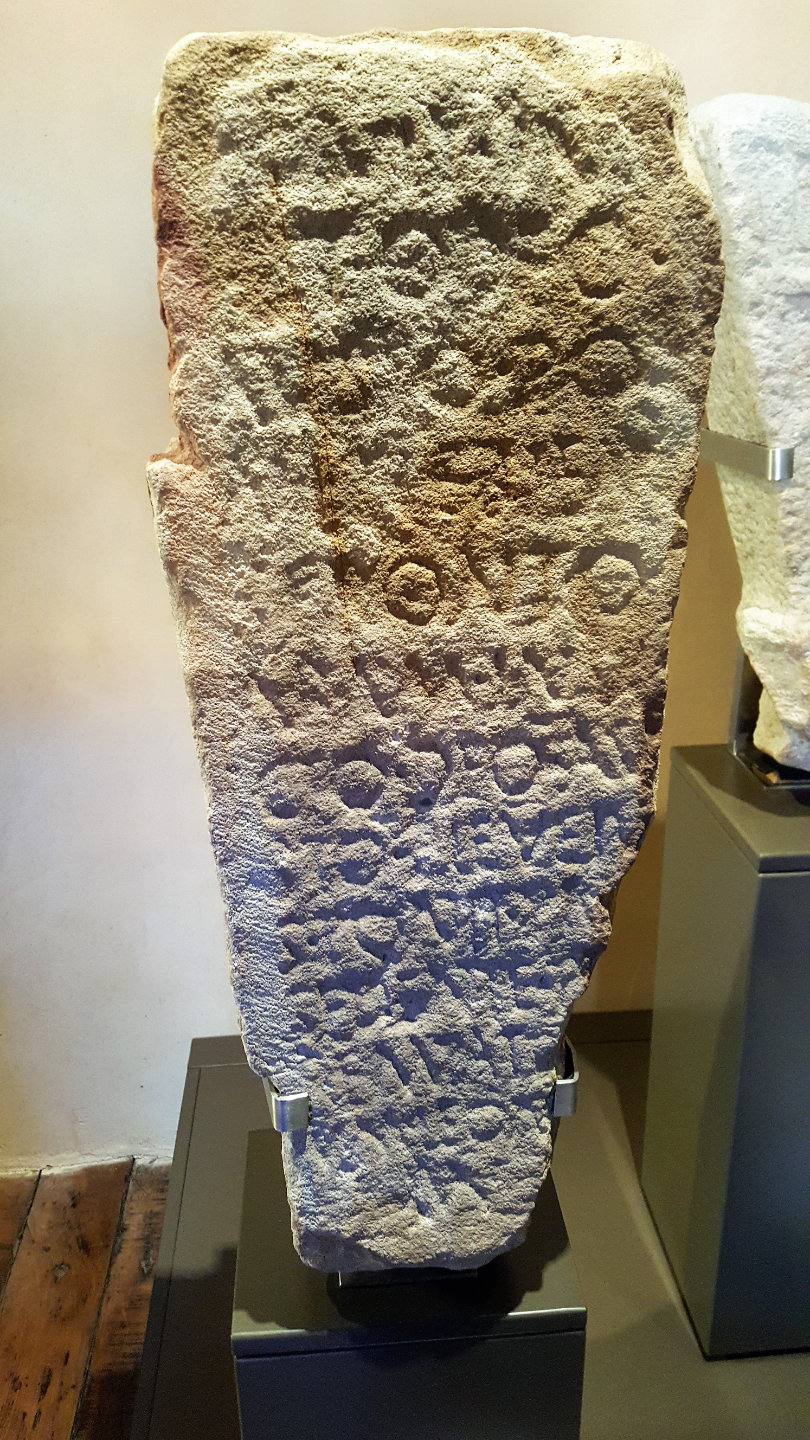
The monument of San Juan de la Isla (Asturias) devoted to Mithras was preserved in the portico of the main church until 1843.
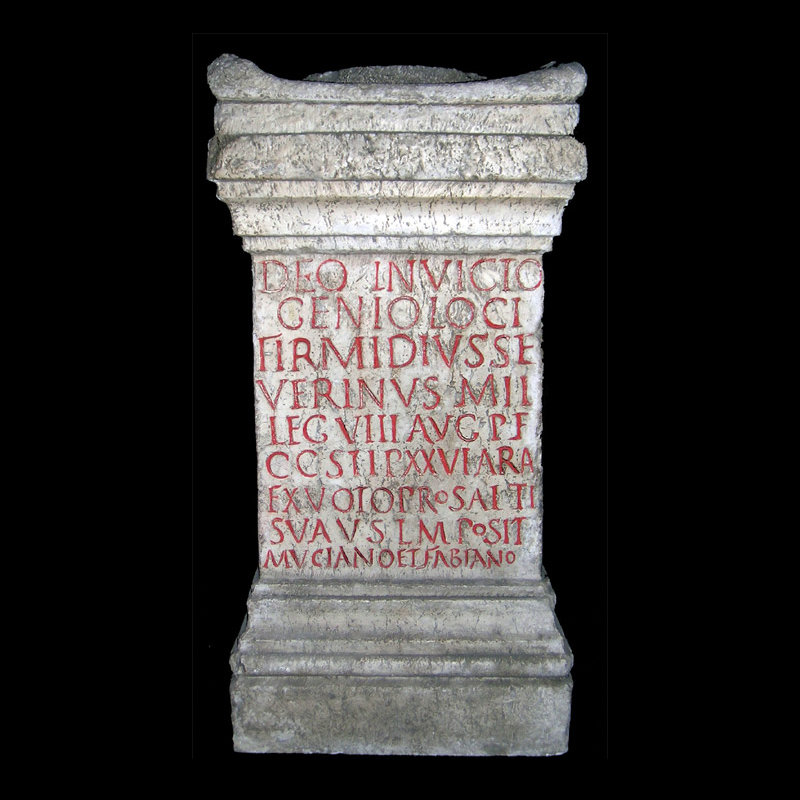
This limestone altar bears an inscription from its donor, Firmidius Severinus, in honour of Mithras after 26 years of service in the Legio VIII Augusta.
A badly damaged tauroctony relief carved in peperino, fixed high into a wall of the old farm known as Le Capanacce on the Via Cassia near Vicus Matrini in Etruria, showing Mithras as a bullkiller in a vaulted cave with serpent, the head and left arm of the god lost…
A subterranean room with a stucco depiction of Mithras slaying the bull, probably from the fourth century, discovered at Agurzano near Ponte Mammolo on the Via Tiburtina outside Rome.
A marble dedication tablet found in the Vigna Curtii Palloni outside the Porta Sant'Agnese near the Praetorian Camp in Rome, recording the construction of a sacrarium dedicated to Sol Invictus by Q. Pompeius Primigenius, pater and sacerdos, under Septimius Severus and Caracalla…
