Your search Sulz am Neckar gave 1039 results.

Bust of a man in lorica and paludamentum from the Mithraeum at the Palazzo dei Musei, Rome; the head is lost.
Fragment of a small white marble relief showing Cautes in tunica manicata and long cloak with an upraised flaming torch, from the Mithraeum at the Palazzo dei Musei, now at Via Portico d'Ottavia 29, Rome.
Square marble slab walled in the right projecting elevation before the cult-niche of the Palazzo Barberini Mithraeum, with a dedication by Yperanthes (a Persian name) to the Invictus, inscribed in a red frame with traces of red and blue colour.
Mithraeum discovered towards the end of the 16th century in a vineyard of Horazio Muti opposite S. Vitale, between the Quirinal and Viminal hills, known from Vacca's report of a sealed room with many terracotta lamp-holders.
Marble relief with the dressed busts of Sol with five rays, a long-bearded man, and Luna with crescent, found in the camp of the equites singulares near the Scala Santa, now in the Museo Nazionale delle Terme.
Two marble fragments of the same stone, with worn lettering, set into the floor of the church above S. Clemente, bearing dedications to Sol Invictus Mithras and to Jupiter Dolichenus.
Inscription dedicated to the Numen Caelesti by P. Clodius Flavius Venerandus, sevir augustalis, who acted in response to a dream, from the Mitreo Sabazeo at Ostia.
A small hollow edicola of simple square structure near altar K, with an opening for lamp offerings, from the Mitreo del Palazzo Imperiale at Ostia.
A group of small finds from an Ostia Mithraeum, including three tuff altars, two trapezophores, a column fragment, lamps, vases, and a marble Silen.
Altar serving as a column base, dedicated to Deus Invictus by M. Messius Messor, prefect of a cohort, found in the house of the sheik near Lambaesis at Sidi Okba.
Inscription on a clepsydra dedicated to Sol Invictus Augustus by C. Amulius Pultarius, found on the site of the Mosque Sidi Biri Narze at Cirta.
Damaged statue of Mithras as bull-killer on a rectangular base, found in the piazza of the Fountain of Apollo at Cyrene.
Painted inscription naming a tribune Archelao, found on a column or wall of the Mithraeum of Dura-Europos, Syria.
Clay tablets recording a treaty between the Hittites and Mitanni invoking Mitra among the divine witnesses, excavated at Boğazkale (ancient Boghaz-Koï), 14th century B.C.
Gold lamina from Ciciliano showing a nude, serpent-entwined Aion-Kronos holding a key and surrounded by Greek voces magicae (2nd c. CE).
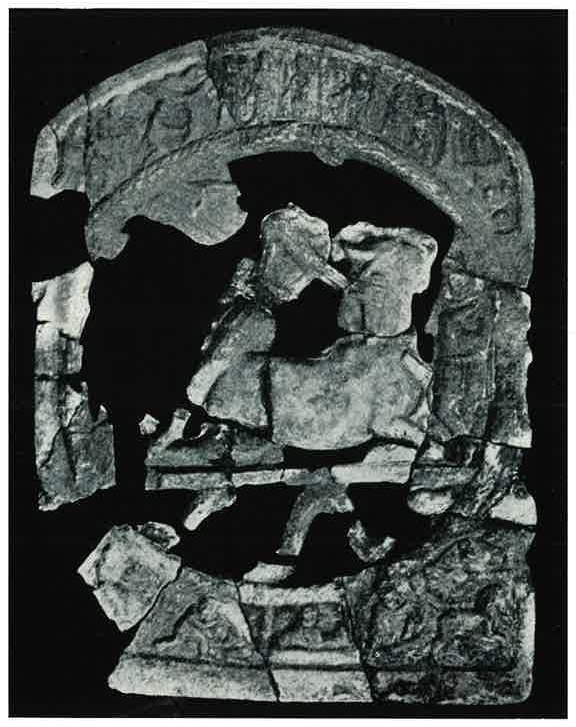
White marble tauroctony relief in several fragments from the Mithraeum at Biljanovac, Moesia Superior, depicting the standard bull-slaying with the full iconographic programme.
Group of Mithraic finds distributed across different localities named San Zeno along the Verona–Brenner route.
Two painted decorative phases from the Santa Prisca Mithraeum whose figures became clearer after later conservation work.
Archaeological remains connected with the Praetorian camp and the presence of Mithraic worship among the imperial guard.

White marble tauroctony relief from Sofia, ancient Serdica in Thracia, found near the Church of St. Kral, depicting the standard bull-slaying with the full iconographic programme.
