Your search Tal hal Hariri / Es-Sâlihiyeh / As Salhiyah gave 3730 results.

Fourth Mithraic sanctuary discovered at Ptuj, ancient Poetovio, at Zgornji Breg in 1937; the sanctuary (c.14 × 7 m) is oriented west–east with the standard corridor and bench division, an altar before the cult niche, and a water-basin in the pronaos.
Marble altar fragment from Mithraeum III at Ptuj, ancient Poetovio, dedicated to Deo invicto Mithrae by a dedicant whose name is partially preserved as -us Candidus.
Marble stele from Mithraeum III at Ptuj, ancient Poetovio, tapering towards the top and bearing a square hollow with five nail-holes designed to hold a small silver plaque — the plaque was removed, perhaps taken by the Mithraists themselves.
Inscription from Mithraeum III at Ptuj, ancient Poetovio, dedicated to Invicto Augusto sacrum by an imperial slave serving as hereditatum tabularius — an officer for death-duties — one of the rarer administrative titles attested in Mithraic epigraphy.
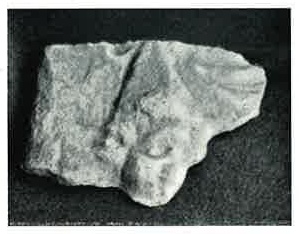
Left marble relief fragment from Mithraeum III at Ptuj, ancient Poetovio, preserving the head of a torchbearer, probably Cautopates, beside remnants of Mithras's flying cloak.
Marble relief fragment from Mithraeum II at Ptuj, ancient Poetovio, preserving a raven as part of a tauroctony scene.
Marble statue on base from Mithraeum II at Ptuj, ancient Poetovio, depicting the naked Mithras entwined by a serpent as he emerges from the rock; the breast is damaged, and the head and arms are lost.
Inscription on the column base from Mithraeum II at Ptuj, ancient Poetovio, dedicated to Deo invicto Mithrae for the welfare of the Emperors and Geta Caesar by Salvianus, contrascrip of the statio Atrantiana; Geta's name was subsequently erased.
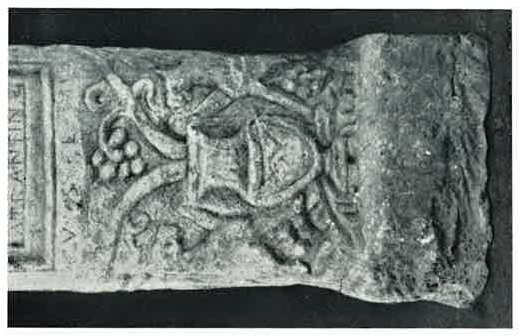
Marble column from the entrance of Mithraeum II at Ptuj, ancient Poetovio, serving as a statue base, its front decorated with a kantharus between panthers and vine tendrils; the inscription names Salvianus, contrascrip of the statio Atrantiana.
Marble relief fragment from Mithraeum II at Ptuj, ancient Poetovio, preserving the hindmost part of the bull and the right leg of Mithras with the scorpion in its usual position.
Left portion of a primitive marble relief from Mithraeum II at Ptuj, ancient Poetovio, preserving the upper part of a figure in Oriental dress holding a downward torch and the bust of Sol in the upper corner.
Inscription from Mithraeum II at Ptuj, ancient Poetovio, dedicated to Deo invicto Mithrae by Licinius Maximinus, miles of Legio II Italica.
White marble base from Mithraeum I at Ptuj, ancient Poetovio, bearing a dressed bust of Sol on the left lateral face and an inscription recording a dedication related to the Mithraic transit ritual.
Fragment of a small altar from Ljubljana, ancient Emona in Pannonia Superior, preserving a dedication to Invicto Mithrae by a dedicant whose name ends in -quartus; the Mithraic attribution is not entirely certain.

Small marble tauroctony relief from Ruše, Noricum, badly weathered, depicting the bull-slaying in a grotto-like niche with cross-legged torchbearers on bases.
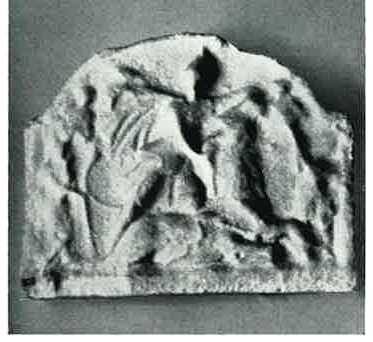
Small marble tauroctony relief from Ruše, Noricum, depicting Mithras killing the bull in a grotto, notable for the unusually elongated neck of the bull; dog and serpent approach the wound, and the raven perches above.
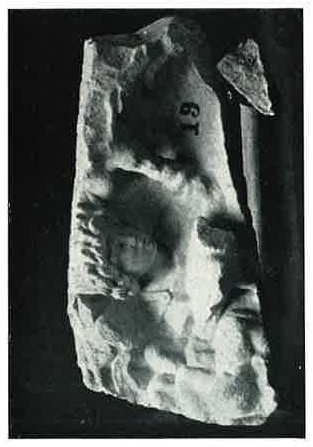
Three Italian marble fragments from the Zollfeld at Virunum, Noricum, forming a tauroctony relief; the iconography is well preserved and the use of imported Italian marble reflects the high status of the dedicants.
Miscellaneous objects from the Rückingen Mithraeum including stone balls, cult-vase fragments, lamps, and two candlesticks
Assemblage of lamps, keys, torches, an iron knife, pottery, glass fragments, and five coins from Mithraeum III at Heddernheim, ancient Nida
Three basalt fragments of a standing figure in jack-boots from Mithraeum III at Heddernheim, ancient Nida, with traces of red paint on the loin-cloth
