Your search Under the Palazzo Montecitorio gave 150 results.

A small terracotta lamp from the Mithraeum at Pons Saravi (modern Saarburg) in Belgica, bearing a beardless head on its upper surface and the inscription SOLI on its underside, found among numerous lamp fragments.
The inscription on the votive altar No. 756 from Pola (modern Pula), reading Soli above the head of Sol and Milace / Atticus under the head, recording the dedication by a person named Atticus.
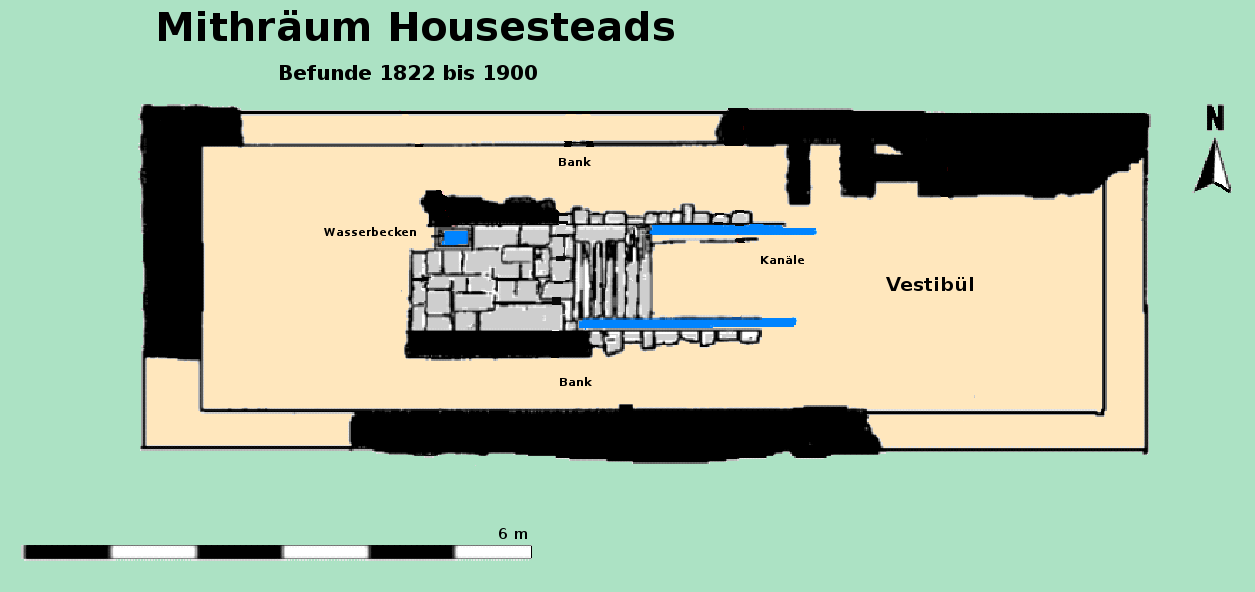
The Housesteads Mithraeum is an underground temple, now burried, discovered in 1822 in a slope of the Chapel Hill, outside of the Roman Fort at the Hadrian's Wall.

First Roman emperor of African origin and founder of the Severan dynasty, which ruled the empire for over four decades.
A marble dedication tablet found in the Vigna Curtii Palloni outside the Porta Sant'Agnese near the Praetorian Camp in Rome, recording the construction of a sacrarium dedicated to Sol Invictus by Q. Pompeius Primigenius, pater and sacerdos, under Septimius Severus and Caracalla…
Wall-painting of Mithras tauroktonos in fresco, discovered in 1886 in an underground room of the house of the Nummi Albani on the Quirinal (Via Firenze); the god wears a red cap and tunic, the torchbearers wear yellow or orange tunic and cap with green or brown anaxyrides…
Underground oblong room at Nyon, ancient Colonia Iulia Equestris, situated on the edge of a second Forum dating to the second half of the first century AD, with a series of pillars along the side walls consistent with Mithraic architecture; its interpretation as a Mithraeum remains tentative…
A marble statue fragment found at Sentinum (modern Sassoferrato) in ancient Umbria, walled in the atrium of the Palazzo Raccamadoro-Ramelli, showing Mithras tauroctone with dog, serpent and scorpion, one foot pointing towards a torchbearer; the bull's head, tail and Mithras'…
A white marble tauroctony statue found in 1925 at the ancient site of Lorium near the eleventh milestone on the Via Aurelia outside Rome, showing Mithras slaying the bull with dog, serpent and scorpion, accompanied by Cautes and Cautopates; now in the Palazzo Doria…
A white marble tauroctony relief fragment, in the seventeenth century at the Palazzo Caesiani near the Vatican and later in the Villa Ludovisi in Rome, showing Mithras slaying the bull with dog, serpent and raven, with a cross-legged torchbearer on a base; now lost…
Fragment of a grey marble slab formerly in the Palazzo Caponii and now in the Vatican Musea, Galleria Lapidaria, with an inscription on two arched borders and a leaping ox in the blank space.
Marble base from the gardens of Julius III dedicated to Iunius Postumianus, vir clarissimus and pater patrum of Sol Invictus Mithras, pontifex of the sacerdotal order of the Sun, placed under the care of Flavius Herculus.
Graffito on the outside of the left wall of the niche in the S. Prisca Mithraeum, recording a birth before daybreak on 20 November 202 A.D., a Saturday with an eighteenth-day moon, under the consulate of Severus and Antoninus.
Marble slab from the Palazzo dei Musei Mithraeum bearing a pierced star in the centre and a dedication to the Invictus by L. Reminius Fortunatus.
Large base found behind the Palazzo Senense inscribed with a brief dedication to Sol Mithras, CIL VI 713.
Marble tablet recording the dedication of a shrine to the Invictus God by L. Aurelius Severus, under the presidency of pater Domitius Marcellinus, dated to 181 A.D.
Black and white mosaic floor of the underground room used as a Mithraeum in the house of the Nummi Albani on the Quirinal; the mosaic ends about 1 metre from the side-walls, suggesting side-benches; Nummius Albinus was consul in 345 A.D.
Marble head with locks of hair and Phrygian cap, probably depicting Mithras as bull-killer, found under the threshold of the Iseum at Cyrene.
Sepulchral inscriptions from Lycaonia bearing the titles leo and aetos, previously interpreted as Mithraic grades but now understood as referring to tomb architecture.
Four small painted cups buried in a row under the niche floor at Mithraeum II, Stockstadt, one still containing a piece of sulphur; with coins of Augustus, Hadrian, and Antoninus Pius
