Your search Villa of Domitian at the Castel Gandolfo gave 3663 results.
.jpg)
This limestone statue of Cautes is now exposed at Great North Museum of Newcastle.
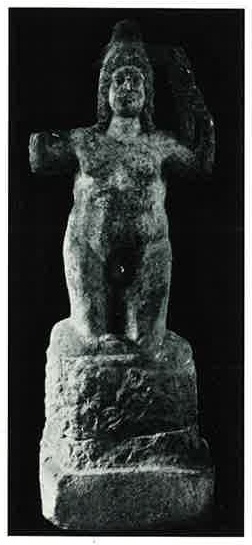
This white marble statue of the rock-birth from Cibinium in Roman Dacia is one of the largest known Mithraic sculptures from the Danubian provinces.

Fragmentary inscription from Ratiaria, Moesia Superior, preserving only scattered letters.
Inscription from Slăveni-Romanați, Dacia, dedicated to Soli invicto Mithrae: ara Solis — the altar of Sol.
Inscription from Doștat, Dacia, dedicated to Soli invicto Mithrae; only the opening formula is preserved.
Marble altar from Hrastnik near Trojane, ancient Atrans in Pannonia Superior, dedicated to Deo invicto Mithrae by Eutyches, contrascrip of the conductores portorii publici, slave of the Iulii, acting as vicarius of Benignus, vilicus of the statio Atrantiana…
A skull and two human femora, the lower jaw missing, recovered from a small circular pit within the Mithraeum at Königshoffen; interpreted by Cumont as a parallel to ritual deposits of human remains in other Oriental sanctuaries on the Janiculum.
Animal bones from the refuse pit of the Mithraeum at Königshoffen, comprising goat, hen, ox, and deer remains, attesting to ritual feasting within the sanctuary.
Assemblage of cult objects from the Mithraeum at Königshoffen including painted lamps, glass and terra-sigillata fragments with potters' stamps and graffiti (including Deo invicto Mithrae), two iron bells, an iron shield-knob, and stone fragments.
Large sandstone altar from the Mithraeum at Königshoffen, hollowed out at the back with a circular opening in the top, which stood before the great tauroctony relief; the front bears a dedication to Deo invicto Mithrae.
Miscellaneous sandstone altar fragments from the Mithraeum at Königshoffen, including uninscribed pieces and one bearing a solar disc with two heart-shaped figures on the upper front face.
Upper portion of a sandstone altar from the Mithraeum at Königshoffen, later reused as building material, bearing a dedication by Ianussa on both the front and reverse faces.
Grey sandstone tauroctony relief from the Mithraeum at Königshoffen, heavily restored, depicting Mithras killing the bull with Cautes and Cautopates and the busts of Sol and Luna; only the lower part of Cautopates and the crossed legs are original.
Iron crescent with four attachment holes from the Mithraeum at Königshoffen, probably belonging to a cult statue of Luna.
Perforated bronze votive tablet from the Mithraeum at Königshoffen, dedicated in honour of the Domus Divina to Deo Soli invicto by Silvester.
Dark red sandstone altar fragment from the Mithraeum at Königshoffen whose upper section, reconstructed from additional fragments, is shown to have supported a shell-shaped basin; dedicated to Soli invicto.
Fragment of a dark red sandstone altar from the Mithraeum at Königshoffen preserving a dedication to Deo Soli invicto Augusto; found in the eastern part of the sanctuary.
Altar from the Mithraeum at Königshoffen, dedicated to Deo Cissonio — a Celtic god identified with Mercury — by Gittonius Pippausus; the dedicant's Celtic name may be etymologically connected to that of the deity.
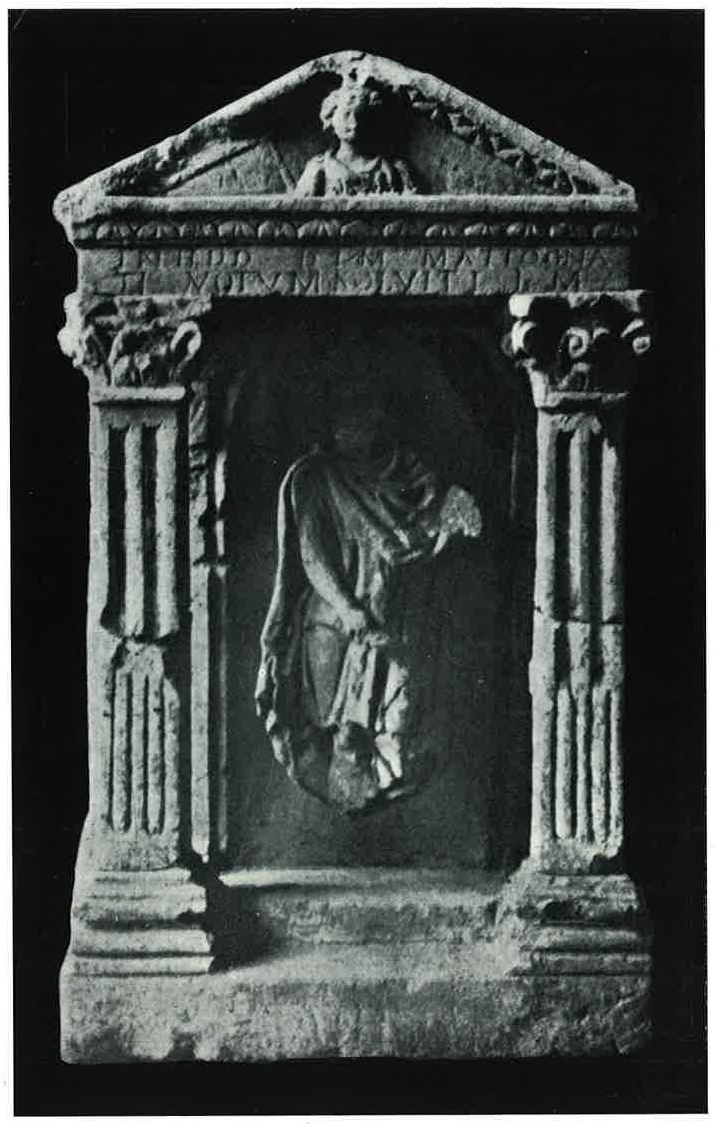
Sandstone monument in the form of a temple façade from the Mithraeum at Königshoffen, accessible by a step and framed by two Corinthian columns; the pediment is decorated with the bust of Luna, and the architrave carries an inscription.
Fragmentary inscription from the Mithraeum at Königshoffen recording a dedication in honour of the Domus Divina to Deo invicto Mithrae; only the opening formula is preserved.
