This site uses cookies to offer you a better browsing experience.
Find out more on how we use cookies in our privacy policy.

 
Region

Mithras in Mesopotamia

Mesopotamia preserves frontier evidence from the eastern limits of Roman Mithraic expansion.

The Mithraic material documented in Mesopotamia reflects the province’s position at the eastern frontier of Roman imperial influence. The evidence remains limited but is important for understanding the movement of religious practices through military campaigns, frontier settlements and exchanges between Roman and Mesopotamian cultural environments.
Mithraic monuments of Mesopotamia


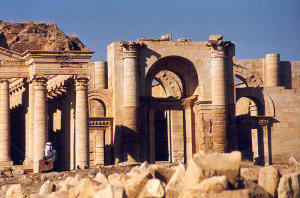
Hatra Temple

The city of Hatra was famed for its fusion of several civilization cults, which several temples devoted to gods from all Indo-European world.


Persian plaque from the palace of Darius

Located at the western entrance to the Palace of Darius in Persepolis, this tablet bears an inscription mentioning Ahuramazda and Mithra.

CIMRM 9


Slab from the Palace of Darius at Persepolis

This plaque, located on the western staircase of the Palace of Darius, mentions the god Mithra together with Ahura Mazda as protectors of King Artaxerxes III Ochus.

CIMRM 9

Places in Mesopotamia


Persepolis

Persepolis was the ceremonial capital of the Achaemenid Empire.


Sumere

Founded on the east bank of the Tigris, Sumere is mentioned in Roman sources as a fortified settlement during the Persian campaign of Julian in 363 CE, notably by Ammianus Marcellinus.

Inscriptions from Mesopotamia

Persian plaque from the palace of Darius

A great god is Ahuramazda, who created this earth, who created yonder heaven, who created happiness for man, who made Artaxerxes king. One king for many, one leader of many.

The great king Artaxerxes, the king of kings, the king of countries, the king of this earth, says: I am the son of king Artaxerxes [II Mnemon]. Artaxerxes was the son of king Darius [II Nothus]. Darius was the son of king Artaxerxes [I]. Artaxerxes was the son king Xerxes. Xerxes was the son of king Darius [the Great]. Darius was the son of a man named Hystaspes. Hystaspes was a son of a man named Arsames, the Achaemenid.

King Artaxerxes says: This stone staircase was built by me in my reign.

King Artaxerxes says: May Ahuramazda and the god Mithra preserve me, my country, and what has been built by me.

Slab from the Palace of Darius at Persepolis

Thâtiy / Artakhshatrâ khshâyathiya / imam / ustashanâm / athâganâm / mâm / upâ / mâm / kartâ.

Thâtiy / Artakhshatrâ / khshâyathiya / mâm / Auramazdâ / utâ / M[i]thra / baga / pâtuv / utâ / imâm / DAHyum / utâ / tya / mâm kartâ.
King Artaxerxes says: This stone staircase was built by me in my reign.

King Artaxerxes says: May Ahuramazda and the god Mithra preserve me, my country, and what has been built by me.

References

  • Livius.org (2004) A3Pa - Livius.org
  • Pierre Lecoq (1997) Les inscriptions de la Perse achéménide
Back to Top